
Local News
Newtown History Center Revisits Belsnickel Traditions, Shenandoah Valley Style
The Newtown History Center is bringing back an old Pennsylvania Dutch tradition. According to Rick Kriebel, Manager of Collections and Programs, Newtown History Center of the Stone House Foundation, Stephens City is bringing back the Christmas season tradition of Belsnickeling, Shenandoah Valley style. Kriebel, dressed as Belsnickel strolled down Main Street, visiting Dragon Fire Comics (gaming store), and the Kris Kringle Market in Stephens City on Saturday, December 3rd.
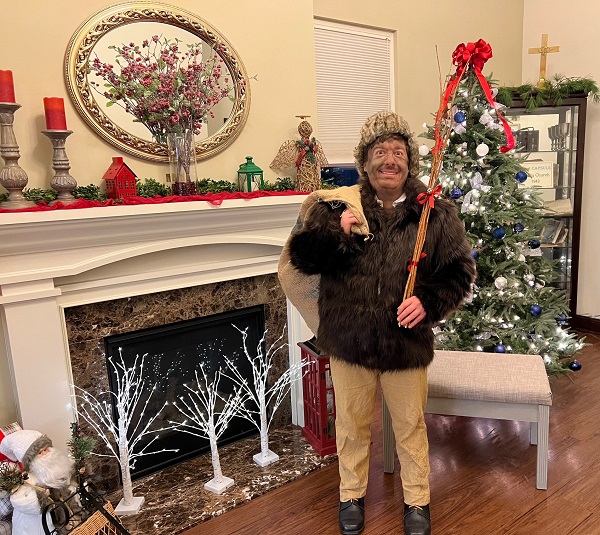
Rick Kriebel, dressed as Belsnickel, visiting Kris Kringle Market at Trinity Lutheran Church. Courtesy Nancy Gunderman.
Belsnickel conversed with folks and handed out gifts from a burlap sack for people who had been good. Fortunately, Belsnickel did not find anyone who had been bad, eliminating the need to use his wooden switch. Belsnickel reminisced about how celebrating the Christmas season has changed over the centuries and generally entertained all who met him.
German immigrants carried Belsnickeling traditions to America in the early 1800s, where they eventually transitioned down to the Shenandoah Valley from Southeastern Pennsylvania. Belsnickel’s origins can be traced to the Palatinate region of Southwestern Germany, where he is also sometimes called “Kriskinkle,” “Beltznickle,” and “Pelsnichol.” The name “Belsnickel” itself is a combination of the German word “bels,” which translates into fur, and “nickel,” which refers to St. Nicholas. Belsnickel made his presence known when he rapped on the windows and doors of German homes several weeks before Christmas.
Belsnickeling was common in towns located in Shenandoah, Page, and Rockingham Counties, where there was a large German population. “However, Belsnickeling did take place in Stephens City during the late 19th and early 20th centuries,’ said Kriebel.
“We do have some records of belsnickeling and similar activities that give us an idea of the tradition’s origins. The original Belsnickel was “Saint Nicholas in Furs,” a grouchy version of Santa Claus who walked from house to house, handing out small cakes, candies, fruits and nuts to good children and smacking bad children with a switch (a small wooden whip),” Kriebel said.
Kriebel provides more detail, “The earliest record we have of anything belsnickel-esque in Stephens City comes from 1860. Milton Boyd Steele wrote about “Phantastics” who rode through town for Easter or April Fool’s Day (it was the same day that year). Phantastics basically dressed in silly costumes and acted boisterous to celebrate the holiday. They were not directly connected to Belsnickel, but were also a Christmas tradition that involved dressing up in outrageous costumes and acting in a loud and unusual manner. (Alfred Shoemaker, Christmas in Pennsylvania: A Folk-Cultural Study, Mechanicsburg, PA: Stackpole Books, 1959, pp. 109-110).
Belsnickel morphed a great deal in the Shenandoah Valley, and may have become blurred with the Phantastic tradition. Instead of a single Santa-like figure, a group of merrymakers would all dress in ridiculous costumes, covering their faces with homemade or store-bought masks. They then went to their neighbors’ houses to see if these friends could guess who they were; this was known as Belsnickeling. While the original Belsnickel was expected to wear fur, Belsnickels made their costumes out of furs and rags or anything available; we even have a family story of someone wearing a cardboard Belsnickeling outfit in the 1910s.”
Unlike with the stern figure in German folklore, belsnickeling took on a fun-loving attitude in Virginia. “Belsnickel transitioned into a more lighthearted activity in the Shenandoah Valley. Good-natured young men and teenage boys went belsnickeling by dressing up like it was Halloween and going from house to house asking their neighbors to guess who was under each disguise. Some even stuffed their costumes to make them appear larger than their actual size. Belsnickels had to lift their masks up if someone guessed their identity correctly,” said Kriebel.
If the neighbor guessed incorrectly, the individual Belsnickeler kept the mask on until the entire group went inside the house for refreshments. Home owners might offer the visitors candies or cakes, or maybe even a cup of hard cider, moonshine, or whiskey. The Belsnickelers then moved on to the next friendly home in the neighborhood to repeat the game.
A. Nicholas Powers, Curator of Collections, Museum of the Shenandoah Valley, provides some additional insight. “Belsnickeling might seem like a tradition that has come and gone, but I have been surprised since first writing my article, ‘Belsnickel-wha?: Holiday Traditions in the Shenandoah Valley, Museum of the Shenandoah Valley, December 11 2017,’ how many people still have memories of it either directly or as part of their family lore,” said Powers. “The recollection by my grandfather Tunstall Chenault ‘T.C.’ Powers of belsnickeling to his Kline cousins was recovered almost by accident, but a fortunate one that allowed my father (the late David Powers) to capture this piece of family history. According to my father, when he was young the family was watching The Scarecrow of Romney Marsh, a Walt Disney film from 1963 set-in eighteenth-century England where the Reverend Doctor Christopher Syn donned a mask and costume to fight back against the king’s impressment gangs. The costuming reminded my grandfather of what he wore when he belsnickeled, which is when he told my father the story I documented in my article.” Powers said, “T.C. was never very good at belsnickeling, though, because his distinctive gait gave him away as he trudged up the hill towards Kline’s Mill [halfway between Middletown and Stephens City]. Before he could even get to the door, the cousins would see him coming and say something along the lines of ‘Tunstall, it’s nice to see you,’ forcing him to take off his mask without their even needing to guess.”
According to Powers, since writing the article, he has had numerous people reach out with stories of their own. Not surprisingly, most of them pertain to families in the central Valley like Shenandoah, Page, and Rockingham Counties. But belsnickeling did also happen in Frederick County, as evidenced by his family’s story and those of a few others who have shared stories with Powers. One person who lived in Mountain Falls west of Kernstown recalled belsnickelers visiting and her being scared to death of them in their costumes. Another person in Lebanon Church, just over the Frederick-Shenandoah County line, recalled the visitors coming to the door and announcing themselves with “Belsnickelers are here! Belsnickelers are here!” (To shout their names would have negated the whole point). After guessing who they were, the belsnickelers were always invited in for refreshments, including spirits in the form of spiked eggnog.
Powers concludes with another interesting tidbit of history. “Belsnickeling also should not be confused with “belling,” which was a different Valley tradition. Belling occurred as a raucous “homecoming” of sorts for newlywed couples, where friends and neighbors would show up at the newlywed’s house banging pots and pans, invite themselves in, and help the couple ‘celebrate,’ often by imbibing. Unlike belsnickeling, belling continued for a bit longer into the twentieth century. A family friend once told me that upon moving to Pendleton County, West Virginia, she, and her husband were “belled,” where the new neighbors put her in a wheelbarrow and pushed the wheelbarrow around the house. Belling, though, could on the rare occasion have fatal consequences. In 1953, a Shenandoah County man was killed when he used three sticks of dynamite to wake the couple being belled. When the dynamite did not go off as expected, he approached to inspect the fuse and the delayed blast killed him.”
The Newtown History Center is bringing this fun and educational belsnickeling activity back for another holiday season. Anyone who is open to talking about Belsnickeling traditions in their families, or want to learn more about this crotchety, ill-tempered fellow, Belsnickel events, and future costume competitions can contact Rick Kriebel at info@newtownhistorycenter.org.

5 Tips to Prevent Sports Injuries

Standardbred Owners Ainspan, McDonald Each Score Thoroughbred Wins at Colonial Downs’ Virginia Derby Meet

Most Dangerous Cycling Scenarios Involving Cars

VDOT: Warren County Traffic Alert for March 23 – 27, 2026

Virginia State Police Seize $22.4 Million in Drugs, Recover Firearms in Weeklong Operation

Virginia Home Sales Rise in February as Inventory Grows, Spring Outlook Uncertain

Bing Crosby Stadium Hosts Warren County–Skyline Baseball Battle Tonight

Warren Supervisors Address Audit Contract, Permits, and Property Sale at March 17 Meeting

Here’s How Virginia Lawmakers Suggest the Next State Budget Handle Federal Health Care Funding Fallout

Spring Essentials Checklist: Prepare Your Home for Summer

Virginia Joins National Push for Refunds After US Supreme Court Voids Trump Tariffs

Four Reasons to Consider Hiring a Professional Cleaning Company

Ask the Expert : We Are Applying for a Mortgage Soon. What Kind of Documents Will We Need?

Charles Michael “Rusty” “Chuck” Fischbein (1944 – 2026)

Jerrold E. “Jerry” Groves (1931 – 2026)

Town Planning Commission Moves Forward with Industrial Zoning, Holds Preliminary Discussion of Urban Agriculture

Schools Push for Budget Flexibility, Consistent Funding as Needs Grow

Skyline High Teams, Athletes Successful Seasons and Performances Acknowledged – Oh, and Those Roosters

School Board Seeks to Restore Meals Tax Funding for School Facilities

Wasting Drinking Water: 3 Habits to Eliminate From Your Daily Routine

Medicare Launches TEAM Program to Improve Recovery After Surgery

Izaak Walton League Promotes Conservation and Outdoor Programs at Community Forum

POLICE: 7 Day FRPD Arrest Report 3/16/2026

Blue Ridge Wildlife Center Patient of the Week: Great Horned Owl
