
Local Government
Part 2: McFadden seeks legally supported response from Town Hall on status of his verbal resignation – ‘It would simply be nice to have some kind of response’
“I don’t want to be in this position, but I don’t want to disappoint my constituency,” Joe McFadden told Royal Examiner earlier Monday, prior to cancellation of the August 22nd Front Royal Town Council meeting he attended, but not as a sitting councilman. As Royal Examiner previously reported on August 13, in the wake of expressions of disappointment from constituents who voted for him, McFadden has rethought his emotional reaction to that August 8 council vote on Town Manager Steven Hicks’ termination, which at the time he referred to as “a kangaroo court”. He later explained that closed session allegations against Hicks were done without the support of what he and several others considered hard evidence affirming those accusations, which he and those others asked be provided prior to a decision on Hicks’ termination. See: After 20-month tenure Steven Hicks ousted as Front Royal Town Manager
Asked at the time about McFadden’s resignation, Mayor Chris Holloway was dismissive of is colleague. “He has in the past thrown fits because the vote didn’t go his way, so last night didn’t really surprise a few of us,” Holloway wrote Royal Examiner in an August 9 email. The mayor also cited a recent statement he attributed to McFadden in which the councilman purportedly stated that he was “just keeping a seat warm”.
As to the councilman’s “kangaroo court” observation of the Hicks dismissal discussion and vote, the mayor responded with a punch line – “Looks to me the kangaroo has left the building”.
As to his disagreements with the mayor, McFadden observed, “I particularly like that he called me a kangaroo. It was similar when he got mad at me for calling him a lame duck.”
McFadden’s “lame duck” reference was to noting the mayor had decided not to run for re-election this year. “Lame duck” is a long-used political term referencing elected office holders who are nearing the end of their term in office.
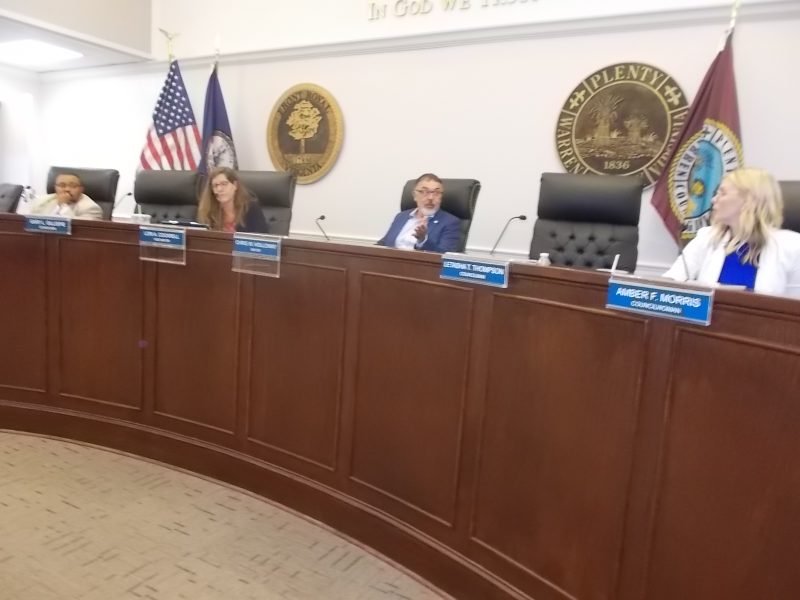
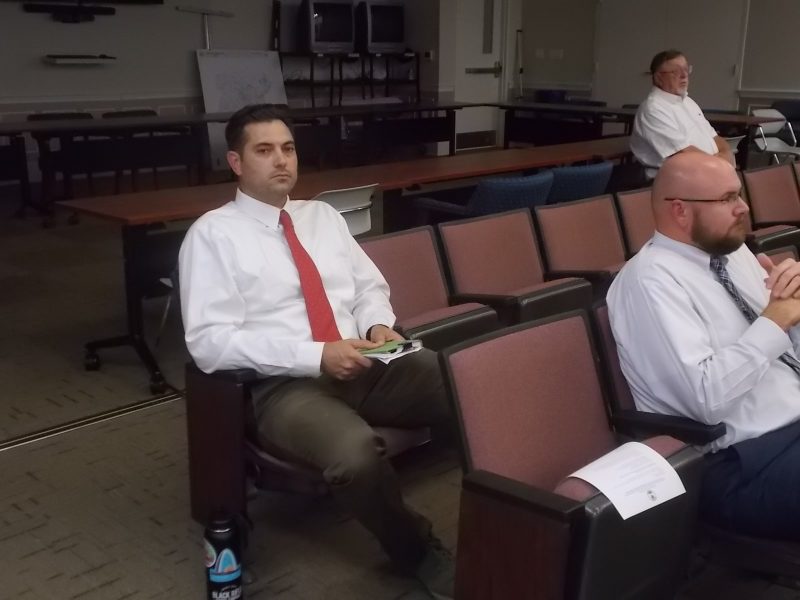
Mayor Holloway converses with council members present prior to announcement the Aug. 22 meeting would not convene. Below, Joe McFadden awaits convening of that scheduled regular council meeting, and perhaps wonders why camera is being pointed at a member of the audience, or is he legally still a councilman? Well, not in the stated opinion of Mayor Holloway, who rejected a public comment McFadden could have created the necessary quorum to convene.
However, McFadden was not left laughing as he approached his future on or off council at the urging of some of those constituents he worried about having disappointed. Initially McFadden cited Robert’s Rules of Order guidelines on acknowledgment of resignations by the chair-person and a vote of acceptance by the involved board, presented to him following his verbal resignation in reaction to the Hicks’ termination. Since then he has been presented with legal opinions in support of the idea his verbal resignation was not legal without official mayoral/council acknowledgement and action on it.
Asked about similar receipt of verbal resignations by recent councilmen Jacob Meza and Scott Lloyd, McFadden replied, “Just because we’ve done it wrong in the past doesn’t mean it shouldn’t be done right now.”
Case Law – 1880 and 1933
McFadden has provided Royal Examiner with two specific cases taken to higher courts, one the U.S. Supreme Court, that appear to uphold the contention his resignation may not have been legally acted on. The source, cited as “Casetext – Smarter Legal Research” online, begins the relevant passage: “Resignations to public offices are generally accepted and it is not infrequently ruled that if a person so desires he can resign, or relinquish his office, and that no formal act of resignation is necessary to render the resignation valid, especially when the resignation is unconditional and goes into effect immediately.”
However, “Casetext” continues to state: “But the better opinion is that a public officer does not have the privilege of resigning, since the public has a right to the services of all the citizens, and may demand them in all civil departments as well as in the military. Therefore, to be effective, the resignation must be accepted by competent authority, either in terms, or by something tantamount to an acceptance, such as the appointment of a successor. The so-called ‘better opinion’ is supported by Supreme Court of the United States. Edwards v. U.S. 103 …” (with the rest of the reference off the page we were emailed).
Online research indicated a case “Edwards v. U.S. 103 U.S. 471” dating to 1880, referencing “Common Law” precedents in Michigan “that the resignation of a public officer is not complete until the proper authority accepts it or does something tantamount thereto such as to appoint a successor”.
McFadden also provided a second case link from the “Casetext” site – Watts v. Lanham dating to a 1933 case involving a resigned board of education president in the “Elk District of Kanawha County” West Virginia. That case involved the arrest of the elected public officer for public “drunkenness” during which a resignation signed by the involved official was submitted by others as part of the office holders release from jail. That office holder, W.E. Hunt, testified he had never intended to submit a resignation and attempted to intercept it during the release process. His resignation was rescinded on appeal by the Supreme Court of Appeals for West Virginia.
As to any legal conclusions regarding possible precedents set in these cases, or the potential of contrasting precedents in other cases or council actions, we throw the ball back into the court(room) of any involved attorneys, as it seems Mr. McFadden has. However, while seeking legal clarity on the matter, McFadden has maintained that he does not intend to take this debate into a courtroom himself.
“It would simply be nice to have some kind of response to my resignation or my withdrawal, of which I have received neither at this time. Not sure what is going on over there regarding this,” he told Royal Examiner of his effort to achieve legal clarity on the matter from Town Hall.
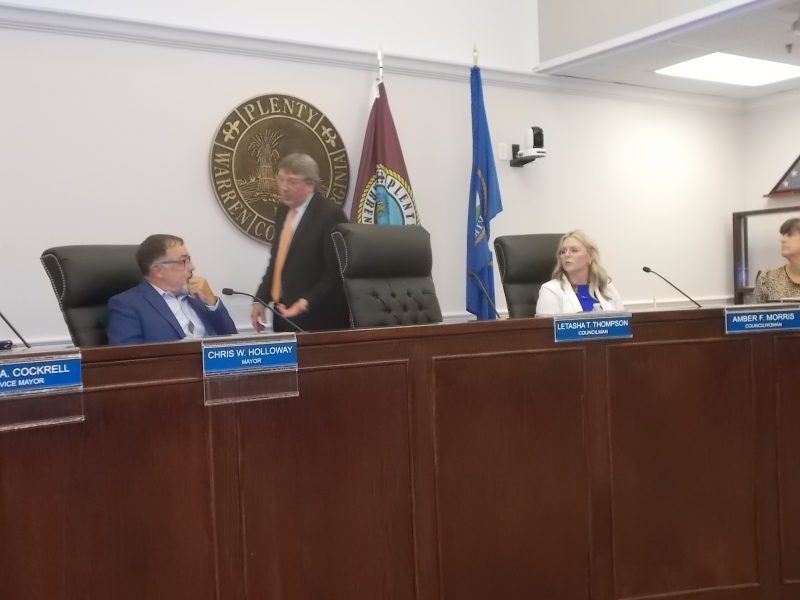
Interim Town Attorney George Sonnett converses with Mayor Holloway prior to announcement the Aug. 22 town council meeting would not convene due to lack of a physically present quorum, as Amber Morris and Council Clerk Tina Presley look on at right.
Whether it be from Front Royal’s Town Hall or the Virginia Attorney General’s Office, it would be nice to achieve that legal clarity McFadden is reaching out for regarding his, as well as other potential future resignation processes. See: Part 1: With no official action in receipt of his verbal resignation, McFadden seeks legal answers to status of that resignation

Virginia State Police Urge Sober Plans for Saint Patrick’s Day Celebrations

In a One-Party County, Internal Party Decisions Affect Us All

Virginia State Police Seize Nearly 100 Pounds of Narcotics, Recover Firearms in Weekly Crime Suppression Effort

Barton Charles “Bart” Haller (1940 – 2026)

Dawn Lee Dodson (1970 – 2026)

Mary Helen “Nanny” Spires Johnt (1954 – 2026)

Another Round of ‘Momnibus’ Bills Are Headed Towards the Governor This Year

Virginia Joins States Challenging Trump Admin Regulations That Limit Free Birth Control Access

Update: Charlotte Swanson Smith (1951 – 2025)
Why We are Challenging the Republican Mass Meeting

Bruce Norman Showman (1954 – 2026)

EDA Relaunches Small Business Loan Program to Help Warren County Entrepreneurs Access Capital

Targeted Exercises to Improve Your Putting

The Hidden Risks of House Hunting Solely Online

Choosing the Right Cleaner for Every Surface in Your Home

New Church Among Consent Items at County Planning Commission Meeting

Warren County GOP Mass Meeting Results Challenged After Allegations of Voting Irregularities

‘This Is About Equity’: In Richmond, Virginia Workers, Lawmakers Push for Inclusive Labor Rights for All

After Five Years of Attempts, Virginia On Track to Set Up a Prescription Drug Affordability Board

New Drug Take-Back Box at Warren County Sheriff’s Office Offers Safe Way to Dispose of Medications

‘Feeding Our Neighbors’ Continues Local Effort to Provide Free Meals in Front Royal

Blair David Eller (1963 – 2026)

Writing Workshop at Samuels Public Library Aims to Help Community Communicate More Clearly

Simple Steps to Reduce Wildfire Risk Around Your Home
