
Local News
Senator Mark Warner visits Valley Health, Warren Memorial Hospital for medical services discussion
Friday morning, February 7, U.S. Senator Mark Warner, D-Va., began a series of meetings with medical professionals, business and community representatives in Warren and Fauquier Counties.
Only slightly after the scheduled starting time of 10:45 a.m. did Valley Health President and CEO Mark Merrill introduce the former Virginia governor and incumbent senator to those gathered in a third-floor conference room to discuss a series of statewide health care issues and what Congress can do to both coordinate with state governments and the health care sector to improve and protect medical services across the commonwealth.
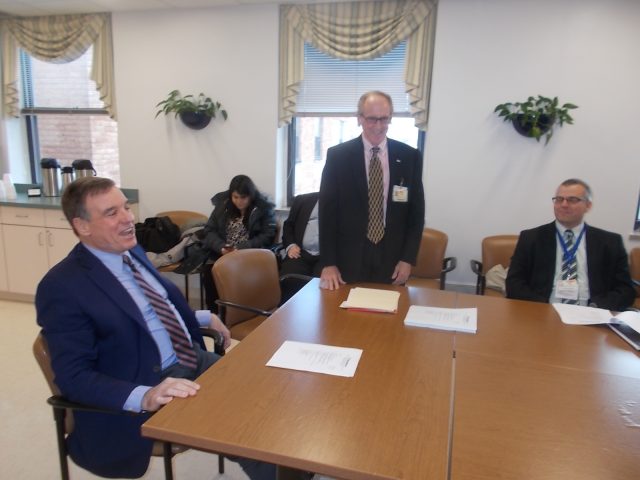
Senator Warner, seated left, Valley Health CEO Mark Merrill, standing, and others share some lighter moments prior to convening Friday morning’s health care discussion at Warren Memorial Hospital in Front Royal. Royal Examiner Photos by Roger Bianchini. Video by Mark Williams, Royal Examiner.
Topics included the Rural Hospital Closure Relief Act; challenges facing new medical school graduates seeking Residencies in a tightening work force; how to offer new nursing school graduates similar training opportunities to those offered medical school graduates; the positive impacts on health care coverage of Virginia finally adopting Medicaid Expansion; prescription drug costs and how to bring them down; the drug and opioid crises and assuring that governmental initiatives are not too narrowly focused on one aspect of that crisis; surprise medical bill’s impacts on middle and lower class American families’ ability to maintain financial solvency; and even the role of private sector greed in traversing the health care service landscape.
During the discussion Warner identified some related issues including what he called “skinny plans” misrepresented as parts of so-called “Obamacare” or the Affordable Care Act (ACA) passed into law during the Obama presidency in an effort to make more affordable health insurance available to more Americans.
“There is nothing in some of these plans,” Warner observed of private sector misrepresentations, calling for more legal teeth to assure some standards of “truth in advertising”.
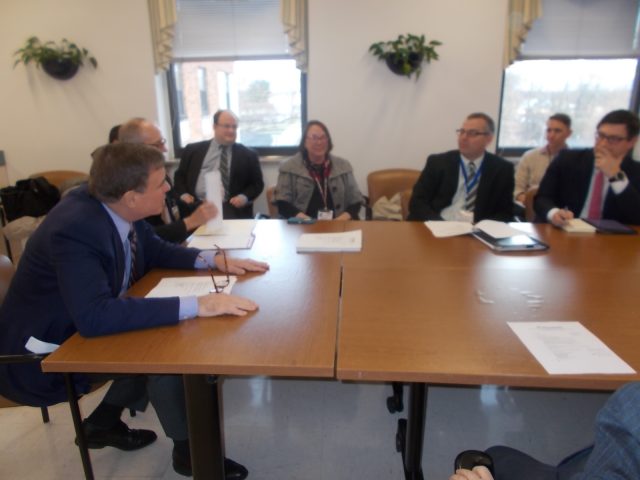
Let’s get down to business – and it was a wide-ranging discussion of many variables facing the medical industry, including efforts to protect hospital survivals in rural areas of Virginia.
One participant observed that however they were represented, the so-called “skinny plans” generally covered only catastrophic medical events, leaving people uninsured for more routine and frequent family medical needs.
The general consensus concerning Medicaid Expansion and the ACA seemed to be expressed by the comment from the table, “the idea to flush all of it is not working – we should be in a fix-it mode”.
Warner also took several shots at what he called abuses of the “PE guys” (Private Equity) – “I think they have not been straight shooters,” he observed.
In response, another participant said his organization was “one thousand percent in support of ending surprise medical bills and getting patients out of the middle” and had sponsored legislation the last two years trying to improve that situation. That participant noted that one such bill had passed two years ago in Virginia, adding, “But some of the commercial insurers had some issues with it and used their power with the state employee health plan to squash it.”
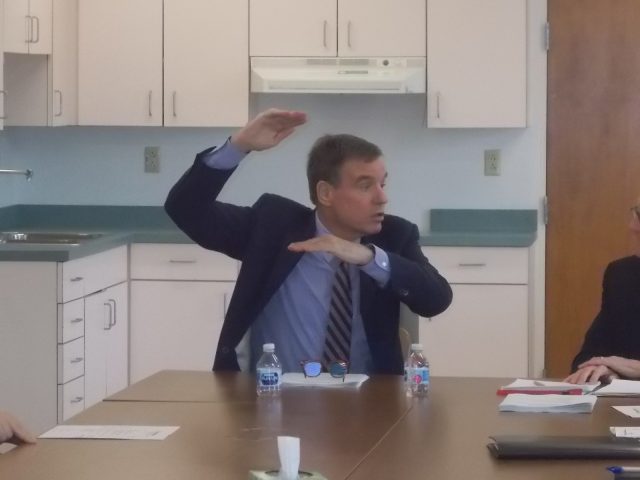
Senator Warner may be illustrating that there are many tiers to solving cost, service, legislative and financial aspects to providing health care at a reasonable cost as the second decade of the 21st century nears an end. There seemed to be a consensus that Medicaid Expansion’s belated adoption is a positive for Virginia’s citizens’ health care and costs.
“You hit the nail on the head, the issue we face here is egregious that you have certain doctors out there charging , 300-, 400-, 500-, 600-percent with Medicare; and it often reflects poorly on the hospitals when we’re kind of stuck in the middle of it,” another participant responded, leading to the observation:
“But if you go the route of Murray-Alexander and you allow the insurers to have this median in-network benchmark rate as a backstop, they’re going to go to every hospital in Virginia where their rate is, say 110% or 120% or whatever of that benchmark; and they’re going to say ‘We’re going to set your rate at 60% of that benchmark and you’re going to take it – because I know if you don’t
I’m going to still be paying you less. And that’s our fear, not what the doctors and the PE-funded groups are getting paid, that’s not our issue. Our issue is giving these large insurers that in some cases have 60%, 70% market-share throughout rural Virginia, even more power to dictate what their rates are.”
Warner responded that he believed when Murray-Alexander was presented “there was a recognition there was potential for abuse,” adding he thought a middle ground solution was achievable.
“I think there is an interesting bipartisan coalition of people who got offended at some of the PE activity. So, you guys are smarter than me here – figure out something … This is front and center – and you guys are all saying take the patient out of the middle,” Warner replied of the dilemma facing legislators and the medical establishment in reacting to private sector abuses within that establishment and the health insurance and investment sectors.
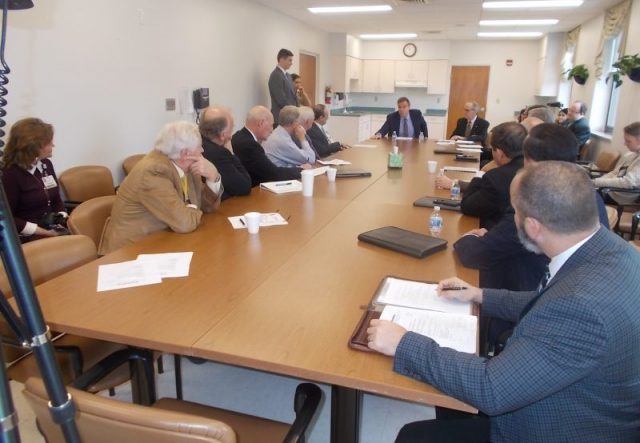
You guys will let me know when you have all the on-the-ground dynamics figured out so we can write comprehensive legislation to fit all needs, right? – Senator Warner may have been thinking as meeting passed the one-hour mark.
“How it all comes together in the end, I think, remains to be seen. But I do agree with you that I think there are ways we can narrow the proposal that gets at your concerns, but also protects hospitals,” came the reply from the table, adding, “And some of that might be included with the network adequacy requirements for insurers; and some of these other pieces that have not been part of the conversation because of a lot of what’s been put on paper has been anti-provider, but ignored the role the commercial insurers of the world play.”
Noting he had family experience with the impact of surprise medical bills, Warner added, “This may be a case where these firms were so damn greedy – ‘darn’ greedy for the press,” Warner self-edited with a glance toward media present drawing laughter, adding, “you know, that they took it in the shorts.”
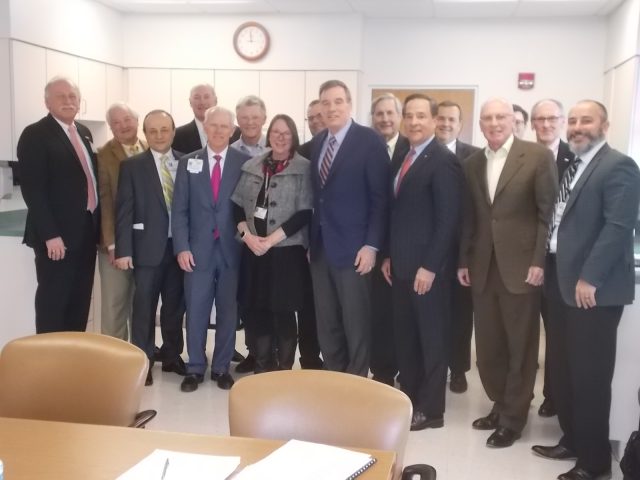
A post-meeting pose after a lively hour-plus discussion of medical service and cost variables.
See this and other exchanges on challenges facing hospitals, the medical industry and legislators in trying to traverse a complex landscape surrounding a basic human need – health care – its costs, the role of greed in the financial and health insurance sectors, as well as other variables impacting rural areas in support of the availability of medical services, in this exclusive Royal Examiner video:


Disappointed In Our Olympic Spirit

How St. Patrick’s Day Became America’s Biggest Irish Party

Virginia State Police Urge Sober Plans for Saint Patrick’s Day Celebrations

In a One-Party County, Internal Party Decisions Affect Us All

Virginia State Police Seize Nearly 100 Pounds of Narcotics, Recover Firearms in Weekly Crime Suppression Effort

Barton Charles “Bart” Haller (1940 – 2026)

Dawn Lee Dodson (1970 – 2026)

Mary Helen “Nanny” Spires Johnt (1954 – 2026)

Another Round of ‘Momnibus’ Bills Are Headed Towards the Governor This Year

Virginia Joins States Challenging Trump Admin Regulations That Limit Free Birth Control Access

Update: Charlotte Swanson Smith (1951 – 2025)
Why We are Challenging the Republican Mass Meeting

Bruce Norman Showman (1954 – 2026)

EDA Relaunches Small Business Loan Program to Help Warren County Entrepreneurs Access Capital

Targeted Exercises to Improve Your Putting

The Hidden Risks of House Hunting Solely Online

Choosing the Right Cleaner for Every Surface in Your Home

New Church Among Consent Items at County Planning Commission Meeting

Warren County GOP Mass Meeting Results Challenged After Allegations of Voting Irregularities

‘This Is About Equity’: In Richmond, Virginia Workers, Lawmakers Push for Inclusive Labor Rights for All

After Five Years of Attempts, Virginia On Track to Set Up a Prescription Drug Affordability Board

New Drug Take-Back Box at Warren County Sheriff’s Office Offers Safe Way to Dispose of Medications

‘Feeding Our Neighbors’ Continues Local Effort to Provide Free Meals in Front Royal

Blair David Eller (1963 – 2026)
