
Local Government
Supervisors seek alternatives to abandoning coyote bounty program, pass county-wide dog ordinance
The Warren County Board of Supervisors during its January 19 meeting unanimously approved a county-wide ordinance that prohibits any dog from running-at-large and deferred action on whether to continue the County’s coyote bounty program.
Board Chairwoman Cheryl Cullers, Vice Chairman Archie Fox, and board members Delores Oates, Walter Mabe, and Tony Carter were present for the actions during a four-hour meeting Tuesday night that followed a one-hour closed session.
The Board of Supervisors voted 5-0 to amend Warren County Code Section 66-28, 66-29, and 66-31 to include Running in a Pack, as well as an amendment to Warren County Code Section 66-32 to make the change applicable to the entire county, “not just specific residential areas,” said Senior Assistant County Attorney Caitlin Jordan.
“Such a change will greatly improve the animal control officers’ ability to enforce the County’s running- at-large ordinances and help to address the issue throughout the County,” Jordan told the board members.
Warren County Code Section 66-28 makes it unlawful for any dogs to run at large at any time in areas of the County as designated by ordinance, except when they’re in the immediate control of an owner or custodian. A dog is deemed to “run at large” while roaming, running, or self-hunting off the property of its owner or custodian and is not under its owner’s or custodian’s immediate control. Section 66-29 of the County Code outlines the violations and penalties applied to this offense, while Section 66-32 enumerates the specific areas and subdivisions where restrictions have been applied since 1984.
During the 2019 session of the Virginia Legislature, Virginia Code Section 3.2-6538, which grants localities to prohibit dogs from running at large, was amended to include a prohibition on dogs running at large in a pack. Violations for any person who permits his or her dog(s) to run at large in a pack will be subject to a Class 4 Misdemeanor and a fine up to $100. That amendment spurred Warren County to amend its code so that it aligns with the Virginia Code changes, said Jordan.
Warren County Sheriff’s Office Animal Control Sgt. Laura Gomez said the ordinance change will protect property owners and dogs.
“I recently had an incident out in the County where a gentleman moved to this area and thought we did have a running-at-large ordinance — because he didn’t read the code section exactly,” Gomez said. “He can’t walk his dog on the main road because of traffic, so he goes up a side road where there’s a dog that’s lived there for years without any problems. But that dog comes out being protective and goes after the dog this man is walking. I had no way to enforce the people to keep their dog on their property and I had no way to protect the man who was walking a dog on a rural road. He’s now taken the matter into his own hands and said that if this dog comes out again, he’s threatened to kill it.
“I have no medium ground,” Gomez explained. “Also, if there’s a dog attack, it either has to be severe, and we’ve got a dangerous dog or severe with restrictions, or I have no way to help people in the community.”
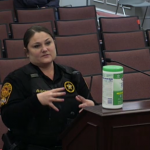
Sgt Gomez address the Board of Supervisors
Sgt. Gomez said the proposed ordinance amendments need to be applied county-wide because “as it is right now, it’s only specific to about 30 subdivisions, and as more people come to the community and there’s more development, we would have to remember every subdivision” where the ordinance did not apply.
No one spoke during the public hearing portion of the meeting regarding this matter. The amendments were previously discussed at the Board of Supervisor’s November 10, 2020 Work Session and the updated ordinance is now in effect as of the board’s vote last night.
Coyote bounties
In other business, despite Animal Control’s request the Supervisors failed to adopt the Ordinance to Repeal Warren County Code Section 66-34, “Bounties for Coyotes,” and to further analyze alternative measures on how to reduce the coyote problem in Warren County.
Board member Mabe made the motion “not to adopt & to look into alternatives” and board member Fox seconded it. The denial came despite hearing from Michael Fies, a wildlife biologist and the Furbearer Project leader at Virginia’s Department of Wildlife Resources, on the reasons coyote bounty programs are being abandoned across the Commonwealth and nation as counterproductive. Fies told the supervisors that Warren County “would have to kill in excess of 60 percent of the total coyote population every year to have a long-term, sustainable impact” on reducing their numbers across the County.
He added Fies that there is “a universal lack of support for bounty programs” among USDA Wildlife Services staff, wildlife protection experts, furbearer biologists, and wildlife professionals from across the nation who all agree that such programs do not work in controlling coyote populations.
“There is no evidence that bounty programs have temporarily or permanently reduced coyote populations,” he said, noting that coyotes are prolific reproducers, so bounties are ineffective because not enough of the animals get killed to substantially impact the overall population.
And while Warren County’s current $3,000 cap allows for up to 60 coyotes to be killed annually, Fies said that is still less than the 60-percent threshold needed to control their numbers.
“Research has shown that coyote populations must be reduced by more than 60 percent or their numbers will recover within a single year. Coyotes can rapidly compensate for losses by increasing the number of females that breed, producing larger litters, and increasing pup survival,” Fies added.
Fies also said in correspondence with the County that since coyote bounties are ineffective, Virginia’s Department of Wildlife Resources has consistently recommended against these programs in favor of targeted control efforts around farms with a history of coyote damage. Such an approach, he said, also has been used successfully by USDA Wildlife Services to reduce livestock losses in other portions of the state.
The Warren County Board of Supervisors in May 2000 adopted Section 66-34 of the Warren County Code, which awards a $50 bounty to any person who kills a coyote according to certain criteria set forth in the ordinance. Currently, the ordinance limits the total amount of bounties awarded within a given fiscal year to $3,000 minimum, or a total of 60 bounties per year.
The Warren County Sheriff’s Office has requested that the Board of Supervisors repeal Section 66-34 of the Warren County Code, “Bounties for Coyotes,” due to the increasing cost to the County and to the “little to no impact said bounties have had on the coyote population.”
The proposed ordinance to repeal that section of the code was previously discussed at the supervisors’ November 10, 2020, Work Session, and now will be taken up again for further review at a forthcoming supervisors’ work session or meeting.
Sgt. Gomez said that during her 13 years on the job, only two farmers have contacted her about possible coyote attacks on their properties, and she told the board members that her office has no way to track the number of coyotes that get killed without a bounty payout.
Local resident Amos Mitchell, who said he has two farms, disagreed with the proposed ordinance to repeal the coyote bounties. “You aren’t going to kill all the coyotes; we been doing it for years,” Mitchell said. “The bounty should continue. It’s a good incentive, and it’s not that expensive.”
Watch other action by the Board of Supervisors during its Tuesday meeting here.

Uptick in Continued Virginia General Assembly Legislation Reflects Varied Motivations

Mini Quiches with Ham and Swiss Cheese

Tips to Help Employers Sort Job Applications More Efficiently

Town Council Finishes Retreat, Considers Memorandum of Understanding with Smithsonian for Water Conservation

Spanberger Amends, Signs Sweeping Gun Legislation Reshaping Virginia’s Firearm Laws

Governor Pitches Amendments to Prescription Drug Affordability Board Bill That Some Say ‘Nullify’ It

Debate Continues Over Tax Rate as Supervisor Offers New Option

Blue Ridge Wildlife Center Patient of the Week: Eastern Fence Lizard

Joyce Henderson Banks (1941 – 2026)
Accountability Before Adjustment

Supreme Court Ruling Revives Debate Over Conversion Therapy Bans, Including in Virginia

Growing Pains: Rising Diesel, Fertilizer Costs Spurred by Iran War Impact Virginia Farmers

Virginia, Other States Make It Easier for Physician Assistants to Practice

Working Part-Time After Retirement: For the Paycheck — and the Fun

Compressed Air Safety: Why 30 PSI Is the Limit for Cleaning

ORDER OF PUBLICATION: In the Circuit Court for Warren County, Virginia

Local NAACP Recalls Segregated Criser High/Elementary School During ‘Learn From the Past for a Better Future’ Event

Virginia Revenues Top Forecast, But Economic Concerns Remain

Governor Clarifies: Proposed Tax Changes Never Became Law

Driver Runs After Crash, Caught by Police Moments Later

Debate Continues Over Tax Rate as Supervisor Offers New Option

POLICE: 7 Day FRPD Arrest Report 4/13/2026

Spanberger Joins Other Governors in Push for PJM to Prioritize Ratepayer Protections

Cannabis Testing Challenges Persist as Virginia Retail Market Nears
