Local Government
Former Trump Administration councilman seeks town street re-naming
A wide-ranging, hour-plus work session discussion took an unexpected turn Tuesday evening as the Front Royal Town Council reached the “Open Discussion” portion of its agenda at about 8:10 p.m. In addition to a monthly revenue/expenditure update from Finance Director B. J. Wilson and a half-hour plus Freedom of Information Act (FOIA) briefing by Town Attorney Doug Napier, the first 70 minutes saw council consider some potentially profound procedural and code changes.
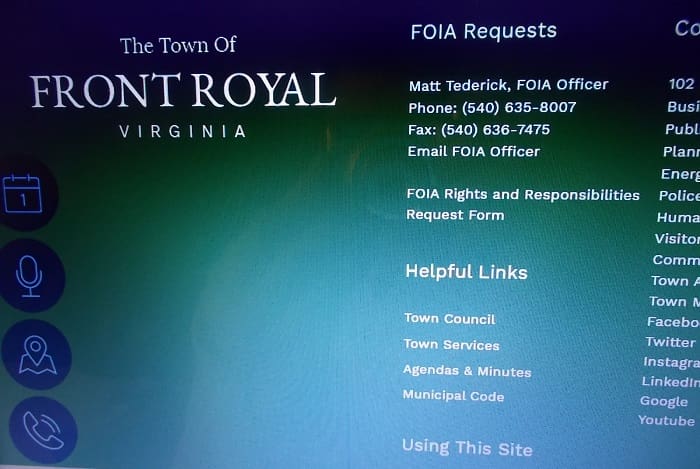
Unmentioned during Napier’s FOIA briefing to council was the fact that Matt Tederick is now listed on the Town website as the Town’s FOIA Officer. – That’s strange, I thought he’d been re-upped as Town Manager Hicks’ ‘Transition Team’. Royal Examiner Photos by Roger Bianchini & TV image news agencies as identified
Those included changes in meeting procedures, most pointedly starting Public Concerns at 6:30 p.m. in order to separate them from the regular council meeting beginning at 7 p.m.; reducing the number of regular meetings and work sessions to once a month; and altering Town Codes to give council case-by-case authority to approve apartment developments in the Historic Downtown Business District, as opposed to being constrained by coded guidelines. Maybe there is substance to that rumored 60-unit apartment building earmarked for the old Murphy Building site now housing the Dynamic Life Coffee Shop on the first floor.
With non-agenda items then on the table, newly elected, first-term Councilman Scott Lloyd had several ideas, including a final one for a town street name change. Here’s a hint – Lloyd comes to municipal service after a hugely controversial stint as the Trump Administration’s Department of Health and Human Services Director of Refugee Resettlement during the migrant child-parent separation policy.

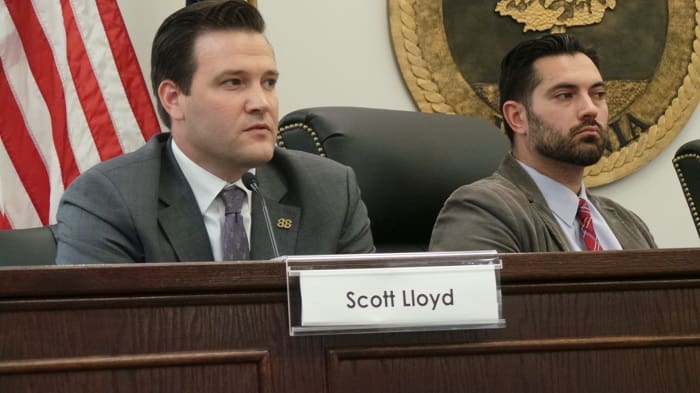
Scott Lloyd, left in a file photo, couldn’t seem to leave his federal government roots behind in his first month as an elected town municipal official. Fellow first-termer Joseph McFadden, right, focused on how to access council records so as not be blindsided on future votes as he was on the Meza appointment issue.
“And the third is to consider changing one of the streets in town to Donald J. Trump Avenue in honor of the president,” Lloyd offered. And while the January 19th discussion immediately turned to the process for altering town codes, specifically reducing the number of readings to make an ordinance change from two to one, it soon turned back to Donald J. Trump Avenue on the final full day of Trump’s presidency.
Perhaps surprisingly, Lloyd saw some resistance generated from fellow Republicans starting with Gary Gillespie. Noting his concerns weren’t political – “I think he was great, don’t get me wrong, but I think we’re opening a can of worms,” Gillespie offered. Several potential repercussions were voiced by council, including forcing potential long-time residents to change their addresses and raising the possibility of other long-time prominent locals and political figures wanting street names changed for them.
“I agree with Gary,” council’s one non-Republican Committee member, Letasha Thompson offered.
“I agree,” it appeared Mayor Holloway chimed in, in the Town’s one long-camera shot virtually broadcast Town Hall work session during which no media or public was allowed in the Town Hall meeting room due to COVID-19 pandemic concerns.

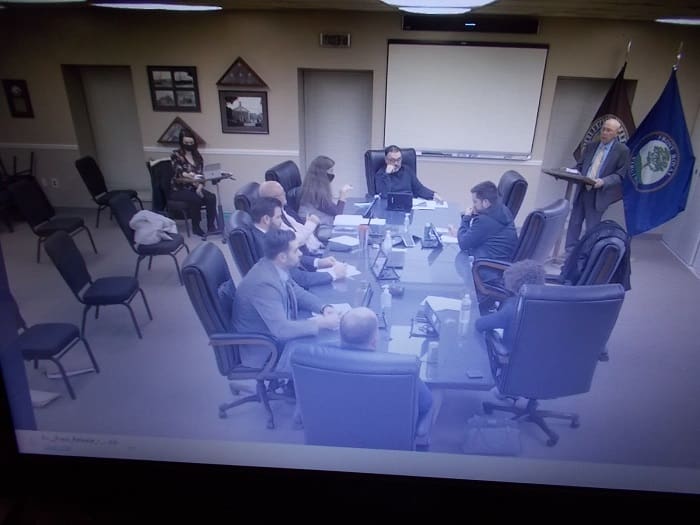
While no media or citizens were allowed in the Town Hall meeting room due to Coronavirus pandemic surge concerns, only one mask and little social distancing were evident at the council table. Any press or citizen live spectators were relegated to a Town Hall-way viewing of the meeting.
After some additional discussion during which Jacob Meza pointed to the City of Winchester’s recent bout of road name changes related to past political road naming accommodations of known segregationists, Lloyd countered.
He pointed out that Trump won Warren County by 67% of the vote in the 2020 election, “Which if it was Congress would be enough to change the Constitution, it’s a supermajority,” Lloyd offered as justification for his former federal employer’s name emblazoning a Town of Front Royal street.

Lloyd then went THERE. “There” being the online conspiracy theory that the only way the man who won the presidency 4 years earlier despite a nearly 3-million popular vote deficit and never hit a 50% approval rating during his presidency, could only have lost the 2020 election, this time by about 7 million votes, was by widespread voter fraud, as opposed to a growing majority of Americans viewing his presidency as a failed one that pandered for the support of evangelical, white supremacist and neo-fascist extremists.

Apparent leaders of the Jan. 6 siege of the U.S. Capitol pause to pray in Congressional chambers as the members who had been there to certify the election result were driven into hiding in fear for their lives. While not all present in D.C. in support of the incumbent president were part of the violent occupying force, what one might ask, does it all have to do with municipal politics 70 miles to the west?
Policy Attorney Lloyd theorized that despite over 60 or so courts nationally, including the U.S. Supreme Court, ruling against the voter fraud challenges on behalf of the president, the issue was never decided factually. “What people can’t argue is that they weren’t ever adjudicated on a factual basis, they were on a procedural basis,” Lloyd offered, failing to continue that the “procedural” basis was a lack of factual support of the theory of widespread voter fraud presented to the court after court across the nation.
“And that’s been denied to those people who have legitimate concerns,” Lloyd appeared to continue on the theme of procedures versus facts, adding, “And then moving from that to the question of did I attend a rally or did I attend a riot? And so the people, people I know, people who went there and just had a great time, left before they even realized, are now being targeted and actually harassed by other people in this community, being labeled as bigots and rioters and everything else,” said Lloyd claiming victimization of the local pro-Trump crowd in Washington, D.C. and/or at the U.S. Capitol on January 6.
If you think I am making this odd turn in the January 19 Front Royal Town Council municipal meeting up, I suggest you watch the linked Town video, also on the Town website. As noted above, it begins around 1-hour-and-9-minutes in and continues to just past the 1:21-minute mark.
But as odd a turn as this municipal meeting took there, the agenda business, as noted above, tackled some potentially impactful topics and is worth a listen during those discussions as well. The Open Discussion that continued beyond the street renaming detour, included late meeting discussion of the potential of offering town residents town work on private-property infrastructure repairs during its state-mandated I&I (Inflow and Infiltration) upgrades, particularly targeting older homes whose sewer and water lines may need upgrading.

The potential of offering payment plans, adding perhaps $100 to monthly utility bills Mayor Holloway suggested, with liens until the work was paid off being attached to those homes, might be of particular interest to town citizens owning such old homes, several council members theorized.
Local Government
Supervisors Defend Public Schools and Crucial Services Budget Cuts as Sign of Tight Economic Times
At its Fiscal Year 2026 Public Hearing on Tuesday, June 10th, the Warren County Board of Supervisors heard from 13 citizens urging them to, if not fully fund, at least adequately fund crucial community services. Those services cited by citizen speakers included Warren County Public Schools and Fire & Rescue services extending to the dual-county funded Chester Gap Company 2 Fire Department located in Rappahannock County.
Four of the five supervisors were present to hear the citizen input on budget variables, with Fork District Supervisor Vicky Cook absent, apparently due to out-of-state car repair issues in Tennessee, Chairman “Jay” Butler later indicated to this reporter.

The WC Board of Supervisors, minus 1, prepares to hear from the public on its recommended FY-2026 budget. The assessment was not positive. Royal Examiner Still Photos Roger Bianchini, video Mark Williams.
As the staff meeting agenda packet noted, the State requires budget public hearings to be held a minimum of seven days prior to a vote on approval of the budget. Adoption of the 2026 Fiscal Year budget beginning July 1 is scheduled for a vote at the supervisor’s Special Meeting on Tuesday, June 24th, starting at 6 p.m.
After County Administrator Ed Daley and Finance Director Alisa Scott presented a graphics-assisted FY-2026 budget summary (see summary at story’s end), the public weighed in. That public included a number of Public School teachers wearing identifying WC Public School Teacher T-shirts.

County Administrator Ed Daley and Finance Director Alisa Scott handled the staff summary of the proposed budget and revenue projections versus requested expenditures. Below, outside the WCGC public school, teachers display their pride in their work. Several spoke during the Public Hearing, telling the supervisors their proposed budget would negatively impact the community’s publicly educated children most of all.

Samuels Library and “Misplaced Priorities”
While not the dominant issue of the evening, the recent controversy surrounding Samuels Public Library surfaced in public comments—often used to argue against cuts to education and emergency services.
Fork District resident George Cline, husband of WC Sheriff Crystal Cline, delivered one of the evening’s most pointed and impassioned statements, accusing the board majority of fostering a toxic political climate while mismanaging taxpayer funds. His remarks drew attention to a range of issues—personal attacks, misplaced priorities, and underfunded public services—that he argued were symptoms of both dysfunction and disregard for core community needs.
“I want to start with two simple definitions,” Cline began. “Toxicity is when bad behavior spreads and stops good things from moving forward. Fiscal irresponsibility is wasting taxpayers’ money, spending without purpose, ignoring real needs, and pushing personal political agendas over the people you were elected to serve.”
He told the board that both were on full display in Warren County.

Fork District resident and school board candidate George Cline pulled no punches in negatively assessing this board majority’s track record as Warren County’s elected officials.
Cline cited specific examples of what he called political toxicity: a public incident where a library board member, Melanie Salins, allegedly texted a sitting supervisor during a meeting to call her a liar; Supervisor Vicky Cook’s continued criticism of the sheriff’s office, which Cline argued was less about performance and more about political grievance; and the board’s decision to stack powerful committees like the Library Board and Audit/Finance Committee with politically aligned appointees, sidelining diverse voices and community representation.
But it was the spending decisions that drew his most forceful criticism.
“You’ve spent $51,000 fighting a well-run library,” Cline said, referring to the county’s ongoing legal and political battle with Samuels Public Library over content and governance. “That money and time could have gone to roads, public safety, schools, and basic infrastructure.”
He offered a striking anecdote to illustrate his point: a building inspection vehicle with more than 200,000 miles reportedly broke down near Gooney Loop last week—an area with no cell service. The stranded staff member had to walk to the nearest home to call for help. “$51,000 could have replaced that vehicle,” Cline said.
He then pointed to underfunded emergency services, noting that fire and rescue services were unable to respond to 429 calls this year—an issue compounded by reduced support for Chester Gap Company 2 Fire Department. “Our firefighters are missing calls. And your answer is fight a library?”
Cline also credited the Warren County Sheriff’s Office with using internal cost-saving measures to fund an overdue records system upgrade. But that came at a cost, he said: the sheriff had to agree not to fill five vacant deputy positions to adjust the department’s salary scale, simply to remain competitive with town salaries.
Meanwhile, he noted, the county’s school system is facing serious challenges.
“Teachers are buying their own supplies,” Cline said. “Facilities staff are asking for money for roof repairs, tennis court maintenance, and basic energy upgrades. Blue Ridge Tech Center turned away 100 students this year because they’ve outgrown their space. Our schools need your help, and your priority is to control the library?”
His closing words underscored the gravity of the moment as he saw it.
“You have a choice,” Cline said. “You can stop wasting money fighting a functioning library and use that money to help solve real problems. Being fiscally irresponsible with the community’s money is compounding the problem—and will cost even more when a responsible board is finally elected in November.”
He ended with a warning: “If you don’t act, you’ll be remembered not just for being toxic and irresponsible but for choosing to do nothing when the community needed you the most.”
Other speakers criticized the creation of a new county-run library board, which requested a 16% budget increase despite being formed under the banner of cost savings.
Multiple speakers framed the Samuels controversy as emblematic of deeper issues—citing it as an example of misplaced focus during a time when basic services are underfunded.
Public Schools plea
Lead-off speaker Sara Jones of the Happy Creek District set the tone of coming pro-public schools comments (at the 18:54 mark of the video): “I am here tonight with a simple but urgent message: You must prioritize funding our public schools now. I understand that the requested increase of $4.2 million is significant. However, it is important to remember they were flat-funded last year, and the needs of our students have not diminished—an increase of only $750,000 falls far short of what is adequately required to support every student.
“At the very least, I urge you to consider approving a $1.2-million increase to help our schools begin addressing these essential needs. This isn’t just another line item in the budget. It is an investment in the future of Warren County, in the future of over 5,000 children who walk into those classrooms every day full of potential, hope, and promise.
“If you could see their faces on the first day of school, their excitement when they find their classroom, when they are welcomed by a teacher who believes in them, when they find a talent or a strength they never knew they had, you’d know this is something we can’t afford to delay or short change.

Lead-off Budget Public Hearing speaker Sara Jones made the point in explaining the need and importance to the community’s children of a funding increase, even less than requested, for WC Public Schools this year.
“And behind every one of those moments are the educators and staff of Warren County Public Schools, mentors, supporters, advocates doing everything they can to help students grow, learn, and believe in themselves. They need our full support, not just words, but resources. Our community can’t afford the cost of inaction,” Jones said pointedly, adding in conclusion:
“The time to act is now. Our students can’t wait. Our teachers can’t stretch themselves any thinner. Our community can’t afford the cost of inaction. Let’s make it clear: Warren County’s future depends on strong, well-funded public schools. Invest in that future today.”
But Public Schools weren’t the only crucial funding need addressed during the FY-2026 Budget Public Hearing.
Chester Gap: “This is life or death”
The Chester Gap Fire & Rescue Department, located near the county’s southern edge, became the emotional heart of the evening. Residents credited the station with saving lives in emergencies where response times were measured in minutes, not miles.
“I should have died,” said former Public Schools administrative staff employee Alan Fox (starting at 41:40 video mark), who was struck by a car in 2021 as he attempted to change a flat tire on the side of the road. He said Chester Gap EMS intubated him on scene and kept him alive long enough to be transferred to Fairfax. “They’ve saved my life, my father’s, my mother’s, and my mother-in-law’s,” Fox recounted of a life-and-death family history that impacted positively across county lines in southern Warren County.

Former WC Public Schools Admin staffer Alan Fox recounts how Chester Gap F&R saved his life several years ago due to a rapid response time after he was struck by a car while changing a tire off the side of the road. Following her brother to the podium, Janet Fox-Monismith lauded the presence and quick emergency access of the Chester Gap F&R Station to not only her brother and family but all the Chester Gap-southern Warren County residents in times of emergencies.

Fox’s sister, Janet Fox-Monismith, followed her brother to the podium. She recounted the accident’s aftermath. “They were there in three minutes. Alan had five brain bleeds and 15 broken ribs … but he survived. Chester Gap made that possible.”
Under the current funding structure, Warren County contributes about $178,000 annually—less than 5% of the public safety budget—to support Chester Gap’s paid EMS staff in coordination with Rappahannock County. The proposed FY-26 budget removes that funding, which would eliminate paid coverage and leave only volunteers.
“This is not political,” said Lt. Kris Fulton of Chester Gap, who identified himself as a representative of the Chester Gap Fire & Rescue Company. “Fires double in size every 60 seconds. Brain damage begins in four to six minutes without oxygen. This is a life or death decision.”
Fulton, a U.S. Army veteran and career firefighter, pointed out that replacing Chester Gap with fully staffed county career responders would cost around $1 million annually. “We’re not a liability. We’re your best return on investment,” he told the supervisors.

Chester Gap Station Lt. Kris Fulton told the supervisors adequate funding for paid personnel is more than a budget matter; it is a matter of Life & Death moving ahead for southern Warren County. Below, Lt. Fulton and another Chester Gap F&R Station supporter talk with their South River District rep Cheryl Cullers and Chairman ‘Jay’ Butler following the meeting’s 6:20 p.m. adjournment.

Fulton left the board with a final message: “Good business isn’t cutting things that work. It’s investing in systems that save lives and money. And Chester Gap does both.”
Supervisor Cheryl Cullers, in whose South River District Chester Gap lies, is a longtime supporter of the Chester Gap Fire & Rescue Department. She made her stance clear: “I have always championed Chester Gap, and I continue to do so. I don’t support the elimination of these positions. Lives cannot be replaced,” she told her colleagues.
But despite Fulton and Cullers ‘Life or Death’ public-hearing closing comments and the Fox family history heard earlier among all the citizen comments, it was just words those comments were met with, explaining a reluctance to provide the requested revenue for Public Schools and the Rappahannock-based Chester Gap Fire & Rescue Department, and likely other departmental and partner budgets as well.
Following the public hearing comments, several supervisors defended their budget cut decisions as being a consequence of tight economic times, diminished County revenue, and their stated opposition to public tax increases to provide needed revenue, even for a level of public services seeming to be desired by a majority of citizens addressing the issues publicly.
Supervisors response
Supervisor Richard Jamieson emphasized the harsh financial reality facing the board: “There’s no comfortable decision here. If we want to keep funding vital services like Chester Gap, we have to look seriously at creating more revenue. We can’t keep pulling from the same well and expect it not to run dry.”
Supervisor John Stanmeyer echoed those concerns, pointing to the shared staffing agreement with Rappahannock County. “Rappahannock has put us in a difficult position,” he said. “We don’t want to make these cuts, but we can’t spend what we don’t have.
“We are in a tight place,” Stanmeyer said of the Public Schools budget. “The same is true for Chester Gap 2 (Fire & Rescue). We would like to be able to fund everything. But hard decisions need to be made, and sometimes it comes down to data-driven analysis,” Stanmeyer concluded.
Budget overview
Click here for the Fiscal Year 2025-2026 budget packet.
Warren County Finance Director Alisa Scott began the public hearing by outlining the key figures and structure of the proposed Fiscal Year 2025–2026 County Budget. She stated that the total proposed budget is $93,450,661, which represents a decrease of $1.5 million from the previous year’s amended budget.
Scott explained, “There is no tax rate increase included in this budget,” reaffirming that the real estate tax rate has remained flat for the fourth consecutive year.
She noted that while revenues have increased, the overall reduction in the budget is primarily due to the removal of one-time capital expenditures that were present in the FY-2025 budget, not because of any loss in local tax revenue. “Revenue growth continues to be strong, particularly in real estate assessments, meals and lodging taxes, and personal property tax,” Scott said.

At the meeting’s outset, Finance Director Alisa Scott took the lead in responding to board questions about the overall perspective on the proposed FY-2026 budget.
Specifically, she highlighted that:
- Real estate tax revenue will increase due to property assessment growth, even though the rate remains unchanged.
- Personal property tax revenue is projected to total $15.4 million, down from $16.2 million the prior year, due to market adjustments in vehicle values.
- Sales tax revenue is estimated at $5.6 million, up from $5.2 million.
- Meal tax is expected to bring in $1.9 million.
- Lodging tax is projected at $1.2 million.
She emphasized the importance of prioritizing essential services within the confines of available revenue, stating: “This budget seeks to strike a balance between maintaining vital county services and recognizing the inflationary pressures residents are facing.”
Scott also confirmed that the proposed $750,000 increase for the school division is included in the budget, though she acknowledged the school board had requested significantly more—$1.147 million at minimum—adding that county staff had worked to meet as many priorities as possible.
No new positions are funded in this budget, and departments were asked to level-fund where possible. However, salaries were adjusted to include a 4% cost-of-living increase for county employees, which was necessary to remain competitive.
Scott concluded her remarks by noting that a balanced budget is required by law, and this budget accomplishes that, even in a year of “competing needs and limited flexibility.”
Royal Examiner video by Mark Williams.
Local Government
Town Council Weighs Fairness of Waste Site Use by County Residents
The Front Royal Town Council tackled a number of key issues during its Monday, June 9 work session—including finalizing the 2025–2026 fiscal year budget and taking a hard look at the fairness of county residents using the Town’s waste drop-off site at no cost.

The Town Council gathers for a work session on the evening of Monday, June 9. Royal Examiner Photo Credits: Brenden McHugh.
The budget was adopted despite some disagreement on the real estate tax rate. Councilman Glenn Wood cast a dissenting vote, arguing that a modest increase of two cents could help fund important community projects. “We can do better,” he said, pointing to needs he feels are not being met.
Vice Mayor Amber Veitenthal opposed the suggested tax increase, pointing to the fact that the real estate tax rate has not increased in the past four years—a point of pride, she noted. In her view, the Town must take a more disciplined approach to budgeting by focusing on what is truly essential rather than pursuing projects that may be considered luxuries. Her position reflects a concern for residents living near the poverty line, who could be disproportionately affected by even modest tax hikes.
After adopting the budget, council members reviewed a memo from Town Manager Joe Petty concerning the use of the Town-operated waste site—known as “the Farm”—by Warren County residents. The 103-acre facility includes a drop-off location for yard waste and other materials, a service that town residents help fund through their taxes. But county residents, who don’t pay town taxes, have been using the site at no cost.
“This isn’t tit-for-tat,” said Mayor Lori Cockrell. She pointed out that while Front Royal residents pay county taxes supporting the Bentonville transfer station, county residents do not contribute to the upkeep of the Farm despite using it. The Town is especially concerned with the cost of yard waste processing, which is increasing as more non-town residents use the site.
The council discussed four potential responses:
- Charging a $15 fee per yard waste drop-off for county residents.
- Negotiating a reduction in tipping fees, the Town pays the County to offset the cost.
- Limiting access to county residents, allowing only commercial deliveries with valid tickets.
- Taking no action and leaving the policy as it stands.
Several council members expressed preference for the second option—pursuing a negotiated cost adjustment with the county—with the fee-based model as a backup plan if no agreement can be reached. Mayor Cockrell emphasized the importance of involving the county in the discussion, aiming for an equitable and cooperative solution.
Other items on the evening’s agenda included a presentation on a potential analytics service contract and a discussion of Brightspeed’s franchise agreement to continue managing local telephone infrastructure. The council also heard a request for reimbursement of an application fee related to a special use permit, and Mayor Cockrell led a brief review of the Town’s strategic plan for 2025–2028.
The meeting closed with no final decision on the Farm issue but with strong momentum to begin discussions with county leaders. The goal: a solution that ensures fairness for town residents who currently foot the bill for a service being shared across the county line.
Local Government
Homesteaders of Warren County Propose “Farmstand Hub” as New County Park to Support Local Agriculture
A new effort to reconnect the community with its agricultural roots is taking shape in Warren County, thanks to a proposal by the Homesteaders of Warren County for a unique and collaborative project: the Farm Stand Hub. This innovative market space is designed to support local farmers, homesteaders, and makers by offering a centralized location for selling goods—without the need to staff individual booths.
What makes this project especially notable is that the Farm Stand Hub is set to become a county park managed and maintained by Warren County Parks and Recreation.
Amber Martin and Sarah Kerns, co-leaders of the Homesteaders of Warren County, introduced the idea to the Board of Supervisors earlier this spring. The proposed location is the McKay Springs property, one of the few remaining undeveloped commercial parcels in the county. The vision is to create a rustic yet functional park where producers can stock shared, unmanned stands with everything from fresh eggs and herbs to handmade goods and natural remedies—offering the public a charming, convenient, and family-friendly way to shop local.

Farm Stand Hub concepts.


“This is a community-first idea,” said Kerns. “And while it’s being led by homesteaders, the Farm Stand Hub will be fully operated by Warren County as a public park. That means this isn’t just our project—it’s something that will belong to the people of Warren County.”
The Homesteaders, a recently formed grassroots group, say the project is inspired by a desire to preserve the area’s rural heritage and create opportunities for families and small-scale producers to share what they grow and make. The idea was also influenced by the success of similar homesteading and local farm initiatives in neighboring counties and the growing popularity of the annual Homesteaders of America conference held in Front Royal.
Martin, who raises livestock and sells eggs, and Kerns, who runs a local hemp and herb farm, both recognize how difficult it can be for small producers—especially those with young families or full-time jobs—to attend weekly farmers markets or staff booths at events. The Farm Stand Hub offers an alternative: a safe, self-serve shopping area open six days a week (closed Sundays) and aligned with county park hours.
“Farmers and makers can drop off their goods, stock their stand, and not worry about being there all day,” said Martin. “And shoppers can enjoy a slower, more personal experience that’s different from the grocery store.”
Because Warren County Parks and Recreation will operate the hub as a public park, it also opens the door to future community programming—like gardening classes, canning demonstrations, or educational farm visits—designed to promote sustainability and self-reliance.
“This is about more than buying and selling,” added Kerns. “It’s about teaching kids where their food comes from, giving neighbors a way to support each other, and preserving the agricultural spirit that’s always been part of Warren County’s identity.”
The group reports strong interest from local producers, volunteers, and residents eager to see the hub take shape. While there’s still planning and coordination ahead, the project has gained traction quickly, and the partnership with Parks and Rec ensures it will be rooted in the community for the long term.
“This isn’t our private enterprise—it’s a park,” said Martin. “We just helped plant the seed. The county is stepping in to grow it.”
For updates and ways to get involved, residents can join the group on Facebook at Homesteaders of Warren County.
Local Government
Warren County School Board Prioritizes Funding Ahead of Final Budget Decision
The Warren County School Board has formally outlined its top priorities should the county approve additional education funding for fiscal year 2026. At its June 4 meeting, the board passed a resolution asking the Board of Supervisors to consider an increased allocation beyond the $750,000 currently proposed, citing pressing needs in staffing, school supplies, and employee health insurance.
During the discussion, School Board Chair Kristen Pence opened by recapping the budget process so far. The board initially approved its FY26 budget proposal on March 5, requesting a $4.2 million increase in local funding compared to the previous year. The proposed school division budget totals $79.4 million.
“We have a $4.2 million ask out right now, but are there things that the five of us could agree on that we would say, if we got more than $750,000, what would we do with that money?” said Pence, emphasizing the importance of showing clear priorities as the county moves toward its final budget vote later this month.
The Board of Supervisors will hold a public hearing on June 10, but a final vote on the budget isn’t expected until June 24. That delay has created uncertainty for school staff awaiting contract renewals. Pence said the delay adds “another layer of rollercoaster to this budget season” and noted that employees might leave for other districts offering firm contracts sooner.
With those concerns in mind, the school board crafted a proposal totaling $1.147 million. If granted, the revised funding request would go toward several key areas. According to the resolution, the first priority is using $750,000 to split a 10.2% increase in employee health insurance premiums between the division and its workers. That amount had been built into the original budget request and was seen as essential.
In addition to covering insurance costs, the board is seeking $80,282 to increase the non-labor supply budgets for schools. “We know the cost of every single thing has gone up,” Pence said. “Schools are having fundraisers; we’re begging parents to send in paper and pencils and pens… even just that little bit for each of the schools, I think would go a long way.”
The board also wants to use the remainder of the request to restore positions that directly support students. These include seven instructional assistant roles and one bachelor’ s-level student support coach. Pence and others emphasized the value of such positions in addressing academic and behavioral needs.
Another element involves reclassifying a previously held position into a full-time nursing coordinator. That would be funded through savings achieved in a recently renegotiated custodial services contract. Robert Ballentine, Director of Finance, explained that while the contract saved $78,295, the district was already operating with a $56,642 deficit. That leaves just over $21,000 available for reallocation—enough to support the nursing coordinator role.
The $467,233 debt service payment was also figured into the budget discussion. During the meeting, Ballentine clarified that the county has agreed to take over this cost, which relates to a 2016 energy conservation bond. “It won’t be in our school board budget, but they’re gonna have to pay it,” Ballentine said. The school division removed both the bond payment from its expenditures and the associated tax credit from its revenues, thereby reducing its overall budget without masking its actual funding needs. Had the district retained the debt payment in its figures, the local request would have risen to nearly $4.6 million, he added.
While there was discussion about whether that $467,000 could be “used” again, the consensus was clear: the funds had already been accounted for in this year’s numbers and could not be reapplied elsewhere. “We’ve already accounted for it,” Pence said. “We don’t get to play with that money.”
With a motion on the table, board members agreed to finalize and send the resolution to the county. “We’ll type this up and get it to them before that public hearing,” said Ballentine. “We usually hand-carry a letter signed by the superintendent down to the county administrator and copy the county finance director.”
The board voted unanimously in favor of the revised funding request and resolution. Their hope is that by presenting a realistic and prioritized list of needs, the county may be able to allocate more than the proposed $750,000.
“It’s not that I want to… cut our budget or defund our schools,” said board member Melanie Salins. “It’s my method of thought process… to see our request fall somewhere within the amount of money that I know is going to be coming in extra for the county.”
The board also briefly discussed the condition of the tennis courts at Skyline High School, which may require resurfacing or replacement. Estimates for the project are around $106,740, though grant funding through the United States Tennis Association (USTA) could offset up to $64,000 of that cost. While no vote was taken, officials said the topic would be addressed at an upcoming work session.
As the public hearing approaches, the board’s message is clear: additional funding beyond the baseline of $750,000 is critical to meeting the division’s operational and instructional needs.
The Board of Supervisors’ public hearing is scheduled for June 10. Warren County school staff are awaiting contract finalization by June 13, though no budget vote is expected until June 24.
Click here to watch the Warren County School Board Meeting of June 4, 2025.
Local Government
Elsia Drive Parcels Reviewed for Residential Rezoning at Planning Commission Work Session
Two parcels of land near South Royal Avenue in Front Royal may be one step closer to changing from commercial to residential use. At a work session on Wednesday, June 4, the Front Royal Planning Commission reviewed a request from the James E. Williams Family Trust to rezone two parcels on Elsia Drive from C-1 (Community Business District) to R-3 (Residential District). The proposed change would align those parcels with a third, already residentially zoned, adjacent parcel owned by the family.

: The Town Planning Commission commences a work session on the evening of Wednesday, June 4. Royal Examiner Photo Credits: Brenden McHugh
The parcels sit near the 7-Eleven gas station and the Commonwealth Senior Living facility. According to a written statement from Stephen Williams, co-trustee of the family trust, the rezoning is intended to make all three parcels consistent in zoning. This would allow for a broader set of uses—including potentially more units for the nearby nursing facility or the construction of townhomes or apartment buildings.
During the meeting, commissioners examined how the proposal aligns with the town’s comprehensive plan and whether the requested zoning change represents the best use of the land. The discussion emphasized the fact that no development plan is being proposed alongside the rezoning application, meaning that any decision made at this stage would be focused solely on land use—not on what might ultimately be built.

Deputy Zoning Administrator John Ware presents to the commission the single item for a future public hearing on the agenda.
Deputy Zoning Administrator John Ware noted that the current commercial zoning may no longer be ideal due in part to topographical challenges and the parcels’ location off the main thoroughfare. “That may come into play here,” Ware said, suggesting the applicant’s rationale for the change may be related to the land’s limited commercial value.
Commissioner Megan Marrazzo expressed concerns about the lack of a development proposal. “So much is unknown here,” she said. While the statement from the applicant suggested uses like expanding the senior facility or building apartments, none of those possibilities are guaranteed under this application. Since no specific project is being proposed, there are also no proffers—voluntary contributions often used to offset the impact of development—being offered.
Without proffers or a site plan, commissioners are left weighing the merits of the zoning designation alone. Commissioner Teresa Fedoryka questioned whether the change is consistent with the town’s comprehensive plan, which broadly identifies the area as suited for R-1 zoning, a lower-density residential classification.
In response, Commissioner Allen Neel argued that the plan should be viewed as a general guide rather than a set of rigid boundaries. “The comprehensive plan was a vision capturing a wide swathe,” Neel said, suggesting that the language of the plan allows room for interpretation.
If the parcels are rezoned to R-3, the owners would be allowed to build single-family, two-family, or multifamily housing by right. However, certain types of development, such as apartments, would require an additional special use permit even under the new zoning.
For now, no formal action has been taken. The June 4 session was strictly a work session, meaning the matter will come before the Planning Commission again for further discussion or a vote before ultimately heading to the Town Council.
As the town continues to review zoning requests and manage future growth, the conversation surrounding the Elsia Drive parcels highlights the complexity of land-use decisions—especially when no building plans have yet been drawn.
Click here to watch the June 4, 2025 Front Royal Planning Commission Meeting.
Local Government
Faced With Overwhelming Public Opposition to Public Library Provider Switch, Supervisors Delay Vote on LS&S Contract
(Writer’s note: this story has been updated to reference Royal Examiner video marks, as opposed to County video marks originally referenced. Both the new marks and original ones remain valid with their respectively linked videos.)
The topic of most public interest at the June 3rd meeting of the Warren County Board of Supervisors was addressed, first, behind closed doors at a scheduled 6 p.m. Closed Meeting primarily on public library issues. Those issues included legal advice on the board’s FOIA filings to Samuels Library, with legal disputes looming.
Perhaps most crucially discussed behind closed doors was the remaining 14 years on a 30-year, dollar-a-year lease granted to Samuels Library in January 2008 by a previous board of supervisors. That lease is likely indicative of the long-term nature and history of the Public/Private Partnership between Warren County elected officials and the public library entity dating to 1799, which evolved into the Samuels Public Library 501-C3 non-profit, circa the 1950s.

The supervisors and County Attorney Jason Ham, bent over table white shirt center, leave the 6 p.m. closed session discussion largely focused on public library issues about a minute prior to the 7 p.m. open meeting’s scheduled start. Royal Examiner still photos Roger Bianchini, video Mark Williams
However, that was THEN, this is NOW.
As readers know, “NOW” contains a 4-1 board majority opinion, Cullers dissenting, that Samuels Library needs to be replaced ASAP (As Soon As Possible) by out-of-state, for-profit library provider Library Systems & Services (LS&S). That attitude exists despite Samuels Public Library’s history of proactive programs for both youth and adult patrons, in addition to its expansive collection of reading material and current status as Virginia’s Library of the Year 2024, with positive family and educational roots spanning generations, as some Public Comments speakers noted on June 3rd.
Delayed vote on LS&S 10-year contract
However, perhaps unexpectedly to many, facing an official meeting headcount of 187 packing the main meeting room into the hallway of the Warren County Government Center (WCGC), from what was observed essentially ALL there, other than County staff, in support of Samuels Public Library, the four-member majority of “replace Samuels” supervisors joined in approving one of their members, John Stanmeyer’s, motion, seconded by Vicky Cook, to delay a vote to allow time for additional information gathering, legal, financial, and otherwise.

Out of the closed session, the supervisors headed into their open meeting with one large decision to make. Below, first Public Comments, initial speaker Eileen Dierig has a full house of fellow Samuels Public Library supporters behind her and into the hallway as Fire & Rescue issued a head-count of those present for the meeting at 187. Not one citizen present, at or away from a microphone, was heard by this reporter to utter a pro-LS&S contract statement.

That information gathering was handed over to the supervisor majority’s recently hand-picked Warren County Library Board, believed by Samuels supporters to be comprised of like-minded, anti-Samuels applicants, headed by Chairman Eric Belk.
The 5-0 vote to delay acceptance of the LS&S contract came after a first round of Public Comments on agenda items (beginning at the 9:30 Royal Examiner video mark), seeing 10 speakers taking up the full allotted time of 30 minutes, 3 minutes max per speaker, all in defense of Samuels and against the issuing of a new, 10-year library contract with out-of-state, for-profit library entity Library Systems & Services (LS&S). It is a contract that would cost the County and its taxpayers $250,000 to cancel in its first year of existence, with that total decreasing by $25,000 per year through the remaining nine years.
As would be the case in the second round of Public Comments (beginning at 1:15:25 Royal Examiner video mark) late in the meeting during what we counted as 14 more speakers, some of the comments directed at the four anti-Samuels supervisors were scathing, often questioning the motivation and truthfulness of those supervisors regarding their reasons for seeking the change in a public library provider, particularly with legal and financial consequences of such a move as yet undetermined.

Samuels Public Library supporters outside the WCGC express their opinions in signage. Below, at 6:50 p.m. the crowd continues to gather inside the main meeting room as the supervisors remained in closed session until about 6:59 p.m.

Is this the legacy you want to leave?
One second-round speaker, Joanne Kearney (1:40:12 video mark), suggested the board majority take pause and consider the long-term truths about how they have come into conflict with, not a 30-person minority of their constituents as one supervisor, we believe Jamieson, has contended, but a broad swath of those they claim to represent.
After saying she was speaking against the LS&S contract, Kearney added, “I’m also here to remind you, like so many of your colleagues and predecessors, you’re failing to look at the long view.
“You may see things like this privatization as a short-term fix to your moral or ethical goals. But you will not be on the board forever. And your legacy won’t be as heroes saving us from ourselves, the big, bad wolf institution, or phantom fiscal malfeasance. Your legacy will be a mess, an abuse of power, and a waste of taxpayer money,” Kearney said pointedly, offering an analogy to a gap in the community’s tourism promotional efforts from past town municipal decisions presented as quick fixes.
Bigger than politics, a community rallies
“I want to talk tonight about something bigger than politics, something stronger than contracts or court battles,” Happy Creek District resident Michelle Smeltzer told the board in opening her comments (1:34:52 video mark), continuing, “I want to talk about community because what’s happening in Warren County right now, what we’ve seen over these past months is people coming together, not just to save a library but to stand up for what’s right to protect something that belongs to all of us.
“You’ve got lifelong residents working side by side with new neighbors, Republicans, Democrats, Independents, putting differences aside, parents, teachers, veterans, business owners, teenagers showing up week after week refusing to be ignored. That’s not division; that’s strength.
“We didn’t ask for this fight, but we sure as heck answered it. And we did it the Warren County way by leaning on each other, rolling up our sleeves, and never backing down. Samuels isn’t just a building, it’s part of our story. And the fact that it’s still here, still open, is because this community kept going through donations, through volunteer hours, through grit. We held the line.
“And we’re not just fighting to protect what we have, we’re fighting to build a future we’re proud of, one where our kids have access to knowledge, where truth matters, public spaces belong to the public, and where decisions are made with the community, not behind its back,” Smeltzer said pointedly to four of the five supervisors she faced, concluding:
“You might still sign this contract, but know this: Warren County was woken up, we found each other, we found our voice, and we’re just getting started because we love this place, we believe in it, and we believe in each other,” Smeltzer concluded to a combination of prohibited clapping and substitute hand waving and air clapping.
Public Comment rules under scrutiny?
It might be noted here that when the first, second round Public Comments speaker Sydney Patton (begins 1:16:08 linked video mark) began shifting her remarks from general cyber-security issues to that issue’s relationship to the proposed new library contract with LS&S, Board Chairman “Jay” Butler interrupted (1:18:05 video mark) to say the library situation had already been addressed. This second Public Comments period was for non-agenda items, not a return to library issues. However, County Attorney Jason Ham interrupted to request an immediate, off-microphone discussion with the chairman and board (1:18:22 video mark). A five-minute recess was called, after which Chairman Butler allowed Patton, who had identified herself as the President-elect effective July 1, of the Friends Of Samuels Library (FOSL) support group, to continue her remarks, it appeared with a reset time clock.

County Attorney Jason Ham is all smiles for the camera as he exits the 6 p.m. closed session after about an hour behind closed doors. Wonder what he told them in there.
Consequently, the following speakers all continued to address the library contract issue despite it having been an agenda item. One might wonder if the decision to allow a second round of Public Comments to focus on an agenda item already discussed will impact future meetings of Public Comments. Could that decision allowing a second round of Public Comments on an agenda item after discussion with the County Attorney indicate a legal issue with the way the board majority has divided agenda and non-agenda items for access by citizen comment? That splitting of public comments has delayed citizen comments on non-agenda items such as the recent public library dispute, which is often several hours later to near the meeting’s end.
Routine Business?
Ironically, perhaps, following the Closed Session library legal variables discussion, at the subsequent 7 p.m. open, regular meeting referenced above, item number H-10 on a 13-item Consent Agenda was approval of the 10-year contract with Library Systems & Services to operate this community’s public library moving forward. That contract is slated to begin on July 1, 2025, the first day of the coming Fiscal year 2026. It is interesting to note that consent agendas are traditionally formulated to vote on what are considered “routine matters” that do not need board public discussion of reasons for the proposed action. One can only wonder at the board majority’s thought process in designating the switch of library providers as “routine business.”
From the board majority perspective, one might consider that the effort to remove Samuels as the community’s public library has become “routine” business for the majority of Stanmeyer, Jamieson, Butler, and Cook. Expectedly, South River District Supervisor Cheryl Cullers pulled item H-10 off the Consent Agenda for board discussion.

Cheryl Cullers was the first supervisor to seat themselves at the dais for the 7 p.m. open meeting. Below, the crowd responded to Cullers’ loan presence at the dais with a rousing ovation. (See this on the Royal Examiner video at :05 mark)
Perhaps indicative of potential legal tie-ups with current public library provider Samuels Public Library is a passage in the Agenda Staff Summary of the proposed LS&S contract reading, “In the event the Commencement of Services begins at a later date, the Effective Date of the Term of this Agreement shall begin on the first day of the month when such services commence and continue in force for a period of ten (10) years.”
The legal uncertainties include annual costs to void the contract were a change in the board majority perspective to occur post-November 2025 election results. Some suspect such a perspective shift if Tony Carter and Hugh Henry are elected. Both have made support of Samuels Library major points of their campaigns for the Happy Creek and Fork District seats, respectively. If elected, with South River Supervisor Cheryl Cullers continued seating, Samuels would have 3-2 majority support with the addition of Carter and Henry.

BOS candidates Hugh Henry, Fork District (1:37:04 video mark), above, and Tony Carter, Happy Creek District (1:44:55 video mark), both addressed the sitting supervisors in favor of maintaining Samuels Public Library contractual arrangement with the County. As noted above, if both win in November it will shift the board to a 3-2 majority, with Cheryl Cullers, in support of Samuels. But might the current majority hang a $250,000 ‘penalty’ cost on such a realigned board’s desire to cancel that LS&S contract in order to renew the one with Samuels Public Library?

Other Business – Homesteaders initiative
Another topic removed from the Consent Agenda for discussion, also by Cullers, was Item H-9: “Authorization for Parks & Recreation to utilize County-Owned Property on Reliance Road for the Warren County Homesteaders.”
Cullers explained that she did not oppose the Homesteaders’ request; she just believed that additional discussion of other potentially available sites could be beneficial, particularly since VDOT has not yet provided feedback on accessibility issues with the targeted McKay Springs site.
However, her colleagues disagreed with the need to explore the site issue further. On a motion by Jamieson, seconded by Cook, the authorization of the H-9 proposal for the pursuit of use of the property was approved by a 4-1 vote, with Cullers dissenting.
Watch the Warren County Board of Supervisors Meeting on the Royal Examiner Video by Mark Williams or the linked County video, which includes the 5:30 p.m. work session with County staff on the necessity of upcoming Zoning and Subdivision Text Amendments.
Or click here and watch the county video, which includes the work session before the meeting.