
Local Government
Town Planning Commission Evaluates Two Mechanisms for Regulating Tobacco, Smoke, or Vape Shops
“Well, yes, I must admit I smoke.”
“I am glad to hear it. A man should always have an occupation of some kind.”
Although Oscar Wilde is capable of being exceedingly funny and is truly at his best in The Importance of Being Earnest, the Town of Front Royal is taking tobacco, smoke, and vape shops quite seriously. During a work session that followed their monthly regular meeting at the Warren County Government Center on Wednesday, November 20, the Front Royal Planning Commission exchanged views on the best way to regulate the incoming tide of tobacco, smoke, and vape.

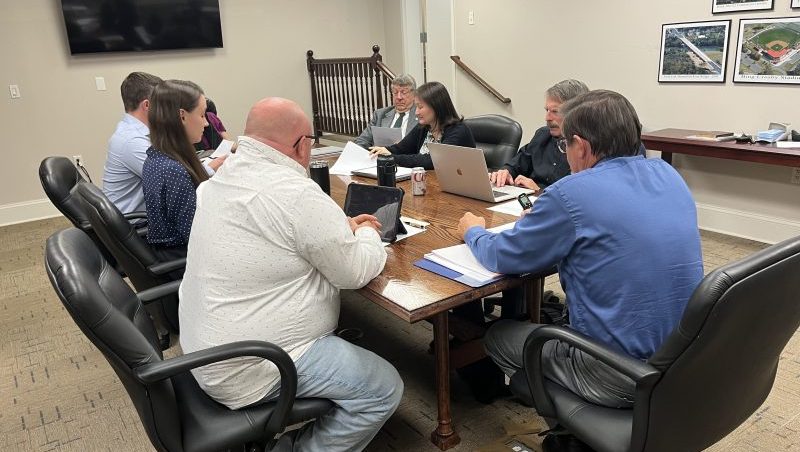
Above: Front Royal Planning Commission sits in anticipation of their monthly regular meeting on the evening of Wednesday, November 20. Below: After their regular meeting, the commission conducts a work session. Royal Examiner Photo Credits: Brenden McHugh.
Before them were two regulatory mechanisms that staff have labored to bring to full definition in response to a request from the town council that the commission forward a proposed ordinance regulating these shops with a recommendation of approval or denial or approval with conditions. This discussion was substantially impacted by a section of the state code that became effective on July 1 of this year and only recently appeared on the staff’s radar. Section 15.2-912.4 reads: “Any locality may by ordinance regulate the retail sale locations of tobacco products, nicotine vapor products, alternative nicotine products, as such terms are defined in section 18.2-371.2, or hemp products intended for smoking, as such term is defined in section 3.2-4112, for any such retail sale location and may prohibit a retail sale location on property within 1,000 linear feet of a child day center as defined in section 22.1-289.02 or a public, private, or parochial school. An ordinance adopted pursuant to this section shall not affect (i) a licensee holding a valid license under section 4.1-206.3 or (ii) any retail sale location of tobacco products, nicotine vapor products, alternative nicotine products, or hemp products intended for smoking operating before July 1, 2024.”
Prior to the discovery of this regulatory language, staff investigated how other municipalities like Quantico handled this issue. Previous drafts of the proposed ordinance featured a wider scope for the 1,000 feet rule, imagining a buffer for churches, parks, and other locations, basically anywhere that children might be in attendance, on the rational basis that such an ordinance would be concerned with the health, safety, and welfare of the populace. Now that the state code with its narrower allowances for prohibition is part of the staff’s reasoning process, Town Attorney George Sonnett is inclined to be no more restrictive than the state code itself. As for the 1,000 feet rule, it is the Town’s pleasure to reduce that distance but not to increase it.
At this point, the commission can recommend one or both of two regulatory mechanisms that staff have labored to bring into compliance with the new law. A by-right mechanism would be enforced administratively by staff, bringing under regulation any new retailer who sells tobacco, smoke, or vape products in any amount, “even a leaf of tobacco,” as Planning Director and Zoning Administrator Lauren Kopishke said at the meeting. Thus, a new gas station could come under the 1,000-foot rule. The by-right performance standards in the proposed ordinance read: “Shall not be located within 1,000 feet of any child or daycare center, as defined in Section 22.1-289.02 or a public, private, or parochial school.” It goes on to stipulate: “Measurements made to verify compliance shall be made in a straight line, without regard for structures or objects, for 1,000 feet from the boundaries of the property on which a public or private school or daycare center.”
When the sale of tobacco, smoke, or vape becomes concentrated in “twenty-five percent or more of the store’s total inventory or fifteen percent or more of the store’s total display area,” the special-use permit mechanism would allow a lengthier legislative process in which the town council evaluates applications on a case-by-case basis and grants a special-use permit that can be revoked if ever the council judges the permit-holder not to be in compliance with code. Under this mechanism, any shop that reaches that degree of concentration would only be permitted in the C-1 and C-3 commercial districts. Kopishke specified that staff would recommend the by-right performance standards as a condition for the SUP approach. In other words, SUP would incorporate the 1,000-foot restriction.
Of course, the language of the state code says that a locality “may” regulate these entities, not that it shall. Therefore, much is left to the appetite and the inclination of the governmental bodies at that level. A vigorous discussion transpired among the commissioners. Questions were raised about whether it is truly consistent to enforce an SUP mechanism without a by-right mechanism. In other words, why go after the retailers who have reached the inventory and display area benchmarks but not regulate a gas station that is selling a product equally insidious to health, safety, and welfare just because it is stocked at a lower volume? Commissioner Gary Gillispie took issue with both mechanisms, arguing that a truly consistent policy would target alcohol as well, insofar as it is potentially dangerous. He views all of the above as undesirable based on a hands-off approach. If he had to choose, he said he would choose the SUP-only route, in which he was joined by Commissioner Megan Marrazzo, who, for slightly different reasons, feels that is the best solution. Her logic was that a store that has reached those benchmarks is more likely to draw young people than a gas station.
In the end, a majority of three, comprised of Chairman Connie Marshner, Commissioner Andrew Brooks, and Commissioner Allen Neel, expressed the opinion that both the by-right mechanism and the SUP mechanism should be recommended to the council. The commission will consider the proposed ordinance once again at their December 4 work session and bring it to a vote at their regular meeting on December 18.

Man Arrested After Domestic Assault, Barricade and Fire at Shenandoah Avenue Residence

“Pink Cocaine” Emerging in U.S. Drug Market, Authorities Warn

Hike Kidz Foundation Builds Momentum with Community-First Mission and New Board of Directors

Some of History’s Biggest Discoveries Were the Result of Dumb Luck

Senators Propose Phasing Out Data Center Tax Credit, House Budget Keeps It

Lawmakers Propose Major Investments to Expand Student Aid, Limit Tuition Increases

Funeral Prearrangements: 3 Good Reasons to Plan Ahead

STEAM Night Launches Students Into Space at A.S. Rhodes Elementary School

Virginia Housing Market Sees Surge in Pending Sales to Start 2026

Is Front Royal Destined to Become Another Fairfax?

Here’s What to Know About the DHS Funding Shutdown

Lord Fairfax Health District Updates WIC Services and Expands Schedule

Poll: Virginians Back Tighter Gun Laws, Favor Current Redistricting System

What is ‘Performance-Based Regulation’, and How Can It Lower Utility Bills?

Lawmakers Reshape Youngkin’s Final Budget With Focus on Affordability, No New Taxes

El Salvador Turns to AI to Personalize Learning Nationwide

New Version of Keytruda Speeds Up Cancer Treatment, With Help From Space

Shenandoah Rail Trail Supporters Applaud CTB Move to Purchase Corridor, Launch Public Engagement

Virginia Delegate Eric Phillips Warns of Growing Strain on Power Grid, Calls for In-State Energy Expansion

Welcoming Spring Into Your Home: A Fresh Start for the Season
Government Business Shouldn’t Require a Public Display of Patriotism

March at Shenandoah River State Park: Salamanders, Wildflowers, and Nights in Nature

Blue Ridge Care Marks 45 Years, Highlights PACE Program That Helps Seniors Stay at Home
Why Trump’s Election Rhetoric Is So Dangerous
