
Agriculture
Virginia Communities Push Back Against Sewage Sludge on Agricultural Land as PFAS Concerns Grow
A flush of a toilet, the rinse of a washing machine, or the discharge from factories – it all ends up as wastewater. That waste is then treated and made into a sludge called biosolids. Biosolids can be converted to agricultural fertilizer, and by using it, many farmers in Virginia may be unknowingly spreading toxic chemicals on their land that could end up in crops and the state’s waterways.

Cows graze on a field that previously had been treated with biosolids that potentially contained PFAS. (Photo by Shannon Heckt/Virginia Mercury)
As state Sen. Richard Stuart, R-King George, said in a recent State Water Commission hearing, “we don’t want it to go in the river anymore, for goodness’ sake.”
Biosolids can contain per- and polyfluoroalkyl substances (PFAS), which pose serious health risks if people are exposed to them in higher amounts. The danger has led some states to outright ban, or enact stricter requirements in the use of biosolids, and prompted calls from some Virginia communities to do the same.
PFAS are everywhere; Virginia doesn’t test for them in biosolids
Forever chemicals are in hundreds of products we use every day, from nonstick cookware to takeout food packaging and even dental floss. They take hundreds of years to break down and can be a serious challenge to remove from the environment. The use of these chemicals started around the 1940s and has only expanded with time.
Being exposed to PFAS over long durations and frequent occurrences increases the risk of the chemicals interfering with the body’s natural hormones, possibly increasing cholesterol levels, lowering women ‘s chances of getting pregnant, affecting the immune system, or boosting the risk of certain cancers.
The hangup for many community members and lawmakers is that Virginia does not test biosolids to see if there are high concentrations of PFAS in them.
The Virginia Department of Environmental Quality samples rivers and creeks across the commonwealth to look for the presence of PFAS; however, that data dashboard was disabled on the agency’s website during the course of writing this story.
DEQ is not required to test biosolids for the presence of PFAS under current law. A map provided by the agency shows that biosolid permits have been granted in almost all corners of the commonwealth, but the map has not been updated in five years.
The federal Environmental Protection Agency put out a draft assessment on the risk two chemicals in the PFAS family pose on farmers with amounts as small as one part per billion. However, the report did not call for the regulation of those chemicals when they are found in biosolids.
Maine became the first state to ban the use of biosolids after multiple farms were shut down after extreme levels of PFAS were detected in soil, livestock, and even farmers’ blood where biosolids had been spread nearby. Well water at these farms had also been poisoned by the chemicals. The state has set up a fund to aid farmers who may have had to halt their production due to the presence of PFAS.
Michigan prohibits the use of highly contaminated biosolids, but still lets some be spread on a very small amount of land that still uses biosolids. Meanwhile, Virginia only regulates setbacks from wells and homes during the spreading of the sludge, as well as nutrient management plans for the fields.
Researchers, communities press for PFAS protection
At Virginia Tech, Shilai Hao researches the analysis of PFAS in the environment and is looking for ways to permanently remove it. He said that people are commonly exposed to forever chemicals by way of the products they use. Hao said it is critical for the state government to be testing biosolids due to the concentration of those chemicals in one source.
“Testing helps agricultural producers understand whether biosolids-derived products are safe to apply on their farms. It also helps wastewater treatment plants decide how biosolids should be managed or disposed of to reduce PFAS-related risks,” Hao said.
One of the companies that provides biosolids in Virginia is Synagro. It is in the process of getting permits reissued in multiple counties. A spokesperson for the company said, “Synagro is a passive receiver of PFAS from municipalities, who themselves are passive receivers from their customers.”
The spokesperson went on to say that Synagro supports potential legislation to remove PFAS at the source or to implement discharge limitations for manufacturers to stop it from ending up in wastewater.
The Shenandoah Valley has a concentration of biosolid permits issued near Charlottesville, according to the 2020 map. At the University of Virginia, Bryan Berger is researching how PFAS end up in soil and food. He said that despite PFAS being basically ubiquitous, biosolids still pose a higher risk.
“There’s a direct correlation between PFAS application and PFAS levels in drinking water and blood serum. At minimum, you’d want to test because you don’t want to have that,” Berger said. “Why do that to yourself, expose yourself to that risk?”
The concern over biosolids is not new in Virginia. Stuart Overbey lives in Albemarle County, where she has been trying to raise awareness for years about the farms in her area that have permits to spread biosolids. She said in the summer of 2024, when spreading was happening near her house, the substance was all over the roads.
“You had to roll up your windows, turn off your AC. It’s not like cow manure smell or even chicken manure. It’s like death. It’s like your body reacts,” Overbey said.
She has been collecting stories of people across Virginia who say their health and well water quality declined after neighbors used biosolids. She’s joined forces with groups like the Piedmont Environmental Council and community advocates in Orange and Albemarle counties to request public hearings for the permit requests and renewals for the biosolid companies.
In Virginia, counties can pass ordinances requiring the testing and monitoring of biosolids. Overbey has written a draft for her county but it has not been taken up by the Board of Supervisors yet.
The permits in each county last for 10 years, and additional land can be added between each permit. In Orange County, Synagro is currently going through the process to add 200 acres to their permit and remove 1178 acres for a total of 2564 acres permitted for the sludge.
Orange County resident Jamie McConnell read about PFAS in biosolids and what other states have done to curb the risk. When he first learned about it he didn’t know how to try and stop it from being used in his community. Now he’s pressing the state to take action.
“They didn’t know the extent to which it’s contaminated. It’s an outrage at the DEQ that they won’t test. It’s silly,” McConnell said.
At an October meeting, dozens of community members showed up to a hearing about the reissuance of the Orange permit. Some of the land in the permit is near Pamunkey Creek.
The chairman of the county Board of Supervisors, R. Mark Johnson, wrote to DEQ to alert the agency that PFAS has already been detected in the creek. Johnson wrote that the board is not against the use of biosolids for fertilizer, but they want to ensure farmers are aware of potential contaminants.
“Our farmers deserve to know what they’re putting on their land, and our citizens deserve protection from forever chemicals,” Johnson said in his letter.
Alternatives to biosolids
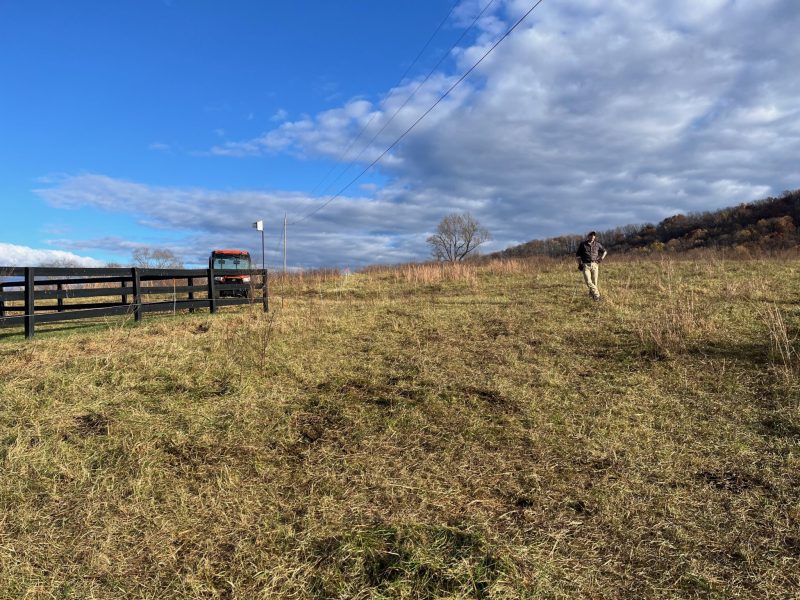
Massey Teel stands in a field where he just cycled out livestock as part of a regenerative farming method. (Photo by Shannon Heckt/Virginia Mercury)
With biosolids being a cheaper option for farmers who need to use fertilizers on their land, many are asking what can be done to reduce the need for it.
On a windy November afternoon outside of Charlottesville, Massey Teel coils up a wire on his land to let cows, sheep, goats, and donkeys shift over to a new small quadrant of land, part of the process of regenerative farming.
Every day, he moves his livestock to a new roped-off area of his land to feed and drop their own waste. He doesn’t put them back in the same area for months to allow for the natural fertilizers to work into the land and the grasses to grow back.
The land he works on had been leased to a previous farmer who had used biosolids in the past. Teel said he understands something has to be done with the waste, but there needs to be more done to help the environment and preserve farmland.
Teel said often, crops are grown, and cattle are raised in ways that don’t allow the land to naturally regenerate nutrients, leading farmers to need the fertilizer.
“It’s not just that those biosolids are being put down there or any other fertilizers being put down there, but because they have poor ground cover and every time it rains, a huge amount of that fertilizer is going to flow downstream,” Teel said. “ And it has all sorts of negative effects for our watersheds all the way down to the bay.”
There are ways to reduce that need, protect the land from runoff, and save farmers money, Teel said, including more oversight from state authorities.
“As far as I’m concerned, a little more regulation is not a bad thing,” Teel added.
In Richmond, lawmakers are debating how to protect their constituents who increasingly reach out to them with their worries about the chemicals in biosolids.
Stuart, the state senator representing King George, said Maryland recently set limitations on how many parts per billion of PFAS found in the sludge can be allowed in order to spread the substance on agricultural land. That often leads to Maryland’s biosolids being shipped over to Virginia, which does not have such limits.
He said he plans to bring legislation in the 2026 General Assembly to set limits and require testing. He would prefer to have a zero tolerance, he said in an interview, but understands that may not be fair to the industry.
“I think it’s important that you go; we at least meet or go below Maryland’s threshold, because if we don’t, they’re going to keep sending it across the river with us,” Stuart said. “The EPA guidelines are much higher than Maryland’s threshold. So we’re not going to be able to rely on the EPA.”
With the strong pushback from communities in Orange County as well as Essex County, Synagro has put a pause on the Essex permit process to see how things play out in Orange, a DEQ representative told the Water Control Board last week.
Legislators will decide the next steps for PFAS testing of biosolids in the upcoming General Assembly session in January. If they fail to take action, there could be negative consequences for Virginia’s agricultural industry and communities, some experts warn.
“If we just let this come to pass, and we apply these biosolids and we don’t test, we can look at places like Maine as an outcome, right? Where there’s now dairy cattle and milk, which is heavily contaminated to the point that, you know, farmers have to dump the milk and can’t sell it anymore and you can’t just clean it up. That farmland is lost,” UVA’s Berger said.
by Shannon Heckt, Virginia Mercury
Virginia Mercury is part of States Newsroom, a nonprofit news network supported by grants and a coalition of donors as a 501c(3) public charity. Virginia Mercury maintains editorial independence. Contact Editor Samantha Willis for questions: info@virginiamercury.com.

Funding Cuts, State Error Strain Virginia’s HIV Care System

Virginia Hospitals Filed More Than 1 Million Medical Debt Lawsuits Since 2010, a New Report Finds

Spanberger Signs Bipartisan Bills Tied to Billions in Business Investment Across Virginia

Birthright Case Forces US Supreme Court to Confront Prospect of Americans Losing Citizenship

Caleb Benton McKinstry (2010 – 2026)

Ideas for Nurturing — or Rediscovering — Your Inner Child

Protein Takes Center Stage in Updated U.S. Dietary Guidelines

Blue Ridge Wildlife Center Acknowledges a Quarter of a Century of Work in Wildlife Preservation & Human Education

What Does A ‘Fair Share’ Really Mean?

South Warren Ruritan Club Hosts 20th Annual Spaghetti Dinner Fuels Scholarships for Local Teens

Trees Take Root as Virginia’s Frontline Defense Against Urban Heat

Virginia Set to Rejoin RGGI as Utilities Prepare to Pass the Cost Back to Ratepayers

Virginia Joins Multi-State Lawsuit Challenging Trump’s Election Order

Trump Budget Seeks 43% Boost in Defense Spending, Cuts in Many Domestic Programs

Virginia Sees 33,000 ACA Enrollment Drop Since Subsidies Expired, More Likely on the Way

Annual Dental Checkups and Cleanings: Essential Appointments

4 Stimulating Activities for a Healthy Brain After 50
The First Amendment: America’s Unique Foundation of Freedom

How to Tackle Credit Card Debt

Summer Enrichment Camp Gives Teens Hands-On Learning Opportunities

VDOT: Warren County Traffic Alert for April 6 – 10, 2026

David Silek to Remain in Chairman’s Seat of WC Republican Committee Pending 6th District Appeal Decision

Sales Set to Bloom Like Daffodils This Spring

America 250: The Bookseller Who Helped Save the Revolution
