
State News
Spanberger Presents Slate of Data Center Regulation Proposals, Puts First Directives in Motion
Gov. Abigail Spanberger on Friday unveiled a package of legislative proposals to rein in the data center industry in Virginia, with goals to tighten environmental regulations, increase cost allocation for the industry, and make the proposal process more transparent by barring non-disclosure agreements between localities and data center developers.
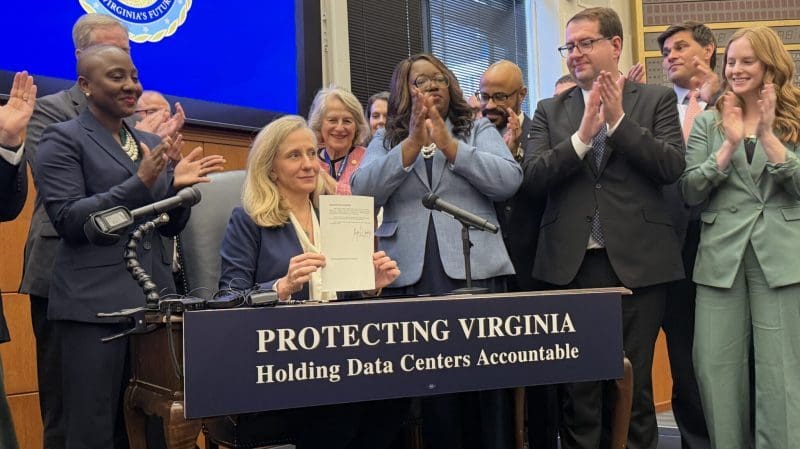
Gov. Abigail Spanberger signed Executive Order 22 on Friday, Sept. 18 to kick off her data center regulation package. (Photo by Shannon Heckt/Virginia Mercury)
The plan does not include a moratorium on data center development while the details of the plan are refined, a step several environmental and advocacy groups and citizens have demanded in recent weeks.
Dubbed the “Data Center Accountability Framework,” Spanberger’s plan outlines five pillars as key priorities: transparency, environmental protections, lowering energy costs, promoting clean energy, and focusing on local workers.
“The Framework is a thorough plan to end data center secrecy, protect our environment, lower energy costs for families, bolster our clean energy economy, and make sure Virginia workers have the protections and assurances they deserve,” Spanberger said in a press conference to announce the plan at the Virginia State Capitol.
Spanberger also signed Executive Order 22, which will kick-start her plans for clamping down on the industry ahead of the next legislative session that will begin in January 2027.
Transparency
Perhaps the most concrete of the directives is a measure to ban nondisclosure agreements between data centers and executive branch agencies, departments, state boards and commissions. It also bars these agencies from requiring such agreements for data center projects.
The order does not impact the use of nondisclosure agreements by localities, but the governor said she plans to work with the General Assembly to pass a law banning the agreements at the local level.
In the framework package, the governor also proposes eliminating by-right local approvals of data centers that use more than 25 megawatts of power.
Many counties statewide have taken steps towards requiring conditional use permits,which require public hearings and a vote of approval from local leaders.

Additionally, the governor wants to remove data centers from Virginia’s fast-track permitting process that allows permit approvals for the projects to speed up when they are proposed in “business ready” locations.
The fast-track process is a remnant of Gov. GlennYoungkin’s administration, which encouraged and supported the rapid build-out of the state’s data center industry as a means to boost Virginia’s business reputation.
Environmental protections
The framework directs lawmakers to develop policies to create standards for energy efficiency, water use, and land impacts.
Budget language that passed the General Assembly in June directed the Department of Environmental Quality to identify “water scarcity areas,” where data centers’ water use for cooling could put drinking water availability at risk. Data centers located in those areas, mainly east of Interstate-95, will have to reduce their water use.
The framework also outlines a plan to expedite noise regulations that were also in the budget language, but does not state when those regulations will be put into place. Currently, DEQ has until 2029 to research the lowest possible sound levels data centers could operate on and make that the standard across the board.
Lower energy costs
Spanberger’s new data center plan requires utilities to allocate more of the energy infrastructure costs largely spurred by data centers onto the industry.
Dominion Energy has already taken action on this front, after the utility created a new rate class, GS5, which mostly includes data centers and large manufacturers. The State Corporation Commission approved the new rate class last November.
Like the recommendations in the framework from the governor, the G5 rate class includes 14-year contracts, as well as specific cost allocations for energy generation, distribution, and transmission costs.
The SCC also recently directed Dominion to create a new tariff to directly assign the cost of high-voltage transmission lines that are only necessary due to data centers to those customers. Spanberger supported the tariff, which is reflected in her framework.
Tech giant Microsoft has already put the State Supreme Court on notice that it could appeal that order.

Microsoft representatives said in an email last week that the company hopes “any rates ultimately put in place are transparent, fair, and reflect the costs each customer creates.”
But filing notice of appeal, they continued, “Microsoft preserves its ability to challenge any implementation that does not meet these expectations.”
Elevating clean energy, hiring Virginia workers
Another component of Spanberger’s plan looks to limit the amount of power data centers can produce on-site through natural gas generators and other “behind the meter” methods that don’t draw from the electric grid.
The plan also proposes making it easier for data centers to bring clean energy options on-site by reforming utility charges for clean energy investments.
PJM, the regional grid operator for 13 states including Virginia, recently proposed a new rule to direct data centers to pay for their power generation or cover their energy needs by backstop power purchases. This would help bring more power on the grid when it’s strained on very hot and cold days.
Several recent proposals by data centers in the Commonwealth show the industry’s growing interest in building its own gas turbines to power data facilities. That method skirts around the Virginia Clean Economy Act, which requires the retirement of carbon-emitting power sources by utility companies by 2050.
The framework prioritizes hiring local workers to build data centers and using local businesses for procurement and contractors.
Lawmakers, environmental groups, data centers react
A slate of state legislators spoke up in support of Spanberger’s framework Friday afternoon, sentiments shared by some environmental groups.
“Governor Spanberger’s Data Center Accountability Framework is a step in the right direction,” a statement by the Virginia House Democratic Caucus read. “We look forward to continuing to work with Governor Spanberger in the upcoming 2027 legislative session to develop thoughtful legislation that holds data centers accountable.”
Many of these policies require legislative action from the General Assembly to take effect. Also, many of the proposals are prospective, meaning they will apply to new data center applications rather than the more than 600 data centers that are already operating or being built statewide.

“For those that are up and running and already operating, we have the ability and intention to continue to make sure that into the future we are holding them to greater and greater standards,” Spanberger said.
Representatives from the Chesapeake Bay Foundation, Sierra Club, and League of Conservation Voters joined Spanberger for the announcement and called it a strong first step towards enacting legislation to cement the framework’s goals.
Other organizations were critical of the framework because it didn’t include an outright pause on data center development.
“It does not address the continued connection of data centers to the grid, despite inadequate power and the many impacts on air quality, water supply, electric bills, and people and communities,” the Piedmont Environmental Council said in a statement. “Not to mention the hundreds of miles of proposed transmission lines, solely to support data centers.”
“We must stop the madness and issue an immediate pause on approvals until these protections – and more – are fully implemented,” Chesapeake Climate Action Network Director Victoria Higgins said in response to the framework.
The Data Center Coalition, the leading national group that lobbies for the industry, said they are waiting for more details on the plan.
“(We) are ready to engage with policymakers to ensure workable, balanced policies that keep Virginia competitive and honor prior commitments by the Commonwealth and its localities,” coalition representative Nicole Riley said.
Spanberger didn’t answer directly when asked why she did not impose a data center development moratorium while her package is considered before lawmakers. She reiterated that some Virginia localities are considering pausing data center development.
“While (localities are) looking at what’s available to them as a potential option, it is up to our communities… But the state has to show leadership,” Spanberger said. “We are in a place where day by day, community members are demanding action.”
The framework, she added, “is an opportunity for us to take action and ensure that we are moving forward.”

By Shannon Heckt, Virginia Mercury
Virginia Mercury is part of States Newsroom, a nonprofit news network supported by grants and a coalition of donors as a 501(c)(3) public charity. Virginia Mercury maintains editorial independence. Contact Editor Samantha Willis with questions: info@virginiamercury.com.




Jest A Moment: What if America Had Taken the Turkey Under Its Wing for a National Symbol?

Overtime Tax Break Gets Easier to Claim in 2026, but Not All Extra Pay Qualifies

The Surprising History Behind Two Thanksgiving Dishes We Think Have Always Been There

Small Hands, Big Hearts: Young Bell Ringers Bring Christmas Cheer to Front Royal

Israel: The Fourth Aliyah

Taxing Talent and Farmland is Bad Policy for Virginia

Wings of Excellence Academy Turns Holiday Food Drive into Year-Round Mission

Maria Lane Himes Miller (1942 – 2026)

JFK & The Woman Who Knew Too Much

Can a Dog Really Have Its Own Smartphone? Meet the PetPhone

How Thanksgiving Leftovers Helped Pave the Way for LASIK Eye Surgery

Joyce Bailey Evans (1940 – 2026)

Cannabis Ordinance Goes Forward with Recommendation of Approval from Town Planning Commission

VDOT: Warren County Traffic Alert for Nov. 23 – Dec. 4, 2026

Avtex Trail Advisory Subcommittee Emerges at FR-WC EDA Meeting

Spanberger Expands Housing Plan Into Three-Year Strategy, Calls for Scrutiny of Corporate Landlords

Front Royal Seeks Applicants for Economic Development Authority Board Vacancy

Notes from the Front Row: Inside the First Night of Front Royal’s Citizens Academy

Virginia Consumers to Receive $4.2 Million in Relief as Attorney General Targets Robocalls and Fraud

Virginia State Police Report Nearly $454,000 in Drug Seizures During Weeklong Operations

Business Growth Series: Burned-Out Businesses Don’t Grow

Virginia Awards $722,000 to Help Farmers Fight Crop Diseases, Improve Food Safety, and Increase Production

Virginia Home Sales Drop Nearly 14% as More Houses Sit on the Market

From a Front Yard in Maryland to a Bus in Front Royal, Communities Come Together to Fight Hunger
