
Local News
From Steel to Sharp: Front Royal Craftsman Turns Handmade Knives Into Works of Art
In his Warren County workshop, Daniel Green takes ordinary pieces of steel and turns them into handmade hunting, fishing, and outdoor knives. The craft requires patience, a steady hand, and an understanding of how metal responds to heat. But for Green, it’s also a family tradition that began when he was a young boy.
Green, owner of DAG Knives in Front Royal, recently invited the Royal Examiner into his workshop to show how he makes his knives, from shaping steel to adding the finishing touches to a polished blade.
Watching him work, it quickly becomes clear that making a knife involves much more than cutting a piece of metal and sharpening the edge. The process combines metalworking, woodworking, and a fair amount of trial and error, something Green has learned to accept along the way.
A Family Tradition That Started With Grandpa
Green’s interest in knife-making goes back to his childhood and a grandfather who found a practical use for old saw blades.
“My grandfather made knives out of saw blades,” Green recalled. “My first hunting knife, my grandfather had given to me, and I was probably 11 years old. And I still have it to this day.”
Those early knives were made from tough steel that could hold a sharp edge, and the idea stayed with Green. Although he still occasionally makes knives from saw blades, today he generally works with high-carbon steel designed for knife-making.
One of his preferred materials is 1084 steel, which contains enough carbon to respond well to the hardening process. The type of steel matters because a good knife must be hard enough to hold an edge but tough enough to withstand regular use without breaking.
Green begins by tracing the knife’s outline onto a flat piece of steel. Using a grinder with a cutoff wheel, he cuts out the rough shape, then drills holes for the pins that will eventually hold the handle in place. Additional holes let epoxy secure the handle material to the blade.
He then grinds the bevels that form the cutting edge. At this stage, the knife has begun to take shape, but the metal is still relatively soft and must be hardened before it can become a working blade.

That’s where the heat comes in.
Green uses a propane-fired forge to heat the steel. As the blade heats, the metal changes color, eventually becoming hot enough that a magnet will no longer stick to it. Green uses that change to determine when the steel is ready for the next step.
The hot blade is removed from the forge and placed into oil, a process known as quenching, which hardens the metal. Green warms the oil beforehand and sometimes clamps the blade in a vise as it cools to help keep it straight.
The process requires care, and even an experienced craftsman doesn’t always get the results he wants.
During the visit, Green showed several pieces of broken steel, including a knife that had cracked during heat treatment. He had already spent hours cutting, shaping, and grinding the blade before discovering the damage.
“They do fail,” he explained.
Sometimes a crack isn’t visible until the metal has cooled and the surface has been cleaned. By then, much of the work is finished, and there is little to do but start over.
For Green, it’s simply part of the craft.
Once a blade survives the hardening process, it goes into an oven for tempering. This reduces some of the hardness, making the steel tougher and less likely to break. Afterward, the blade must be cleaned, sanded, and polished again before the handle can be attached.
More Than Just a Sharp Blade

While the blade is the most important working part of a knife, Green puts just as much attention into the handle.
He uses a variety of materials, including black walnut, oak, maple, and decorative wood-and-epoxy combinations. Some of the wood comes from trees on his own property, giving certain knives a personal connection to the land around his workshop.
During the interview, he showed pieces of maple saved from a broken tree limb and other wood with unusual knots and grain patterns. Rather than seeing those natural features as imperfections, Green appreciates the character they can bring to a finished knife.
Each handle must be carefully shaped, fitted to the steel, and secured with pins and epoxy. Green then sands the wood until it feels comfortable in the hand, sometimes adding contours that help keep a user’s fingers from sliding forward when the knife is wet.
The finishing details can vary considerably. Some knives have decorative pins or contrasting liners between the wood and steel. Others feature patterns ground into the blade spine.
Once everything is fitted, Green works through several polishing compounds, moving from coarse to fine until the blade takes on a mirror-like finish. He also makes leather sheaths, adding another skill to a process that already involves several different trades.
“You do a little bit of everything,” Green said.
Although the finished knives can be attractive enough to display, Green is more interested in making something that works.
He explained that one challenge in knife-making is finding the right balance between hardness and toughness. Extremely hard steel may hold an edge for a long time, but it can also be difficult to sharpen and, depending on how it is made, more likely to chip or break.
Green checks his blades with specially designed testing files that help him estimate hardness on the Rockwell scale. His knives generally fall between 50 and 55, with about 52 being what he considers a good balance for outdoor use.

That allows a knife to hold a useful edge while remaining relatively easy to sharpen when the time comes.
His experience with saw blades also continues to influence his work. Green recently made a custom fillet knife for a friend who planned to give it to his son-in-law. It was the first time he had made that style, and he returned to using saw-blade steel because its thinner profile provided the flexibility a fishing knife needs.
Since the saw blade was already hardened, he could also skip part of his usual heat-treating process.
No Two Knives Are Exactly Alike
Unlike knives coming off a factory assembly line, Green’s creations are made individually, usually one at a time. Some take longer than others, depending on the steel thickness, blade shape, and handle type.
There’s cutting and grinding, heating and cooling, followed by more grinding and sanding. The handle must be fitted, shaped, and finished, and the blade polished until Green is satisfied with the result.
And even then, no two knives turn out exactly the same.
“Every one of them is a little different,” he said. “Because it’s not made by a machine, it’s made by hand.”
Those small variations are part of what makes his work unique. A piece of walnut might have an unusual grain pattern, or a maple handle might reveal a knot that gives the knife its own character.
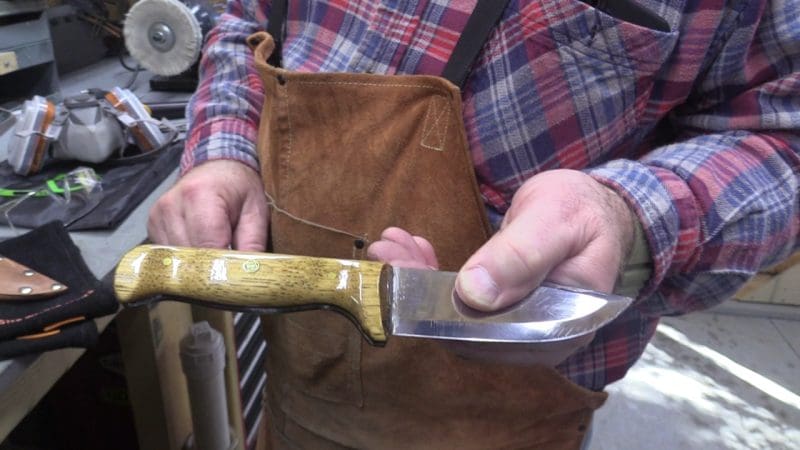
Green describes DAG Knives as both a hobby and a small business. He has made knives for customers and friends and is open to discussing custom orders for people looking for something special.

What began with a grandfather making hunting knives from old saw blades has grown into a craft that combines several skills with the satisfaction of making something useful by hand.
And while Green now has his own workshop, tools, and techniques, he still feels connected to the grandfather who started it all.
The first hunting knife he received as a boy remains in his possession today, a reminder of where his interest began.
Now, with every piece of steel he shapes and every handle he finishes, Green is carrying that family tradition forward, one knife at a time.
About DAG Knives
DAG Knives is located at 2112 Mountain Road in Front Royal, Virginia. For more information about Green’s handcrafted outdoor knives or custom orders, visit dagknives.com or call 540-631-4017.
Town Talk, sponsored by National Media Services, Inc., is a Royal Examiner series that introduces you to local entrepreneurs, business owners, nonprofit leaders, and public officials who help shape Warren County. Conversations cover a wide range of topics about our community and the people making a difference.




Town Council Arrives at Consensus on Joint Tourism Agreement with the County

From Steel to Sharp: Front Royal Craftsman Turns Handmade Knives Into Works of Art

Jest a Moment: Great Unheralded Moments in Food History

Virginia Elected a Woman Governor. The State Constitution Still Says ‘He’

JLARC: Data Center Tax Break Accounts for 60% of Virginia’s Incentive Spending

Commentary: The Blue Tsunami Has a Message for Virginia Democrats on Data Centers and Campaign Finance

Trump Open to Immigration Deal, Calls Crackdown ‘Too Tough,’ Despite Miller Promotion

That Flashing Orange Hand Doesn’t Mean Run: What Pedestrian Signals Really Mean

The Secret to Perfect Snickerdoodles?

Nationwide Emergency Alert Test Set for November 17: What to Expect on Your TV and Radio

Kathy McDonald Butler (1973 – 2026)

UVA Researchers Develop Powerful AI Tool to Help Unlock Causes of Disease and Speed New Treatments

Samuels Public Library Holiday Open House Brings Santa, Mini Alpaca, and New Youth Gift Market December 12

Would You Drive With Your Eyes Closed? Virginia DMV Launches Powerful New Distracted Driving Campaign

Mead Mile Takes a Turn Towards Youth-Oriented Community Nonprofit ‘Reaching Out Now’ for 2026 Event Fundraising

Virginia Could Lose Representation, Funding Under Proposed Census Rule Change, AG Jones, Housing Orgs Say

Virginia Localities Rethink Use of License Plate Readers Amid Privacy Concerns, Report States

Commentary: After the Blue Tsunami, Democrats in Virginia, Nationwide Should Avoid Misinterpreting Their Mandate

Cars Changing Lives Car Show Breaks Attendance Record as Organization Nears 100th Vehicle Giveaway

GOP Congress Faces Funding Deadline, Farm Bill, Lengthy To-Do List in Year-End Session

The Childhood Illness That Looks Like Slapped Cheeks: What Parents Should Know About Fifth Disease

Unmarked Police Car Pulling You Over? Here’s What Drivers Should Know

Their Military Service Ended, But Their Commitment to Serving Others Never Did

Route 66 Turns 100: The Highway That Became America’s Mother Road
