
Local Government
Notes from the Front Row: Inside the First Night of Front Royal’s Citizens Academy
I’ve always been a bit of a Curious George. I’m one of those people who wants to know how things work, how they’re made, and what goes on behind the scenes.
As a child, I was fascinated by the “How It’s Made” segments on Mister Rogers’ Neighborhood and Reading Rainbow. As an adult, my bucket list includes touring a clothing factory. Not exactly everyone’s idea of an exciting vacation, I know.
So when an invitation arrived for Front Royal’s 2026–2027 Citizens Academy, complete with the promise of a tour of the wastewater treatment plant, I was immediately interested.
Yes, the wastewater treatment plant. I really am looking forward to that.
On Wednesday evening, November 18, I joined approximately 14 other curious residents at Town Hall for the first session of the academy, a free program designed to give participants a behind-the-scenes look at how our local government operates.
Between now and June 2027, we’ll visit town departments, meet the people who keep things running, ask questions, and learn about everything from police operations and electricity to public works and water treatment.
But first, we had to learn how the town itself works.
And, as it turns out, there’s quite a lot to learn.
Two Hours of Government, Budgets, and Surprisingly Interesting Details
Our first evening was hosted by Town Manager Joe Petty, Mayor Lori Athey Cockrell, and Assistant Town Manager and Finance Director BJ Wilson.

They spent approximately two hours explaining the structure of town government, the responsibilities of elected officials, and how Front Royal manages its $58.5 million annual budget.
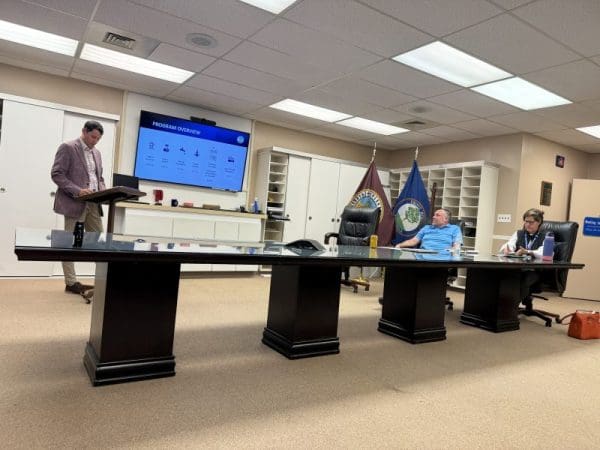
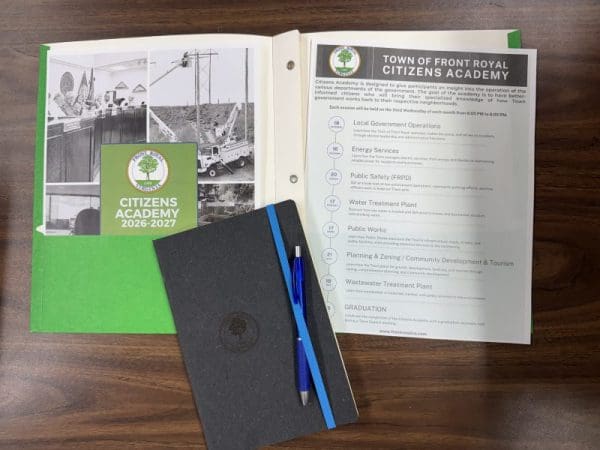
Front Royal Town Manager Joe Petty, Mayor Lori Athey Cockrell, and Assistant Town Manager and Finance Director BJ Wilson presented during the opening evening of the 2026 Front Royal Citizen’s Academy. Below is a copy of the handout material provided to each participant.
Now, I realize that two hours of municipal government and accounting might not sound like a thrilling night out.
But the presentations were well organized, the atmosphere was welcoming, and there were plenty of opportunities to ask questions. More importantly, I came away understanding quite a few things that had never really crossed my mind before.
For example, did you know that Front Royal has earned the Government Finance Officers Association’s award for excellence in financial reporting for 39 consecutive years?
Or that the town undergoes at least two financial audits each year, sometimes three?
And that Front Royal officials say our utility rates remain among the lowest in Virginia, thanks in part to long-term electricity purchasing strategies, careful financial planning, and grants that have helped pay for major infrastructure projects?
Those are not necessarily things that make headlines every day, but they’re worth knowing.
Who Actually Runs the Town?
Mayor Cockrell started by explaining how our local government is organized.

Front Royal has six Town Council members who serve staggered four-year terms, while the mayor serves a two-year term. The mayor presides over meetings and helps set the agenda but generally votes only to break a tie.
I also learned that Town Council directly appoints just three positions: the town manager, town attorney, and clerk of council.
The town manager oversees the day-to-day operations of approximately 175 full-time employees across the various departments.
Cockrell also explained the difference between Town Council work sessions and regular meetings. Work sessions are where council members receive presentations, ask questions, and discuss proposals. Regular meetings are where formal votes take place, and citizens have an opportunity to speak during public comment.
One detail I found particularly interesting was how difficult it can be to change the Town Charter.
Because the charter is established through state legislation, the town cannot simply vote to change it. Proposed amendments must go through the Virginia General Assembly.
So much for the idea that local government can just make up its own rules.
Where Does $58.5 Million Go?
BJ Wilson took us through the town’s budget, and this was where the evening became especially interesting to me.
The town’s fiscal year runs from July 1 through June 30, and the current budget is approximately $58.5 million.

The two largest expenses are employee compensation, at roughly $18.4 million, and electricity purchases, at approximately $17.6 million.
Together, those account for more than 60% of the town’s budget.
Wilson also explained something I hadn’t fully appreciated: the town’s various funds cannot simply be mixed together.
Electric, water, sewer, and solid waste services operate through separate enterprise funds. Money collected through electric bills cannot simply be redirected to pave a street or repair a sewer line.
The town has a structure for how money is collected, accounted for, and spent, with financial rules and audits intended to ensure everything stays where it belongs.
Another interesting point was how the town purchases electricity. Front Royal works through American Municipal Power and makes long-term purchasing decisions based on projected demand.
That means predicting how much electricity residents and businesses will need years into the future, while accounting for growth, changing weather, and economic conditions.
Buy too little, and the town may have to purchase expensive electricity on the open market. Buy too much, and it may be left paying for power it doesn’t need.
Suddenly, managing an electric utility sounded a lot more complicated than just sending out bills.
The Mystery of the High Water Bill

Speaking of bills, Wilson explained how the town reads approximately 13,200 utility meters each month.
About 95% of Front Royal’s water meters can be read electronically, and many provide detailed information about when water is being used.
That technology is especially helpful when a resident calls wondering why their water bill has suddenly increased.
Town employees can review usage patterns and, in some cases, look at readings in 15-minute increments to help identify a possible leak.
And what is one of the most common causes of an unexpectedly high water bill?
A faulty toilet flapper.
Not a dramatic underground water main break. Not some mysterious plumbing disaster. Just a little rubber part inside a toilet quietly allowing water to run.
It’s the sort of practical information I love learning because it might actually save somebody money.
Wilson also discussed how the Finance Department works with residents who are having difficulty paying utility bills. He encouraged customers to contact the town before services are disconnected, explaining that payment arrangements and certain extensions may be available.
That was another reminder that behind the utility bills are people who can answer questions and help solve problems.

More Online Services Are on the Way
One subject that generated considerable interest was the town’s use of technology.
I was particularly interested in how much of the town’s work is being digitized and automated. Having moved to Front Royal earlier this year, I was surprised by how many utility-related transactions still require a phone call or a visit to Town Hall.
Wilson shared some encouraging news.
The Finance Department has been working on a major software upgrade that should eventually make it easier for residents to manage their utility accounts online.
Planned features include optional text-message reminders about upcoming bills and alerts when utility usage increases unexpectedly.
The town hopes to begin rolling out additional features in early 2027, with more capabilities becoming available over time. Eventually, Wilson would like residents to be able to request new utility connections or disconnections online as well.
We also talked about artificial intelligence.
Wilson explained that the town’s auditors have begun using AI-assisted tools to help review financial information and identify potential discrepancies.
Naturally, that raised questions about privacy.
He explained that the information being provided for this process consists of public financial records, not residents’ confidential account information. Sensitive documents are handled separately.
I appreciated hearing that distinction discussed openly. Technology can make government more efficient, but it’s important to ask how information is being protected along the way.
Sidewalks, Streets, and the Value of Speaking Up
Some of the most encouraging discussions involved projects that residents will eventually be able to see and use.
Town officials talked about efforts to improve pedestrian safety, including plans for a continuous sidewalk along Criser Road and changes to South Street near the shopping center with Rural King and Martin’s.
The South Street project was particularly interesting because Petty and Cockrell explained how public comments influenced the design.
Residents had concerns about proposed changes to traffic movements and business entrances. They heard those concerns and adjusted the plans.
That’s an important lesson.
Sometimes it can feel as though government projects are decided long before the public gets involved. But this reminded us that asking questions and providing feedback can make a difference.
We also heard about the Prospect Street Bridge replacement, waterline improvements, wastewater equipment, and the ongoing search for additional drinking water sources.
Some of these projects involve years of planning, engineering studies, funding applications, and coordination with state agencies before construction can even begin.
It’s not always the exciting part of a project, but it’s what makes everything else possible.
Government Needs More Than Employees and Elected Officials
Another takeaway from the evening was how many opportunities residents have to participate in local government.
Petty explained the roles of the Planning Commission, Board of Architectural Review, Economic Development Authority, Advisory Committee for Environmental Sustainability, and other boards.
More than 50 residents serve on the town’s various boards and commissions, but vacancies can still be difficult to fill.
Some positions require particular qualifications or town residency, while others allow broader participation.
What matters is that these boards need people willing to learn, ask questions, and contribute their time.
And if you’re wondering whether you know enough about zoning or local government to serve, Petty explained that training is available for certain positions.
You don’t necessarily have to arrive knowing everything.
Which, frankly, is reassuring.
Why I’m Looking Forward to the Next Seven Months
Before attending the Citizens Academy, I already understood that local government provides essential services.
We all know somebody has to keep the lights on, the water flowing, the streets maintained, and the police department operating.
But knowing those things happen is different from understanding how they happen.
Every utility rate, infrastructure project, budget decision, and public service involves people making decisions, managing costs, following regulations, and trying to anticipate what the community will need next.
The academy offers an opportunity to see some of that work firsthand.
I also think there’s something valuable about being in a room with other residents who are simply curious about their town. Nobody has to agree on every issue to recognize that understanding how government works makes us better-informed citizens.
And in a community like Front Royal, where small businesses, local relationships, and civic involvement play such important roles, that’s knowledge worth sharing.
Next month, we’ll learn about Energy Services and how the town provides electricity to its customers. Later sessions will take us through public safety, public works, planning and zoning, and eventually the water and wastewater treatment facilities.
Yes, I’m still looking forward to the wastewater treatment plant.
For now, I’m grateful for the opportunity to spend one evening a month learning about the place I call home.
Because sometimes the most interesting things happening in a community aren’t the things we see every day.
They’re the things happening quietly behind the scenes that make everyday life possible.




Notes from the Front Row: Inside the First Night of Front Royal’s Citizens Academy

Virginia Consumers to Receive $4.2 Million in Relief as Attorney General Targets Robocalls and Fraud

Virginia State Police Report Nearly $454,000 in Drug Seizures During Weeklong Operations

Business Growth Series: Burned-Out Businesses Don’t Grow

Virginia Awards $722,000 to Help Farmers Fight Crop Diseases, Improve Food Safety, and Increase Production

Virginia Home Sales Drop Nearly 14% as More Houses Sit on the Market

From a Front Yard in Maryland to a Bus in Front Royal, Communities Come Together to Fight Hunger

Commentary: Will Virginia Join Other States in Banning a Pesticide Linked to Parkinson’s disease?

Loudoun County Pauses New Data Center Applications for a Year

George Hamilton Lewis, Jr. (1928 – 2026)

Michael Warren Hughes (1951 – 2026)

A Thanksgiving Tradition Worth Starting: Make a Gratitude Tree With Your Family

Thanksgiving Without the Oven: Five Easy Side Dishes That Make Holiday Cooking Simpler

Cline Highlights New Bankruptcy Law for Small Businesses, House Action on Veterans Benefits

Warren County Man Sentenced to 110 Years in Child Sexual Abuse Material Case

Community Breakfast at Riverton Church Serves More Than Just Pancakes on November 21

Loving Souls Christian Church to Host Soup Outreach in Front Royal

Virginia’s Highland County Christmas Tree Headed to White House for National Holiday Celebration

Three UVA Health Hospitals Earn Top Grades for Patient Safety, Two Maintain Eight-Year Streak

Lawsuit Challenges SNAP Restrictions on Sugary Drinks, Food in 18 States

FEMA Chief, US House Members Push for Emergency Management Changes

Shenandoah River State Park Could Gain 640 Acres Under Virginia Conservation Grants

Sold as a Natural Supplement, Kratom Is an Opioid, UVA Poison Expert Warns

Spanberger Unveils Virginia Housing Plan Aimed at Lowering Costs and Expanding Affordable Homes
