
EDA in Focus
So we didn’t vet it very well – we’ll fix it later
Council majority approves EDA’s ‘workforce housing’ project
Despite hearing from several neighborhood residents, as well as a former Mayor and one of their own over concerns about an EDA-driven workforce housing project, the Front Royal Town Council gave final approval to a Special Exception Request enabling the project on November 14.
Only Bébhinn Egger opposed approval, even though several of her colleagues agreed additional road improvements needed to be done in coordination with the 36-unit residential project. However, unlike Egger, they felt later, rather than sooner was okay.
Egger countered that Council was putting the cart before the horse in approving construction of three, 12-unit apartment buildings where 99 residences and two commercial buildings already exist, BEFORE mandating improvements and a second outlet to the dead-end Royal Lane entrance to those apartments, and that existing development.
John Connolly, Jacob Meza and Bret Hrbek all expressed some concern over the additional traffic being funneled into a dead-end street from John Marshall Highway. VDOT statistics indicated John Marshall with a 12,000-vehicle daily traffic count two years ago; and 1,502 vehicles traveling up Royal Lane into both residential and commercial destinations. However, an overriding desire to add rental housing units designed to fit the needs of “young professionals,” drove the 5-1 vote of approval.

But former Mayor and Councilman Stan Brooks, himself a real estate re-developer professionally, questioned the need for such new rental units in a Town he said has a higher-than-average for the area, 60%-40% rental-to-ownership housing split.
Neighborhood resident Charles Jackson also wondered at the need for the described housing project – “My concern is for the safety of those who are there now (9 single family homes and 90 apartments). Is there a demand for this type of housing or is it just to line someone’s pockets,” Jackson asked.
Our young professionals?
Both Brooks and Egger also noted there was no assurance that the “workforce housing” would be housing this community’s workforce.
“It could be a magnate for those outside the community who are looking for lower-income housing,” Brooks reasoned. “That is an attraction now – lower rentals than to the east.”

Egger agreed.
“There is nothing that stipulates they will be rented to ‘our professionals’,” Egger observed. She agreed with Brooks that the slightly upscale but affordable apartments described by EDA Executive Director Jennifer McDonald in bringing the EDA proposal forward, would likely draw the interest of young professionals seeking the higher-pay scales found to the east, without having to pay the corresponding higher rents found in Northern Virginia.
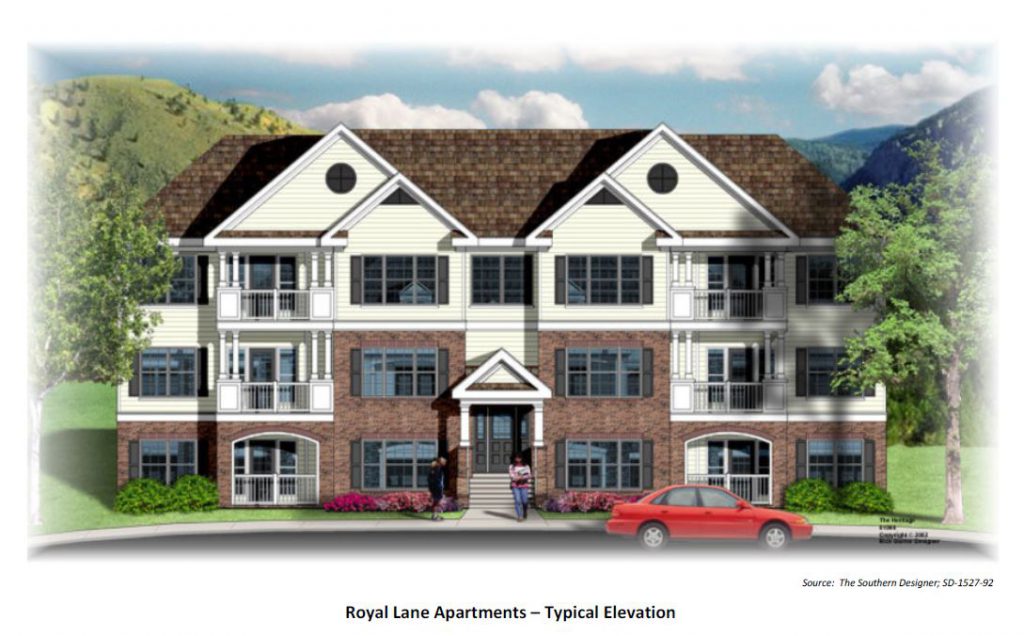
Architect’s drawing of a Royal Lane Apartments ‘workforce housing’ building. Three of 12-unit buildings will be constructed on an 800-foot extension of dead-end Royal Lane, on Front Royal’s south side.
EDA as landlord
Brooks also questioned a quasi-governmental agency like the EDA acting as a landlord for apartments. He wondered if the private sector shouldn’t be approached by government for desired capital improvements of this nature.

“I’ve never seen an EDA get into building apartments,” Brooks told Council, adding, “I’m not saying it’s never done; I’m just not aware of it. They will have to focus a certain amount of time and energy to construct and manage apartments. I think their focus should be on economic development, not on other things.”
Some concern was expressed over the EDA’s Royal Lane Apartments being “low-income” housing, an area – public housing – that governments have been known to delve into, particularly in larger cities. However, after area residents broached that concern during their request that Council reject, or at least delay the project, Councilman Gene Tewalt pointed out that during the Public Hearing prior to the first vote three weeks earlier, the EDA had assured Council the Royal Lane Apartments would NOT be “low-income” housing.
Later, man …
Chief among neighborhood concerns was the additional traffic 36 apartments would add to their dead-end street. All four neighborhood speakers asserted it is already an adventure, often a dangerous one, trying to exit or enter Royal Lane from John Marshall Highway. Royal Lane is just east of Front Royal’s major south-side commercial intersection at Commerce Avenue and South Street.
Meza asked Town Manager Steve Burke about VDOT requirements on traffic flow into dead end streets. Burke replied that he did NOT believe that an engineering study of the intersection with the projected additional traffic from 36 apartments indicated the need to install a traffic light at Royal Lane. That reply brought what this reporter interpreted as cynical laughter from the group of area residents who had addressed Council earlier during the Public Concerns portion of the meeting.

Following the meeting, those residents – Charles and Sharon Jackson, Clarence Tanks and Theresa Norman verified the nature of that laughter – “That was me,” Tanks said. “It won’t get done now that they’ve approved the apartments,” Tanks said of road improvements. Near, if not at, the top of that list of improvements is extension of Royal Lane into a through street also intersecting with Remount Road.
During his earlier comments, Tanks suggested that if Council had any questions about the traffic situation at Royal Lane, individual members come out one morning and sit at the John Marshall intersection from 7 AM to 9 AM. Theresa Norman agreed, calling the existing traffic at the intersection “dangerous”.
“Sure, they gave us lip service, but they went ahead and voted for it anyway,” Sharon Jackson observed. “What does that say about who we are electing to run our town? People have to look at who they voted for.”




Screen Rules That Actually Work

Blue Ridge Wildlife Center Patient of the Week: American Barn Owl

After Taking Off in Charlottesville, Feds Plan National Electric Aircraft Charging Network Rollout

POLICE: 7 Day FRPD Arrest Report 7/20/2026

FDA: Taylor Farms iceberg lettuce sample produced a false positive for cyclospora

Data Centers Want to Build Their Own Gas Turbines. Would That Skirt State Renewable Energy Laws?

Legal Notice: Virginia Alcoholic Beverage Control (ABC) Authority

Removing a Senator

The Dillon Rule Doesn’t Say What Mr. Cuddeback Implies

Test Your Balance Before the Job Tests It for You
Legal Notice: Virginia Alcoholic Beverage Control (ABC) Authority

Late On Rent? New Virginia Law Gives Tenants More Time and Protection From Eviction

Virginia Schools Gain Spending Flexibility Under Federal Program

Three Useful Car Gadgets for a Better Summer Road Trip

When He Retires, Who Runs the Kitchen?

State of the Assistants: The Second Great Voice-Assistant War

Front Royal Family Practice Files $5-Million Civil Claim Against Valley Health and Warren Memorial Hospital

Virginia Violent Crime Fell Nearly 6% in 2025, State Police Report Shows

Virginia State Police Seize More Than $3.3 Million in Drugs During Weekly Operations

30-Acre ITFederal Property at Avtex Scheduled for Auction to Help Resolve EDA ‘Financial Scandal’ Debt to First Bank & Trust

Grand Jury Returns Dozens of Indictments in Warren County

VDOT: Warren County Traffic Alert for July 20 – 24, 2026

Fauquier Health CEO Earns National Recognition for Second Straight Year

Trail Option Draws Strongest Support in VDOT Shenandoah Rail Corridor Survey