
National News
Lawmakers Across the U.S. Seek to Curb Utility Spending on Politics, Ads and More Extras
After a string of scandals and amid rising bills, lawmakers in statehouses across the country have been pushing legislation to curb utilities spending ratepayer money on lobbying, expert testimony in rate cases, goodwill advertising, charitable giving, trade association membership, and other costs.
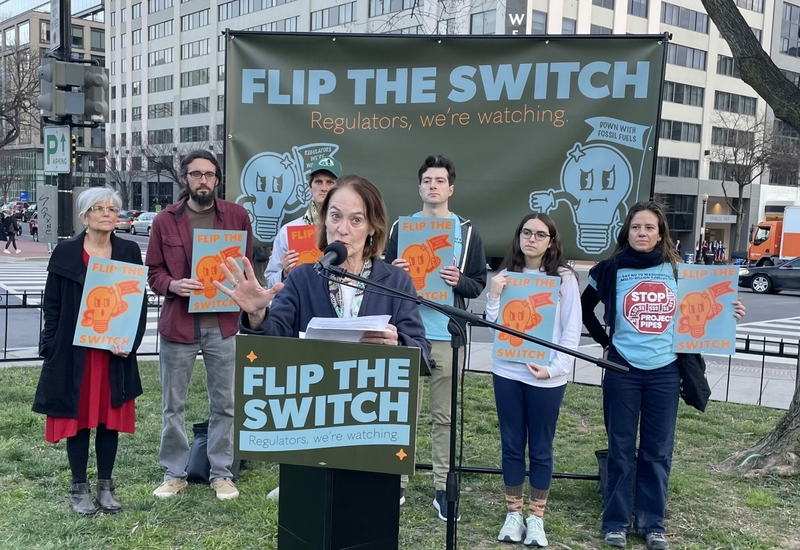
A coalition of climate justice groups organized a rally Monday outside the Washington, D.C., hotel where the National Association of Regulatory Utility Commissioners is holding its winter policy meeting. The speakers, including Christine Pendzich, center, of Montgomery County, Md., took aim in part at energy company and utility sponsorship of the event. (Robert Zullo/States Newsroom)
At least a dozen states have considered bills to limit how gas, water, and electric utilities can spend customers’ money, according to a tracker maintained by the Energy and Policy Institute, a watchdog group funded by environmental and climate-focused foundations that concentrates on utilities and fossil fuel interests.
Louisiana has opened a proceeding at its public service commission to investigate the use of ratepayer cash on trade association dues, “activities meant to influence the outcome of any local, state, or federal legislation,” advertising expenses, and other costs.

Michigan joined the party last week with the introduction of legislation to ban utility political spending. In states like Illinois, the push has been joined by groups like the AARP and the Citizens Utility Board, a state watchdog group, which said the legislation would “stop electric, gas, and water utilities from charging us for a long list of expenses they rack up trying to raise our rates and further increase their political power.”
Three states – Maine, Colorado and Connecticut – have already signed similar bills into law. The legislation comes as natural gas bills have fallen but average residential electric prices in the U.S. climbed from 13.66 cents per kilowatt hour in 2021 to 15.93 cents per kilowatt hour in 2023, per the U.S. Energy Information Administration. That would mean a monthly bill going from $136.60 in 2021 to $159.30 in 2023 for a house that uses 1,000 kilowatt hours per month.
“It absolutely is a growing trend,” said Matt Kasper, the Energy and Policy Institute’s deputy director. “There’s a lot of eyes on the industry, how it’s operating.”
The institute published a report last year that scrutinized how electric and gas utilities use ratepayer money to “fund political machines that push legislation, curry favor with regulators and alter the outcomes of elections, sometimes even breaking laws in the process.”

Some of the lowlights include:
A massive bribery scandal in Ohio involving FirstEnergy, a utility holding company that paid nearly $61 million in bribes to the Ohio house speaker’s political organization in exchange for a nuclear plant bailout worth $1 billion to the company. A U.S. attorney called it “one of the largest public corruption conspiracies in Ohio history.”In Illinois, the state’s largest electric utility, Commonwealth Edison, or ComEd, showered the state House speaker’s allies with jobs, contracts, and payments to grease the wheels for the company’s legislation. Three ex-lobbyists and a former CEO of the company were convicted by a federal jury last year for their roles in the scheme. The speaker’s trial is scheduled for later this year.Florida Power & Light, one of the largest utilities in the nation, is facing calls for a federal investigation over accusations of using political consultants to back “ghost candidates” in legislative races to draw votes away from candidates it opposed. It also took over a news website as “part of an elaborate, off-the-books political strategy to advocate for rate hikes, agitate for legislative favors, slam political opponents and eliminate anything … (that) might undermine its near monopoly on selling power in the Sunshine State,” the Miami Herald reported. That’s not to mention accusations of hiring private investigators to follow a newspaper columnist who was critical of the company.
Other examples of questionable spending abound. In 2018, South Carolina lawmakers were flooded with bogus emails encouraging them to support Virginia utility giant Dominion Energy’s takeover of SCANA Corp., a company struggling under the weight of a failed nuclear project. Dominion denied having anything to do with the fake emails, which were sent by the Consumer Energy Alliance, a group that was then supported by Dominion. (The company is no longer listed as a CEA member.)
Consumer Energy Alliance was also involved in a 2016 campaign to support a natural gas pipeline running through Ohio that involved sending 347 letters to the Federal Energy Regulatory Commission using the names of locals — more than a dozen of whom signed affidavits denying they signed the letters — including “an Ohio man who has been dead since 1998,” The Plain Dealer reported.

In Louisiana, Entergy was fined $5 million by the New Orleans City Council after actors hired by a public relations firm working for the utility showed up at public hearings to support a proposed power plant.
Arizona Public Service, which has 1.4 million electric customers in the state, spent $10 million in 2014 that was funneled to dark money groups to help elect its preferred members of the State Corporation Commission, which regulates utilities. That spending wasn’t revealed until 2019, when the company complied with a subpoena to release documents.
“Utilities are often using their ratepayer-funded political machines to slow the nation’s urgently-needed transition away from fossil fuels and toward clean energy,” the Energy & Policy Institute wrote. “Working hand-in-hand with their trade associations, the Edison Electric Institute and American Gas Association, utilities continue to fight tooth-and-nail against policies that enable the adoption of essential technologies like rooftop solar power, energy efficiency and building electrification.”
‘The appetite is there’
However, bills to curb utility influence spending can face an uphill fight, demonstrating the stronghold that the companies can have on state governments.

In Virginia’s Democratic legislature, campaign finance reform bills languish without votes
In Virginia, for example, another round of legislative attempts to prevent candidates from accepting donations from public service companies like Dominion Energy, the state’s largest electric utility and long the biggest corporate donor in Virginia politics, died in House and Senate committees. Both houses are controlled by Democrats.
“Time will tell what will happen,” Del. Josh Cole, a Democrat who was carrying the House version of the legislation,told the Virginia Mercury. “The appetite is definitely there for it.”
A separate proceeding at the Federal Energy Regulatory Commission has been looking into the “rate recovery, reporting and accounting treatment of industry association dues and certain civic, political and related expenses.”
The Edison Electric Institute, which represents investor-owned electric utilities and is one of the trade groups affected by some of the state-level legislation, said electric customers benefit when its member companies “have a seat at the table,” adding that they are among the most regulated businesses in the nation.

“We engage on their behalf through lobbying, advocacy and regulatory proceedings as part of our work to ensure that electricity customers have the affordable, reliable and resilient clean energy they want and need. Engaging in discussions with policymakers and regulators is essential to achieving these outcomes,” EEI spokeswoman Sarah Durdaller said in a statement. “We bring unique expertise and insights on how policy proposals will affect business operations, the cost for capital, and, ultimately, our customers. … There are strict laws in place already to ensure that lobbying activities are always funded by shareholders not customers.”
The American Gas Association, which represents natural gas utilities, did not respond to a request for comment.
On Monday, across the street from the Washington, D.C., hotel where the National Association of Regulatory Utility Commissioners was holding its winter policy meeting, a group of climate justice organizations held a rally to call attention to energy company influence, taking aim at corporate sponsorship of the event and a lack of progress on renewable power.
“When we see events like this where utility execs fund gatherings and hobnob with regulators … we need to speak out,” said Sukrit Mishra, DC program director at Solar United Neighbors, a nonprofit that helps communities form solar co-ops. He voiced support for state legislative efforts as well as federal legislation introduced by U.S. Rep. Kathy Castor, a Florida Democrat, to prevent utility companies from using ratepayer dollars to fund political activities.
“The public is ready to hold utilities accountable. We need regulators to do the same.”
by Robert Zullo, Virginia Mercury
Virginia Mercury is part of States Newsroom, a nonprofit news network supported by grants and a coalition of donors as a 501c(3) public charity. Virginia Mercury maintains editorial independence. Contact Editor Sarah Vogelsong for questions: info@virginiamercury.com. Follow Virginia Mercury on Facebook and Twitter.




Mayor Lori Athey Cockrell Looks to Water, Economic Development and Rail Trail in Another Term

WCHS vs. Brentsville HS – Girls Volleyball – October 6, 2026

BMI Is Only One Piece of the Health Picture

The Eye Surgery Factory That Could Not Expand

Ancient Ownership of Israel

VDOT: Warren County Traffic Alert for October 5 – 9, 2026

Reaching Out Now Expands Programs and Opportunities for Warren County Youth

Dance and Arts VA Finds New Home, New Opportunities on Water Street

Ann L. Shuman (1933 – 2026)

Wendy Lee Whitacre-Stout (1966 – 2026)

Spanberger’s Energy Plan Keys in on Clean Energy to Meet Growing Demand and VCEA Goals

Jean Elizabeth Grubbs Fogle (1939 – 2026)

Feds Provide Guidance on New Federal K-12 Scholarship Tax Credit Program

Why Wait Till November? Mid-Term Election Early Voting Processes in Place Now

US Senate Leaves Nation’s Capital in Advance of Midterms With Much Still Undone

Business Growth Series: If You Don’t Control Your Day, It Controls Your Business

The End of a 20-Year Monopoly on the Credit Score
Voltron and Immigration

States OK Solar Panels for Balconies. Safety Guidelines Haven’t Caught Up

Trump TV Ads Paid for with $20M in Homeland Security Funds, Dems Find

Blue Ridge Wildlife Center Patient of the Week: Gray Treefrog

Birthday Twins: See Which Famous Face Shares Your Big Day

Meet-and-Greet Set Sunday for Republican-Endorsed Front Royal Candidates

Barbara Ann Mathews Smelser (1943 – 2026)
