
State News
Increasing Cannabis Legalization Reveals Danger in Disjointed Safety Regulations Across States
Amid the growing acceptance and legalization of cannabis use across the country, a concerning reality has emerged: The state-by-state patchwork of safety regulations can leave marijuana consumers wandering through a haze of uncertainty, exposing them to potential risks.
Under federal law, marijuana is illegal — period. So, it’s up to individual states to determine their own regulations and safety standards.
Those inconsistent regulations are part of a broad debate about the U.S. cannabis industry. The 47 states that allow at least some cannabis use (cannabis is still illegal in Idaho, Kansas, and Nebraska) have taken various approaches to issues such as the allowable amount of euphoria-inducing tetrahydrocannabinol, or THC, in a product.
“We don’t really know what’s going on behind the doors of each and every lab in each and every state,” said Anna Schwabe, a cannabis geneticist and the director of cannabis education, research and development for 420 Organics, in an interview with Stateline. “I don’t really have any sense of or any level of comfort for the numbers that they’re putting out.”

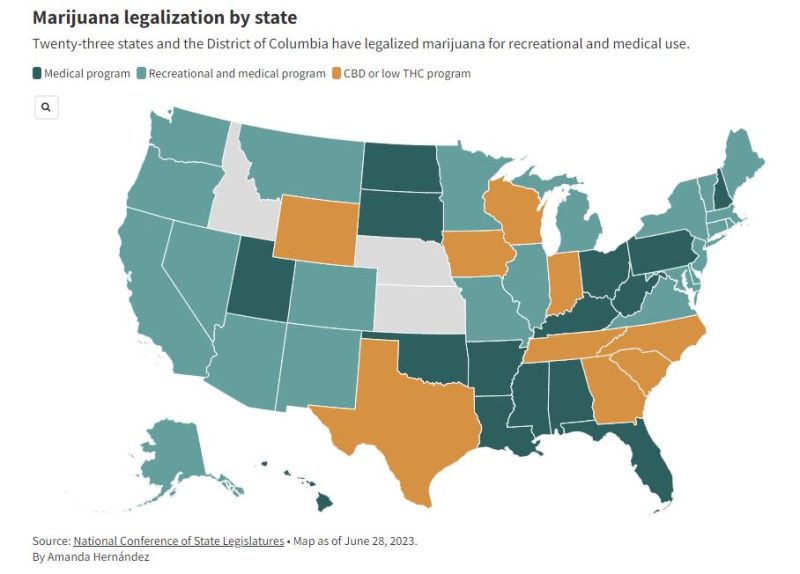
Most states require legal cannabis products to be tested by licensed laboratories for potency and for contaminants such as pesticides and heavy metals.
Still, the lack of uniform testing standards has led to inconsistent lab results. Some labs that test products on behalf of farms have been caught inflating THC levels to cater to the demand for potent products, leading to a practice called “lab shopping” by producers, according to Leafly, an online platform dedicated to all things cannabis.
“Some businesses will decide to contract with those labs because it means that their products will test stronger [in THC] and, in theory, be more attractive to consumers,” said Morgan Fox, the political director for the National Organization for the Reform of Marijuana Laws, known as NORML. “This is pretty unethical and also an unfortunate byproduct of a financially competitive testing market.”
The Virginia picture: Legalization of use, but not of sale
In Virginia, the General Assembly legalized the possession and use of small quantities of cannabis beginning in 2021 but failed to set up a legal retail market. According to The Daily Progress, a member of Gov. Glenn Youngkin’s administration recently said the governor “is not interested in any further moves towards legalization of adult recreational use marijuana.” Read more about the most recent developments in Virginia’s current laws and system here:

Some states have had to issue recalls due to products being cleared for sale despite the presence of harmful contaminants. In May 2022, the Oklahoma Medical Marijuana Authority suspended Scale Laboratories’ testing license after regulators uncovered more than 140 approved samples with mold, salmonella, or E. coli. The authority also recalled 99 products related to the lab’s alleged rules violations.
An estimated 64,000-pound marijuana recall in Michigan in 2021 was linked to at least 18 health complaints, including increased seizure activity, allergic reactions, paranoia, and a chemical burning sensation.
The Oregon Liquor and Cannabis Commission, which regulates the production and sale of marijuana in that state, issued a recall in late June for several batches of cannabis flower that tested positive for mold and heavy metals, including cadmium and mercury. The recalled flower was harvested before testing requirements were updated to include tests for microbiological contaminants and heavy metals.
“Having some standards of operation across the board would dramatically decrease the variation that we see among labs, but then we would have to have some sort of regulatory oversight to make sure everybody is following the rules [on THC levels and testing practices], which we already don’t have,” Schwabe said.

Testing methods
Labs across the country have different methods of testing cannabis for potency and contamination, which may be part of the reason why there’s so much variation, Schwabe said. Some states run the labs and have a more standardized testing approach, while others offer licenses to independent labs.
Inconsistent state cannabis regulations could have potentially dire implications for consumer health, according to a 2022 study published in the Environmental Health Perspectives journal. The study found that state-level regulatory disparities pose an increased risk of contaminant exposure for immunocompromised people who could contract potentially fatal infections while also causing confusion among cannabis growers, manufacturers, and testing laboratories.
The study also found that identical cannabis samples could be considered acceptable in one jurisdiction but not in others.
Having some standards of operation across the board would dramatically decrease the variation that we see among labs, but then we would have to have some sort of regulatory oversight to make sure everybody is following the rules.
– Anna Schwabe, a cannabis geneticist for 420 Organics

Cannabis consumers also face the challenge of navigating inconsistencies in THC potency and marijuana strain names across different dispensaries and states, Schwabe said.
“If you’re thinking that Durban Poison is your go-to strain to alleviate whatever symptoms you are having and it works well for you, if you wanted to refill your medicine in a different state or at a different dispensary, you might end up getting something that’s not what you’re used to,” Schwabe said.
What is permissible in one state may be prohibited or regulated differently in another, said Karmen Hanson, a senior fellow with the health program of the National Conference of State Legislatures, a think tank working on behalf of state lawmakers.
“Legislators generally want just to have a program that works for their state in the way that they feel is best for their state, and that’s why they all look different,” Hanson said in an interview with Stateline. “What’s going to work in Colorado isn’t going to work for North Dakota or Texas.”

Moreover, cannabis programs are constantly evolving as states learn from one another and adapt their laws and regulations based on factors such as emerging research or public health concerns, said Michelle Rutter Friberg, the National Cannabis Industry Association’s director of government relations.
“States are still very interested in the revenue, but they’re also more interested in things like getting rid of an illicit market, making sure that the products that people are consuming are safe, or trying to end the war on drugs by legalizing cannabis and doing so in an equitable way,” Rutter Friberg said in an interview.
Keeping consumers safe
Industry supporters say regulatory consistency also could steer consumers away from illicit sources, which can be even more dangerous.
“You don’t know what’s in it, especially at a time when we’re talking about things like fentanyl. That’s more of a reason now than ever to talk about the regulation of products like this,” Rutter Friberg said.
States have implemented various initiatives to ensure product safety and to protect consumers. In several states, including Colorado and Washington, edibles are limited to 10 mg of THC per serving, with a maximum of 10 servings or 100 mg of THC per package. In Connecticut, edibles are limited to 5 mg of THC per serving and a maximum of 100 mg of THC per package. And in Massachusetts, edibles are limited to 5.5 mg of THC per serving and up to 110 mg of THC per package.
The Colorado legislature in 2017 began prohibiting the production and sale of edibles shaped like humans, animals or fruits in an effort to reduce their appeal to children. Similar measures, including child-resistant packaging, have been implemented in other states to make cannabis products less accessible to children.
Some marijuana advocates argue that federal legalization could provide a solution by establishing consistent standards and harmonizing regulations across state lines. Alongside potential research funding, they say, federal legalization could be a way to streamline the cannabis industry and enhance consumer safety.
“If [the federal government] legalized it, that would open the doors tremendously and wipe out some of the issues that we have,” Schwabe said. “We could all work together as one industry and start working on some of the things we don’t know … and start working toward making it safe for everybody.”
Stateline is a sister publication of the Virginia Mercury within States Newsroom, a network of news bureaus supported by grants and a coalition of donors as a 501c(3) public charity. Stateline maintains editorial independence. Contact Editor Scott Greenberger for questions: info@stateline.org. Follow Stateline on Facebook and Twitter.
by Amanda Hernandez, Virginia Mercury
Virginia Mercury is part of States Newsroom, a network of news bureaus supported by grants and a coalition of donors as a 501c(3) public charity. Virginia Mercury maintains editorial independence. Contact Editor Sarah Vogelsong for questions: info@virginiamercury.com. Follow Virginia Mercury on Facebook and Twitter.




Mayor Lori Athey Cockrell Looks to Water, Economic Development and Rail Trail in Another Term

WCHS vs. Brentsville HS – Girls Volleyball – October 6, 2026

BMI Is Only One Piece of the Health Picture

The Eye Surgery Factory That Could Not Expand

Ancient Ownership of Israel

VDOT: Warren County Traffic Alert for October 5 – 9, 2026

Reaching Out Now Expands Programs and Opportunities for Warren County Youth

Dance and Arts VA Finds New Home, New Opportunities on Water Street

Ann L. Shuman (1933 – 2026)

Wendy Lee Whitacre-Stout (1966 – 2026)

Spanberger’s Energy Plan Keys in on Clean Energy to Meet Growing Demand and VCEA Goals

Jean Elizabeth Grubbs Fogle (1939 – 2026)

Feds Provide Guidance on New Federal K-12 Scholarship Tax Credit Program

Why Wait Till November? Mid-Term Election Early Voting Processes in Place Now

US Senate Leaves Nation’s Capital in Advance of Midterms With Much Still Undone

Business Growth Series: If You Don’t Control Your Day, It Controls Your Business

The End of a 20-Year Monopoly on the Credit Score
Voltron and Immigration

States OK Solar Panels for Balconies. Safety Guidelines Haven’t Caught Up

Trump TV Ads Paid for with $20M in Homeland Security Funds, Dems Find

Blue Ridge Wildlife Center Patient of the Week: Gray Treefrog

Birthday Twins: See Which Famous Face Shares Your Big Day

Meet-and-Greet Set Sunday for Republican-Endorsed Front Royal Candidates

Barbara Ann Mathews Smelser (1943 – 2026)
