
State News
Bills Targeting VMI Governance Gain Traction in General Assembly
Legislation aimed at reshaping Virginia Military Institute’s governance, policies, and oversight is gaining momentum, after a House subcommittee last week advanced a bill that could directly affect the state-funded military college’s finances.
The bill would create a task force that, in part, would recommend whether VMI should continue receiving public funds as a state-sponsored institution, amid lawmakers’ concerns about discrimination and institutional culture.
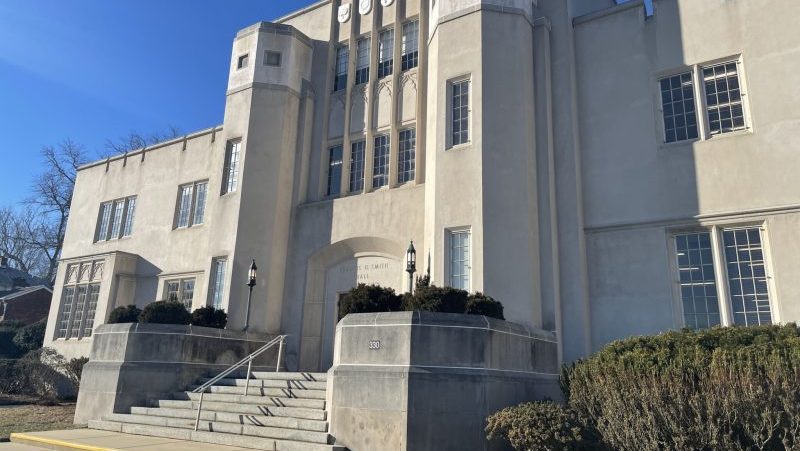
Francis H. Smith Hall on the campus of the Virginia Military Institute. (Photo by Nathaniel Cline/Virginia Mercury)
Del. Dan Helmer, D-Fairfax, said an investigation is warranted because VMI’s board did not renew the contract of Ret. General Cedric Wins, the institution’s first Black superintendent, and because of unresolved issues following a 2021 investigation that found persistent disparities, cultural barriers, and a lack of accountability.
“For those of us, like me, who care deeply about service and care deeply about producing leaders of character, we need to ensure that VMI has turned the page,” said Helmer.
“This task force offers a real opportunity to ensure we are inspiring leaders of character who understand the importance of the United States, who understand the history of Virginia, and reject rebellion against the United States, all the more important, at a time when we have a president of the United States and others who seem uninterested in the Constitution of the United States.”
Opposition emerged during the legislative process. Ret. Lt. Gen. David Furness, VMI’s superintendent, voiced concerns about the bill during an appearance before the House Studies Subcommittee on Jan. 23.
He pointed to VMI’s honor system and progress on equity audit recommendations, noting that 34 out of 38 changes have been completed, and objected to claims that VMI’s leadership supports the Lost Cause of the Confederacy.
“It is hard for me to understand how the institution lauded for its leadership model by so many notable state and national leaders could be described by the patron of this bill as committed to the Lost Cause of the Confederacy,” Furness said.
“That may have been true of VMI in the past. It is not now, nor will it be in the future.”
The subcommittee, which Helmer chairs, voted 4-1 to send the proposal to the House Rules Committee. House Minority Leader Terry Kilgore, R-Scott, cast the lone dissenting vote. .
Helmer’s House Bill 22 had not yet been docketed with the House Education Committee, as of Monday at noon. The proposal would align VMI with standard policies used at other public universities regarding disciplinary immunity for students who report acts of sexual violence.
Helmer said it is critical to understand how VMI is responding to the General Assembly’s concerns, particularly around racism, sexism, sexual assault, educational outcomes, and leadership development.
Separately, the House Education Committee is expected to consider House Bill 1374, which would dissolve VMI’s governing board and transfer oversight to Virginia State University’s Board of Visitors.
Del. Michael Feggans, D-Virginia Beach, the bill’s patron, said the proposal is intended as a structural — not punitive — response to longstanding governance concerns.
“The bill reflects broader, longstanding concerns about whether VMI’s current governance structure meets the standards the commonwealth expects,” Feggans said in a Jan. 21 statement. “When patterns of governance issues arise, it is appropriate for the General Assembly to review and, if necessary, adjust oversight structures.”
He added that the proposal “strengthens oversight, clarifies accountability, and ensures that VMI can focus on its core mission while operating under a governance framework that meets modern expectations for a public institution.”
If the measures clear the House, they would move to the Senate before heading to Gov. Abigail Spanberger’s desk, marking the next steps in the legislative process.
Sen. Jennifer Carroll Foy, D-Prince William, a graduate of both VMI and Virginia State University, has been a vocal critic of the institution’s leadership. However, she said she played no role in the drafting of the legislation.
“Unequivocally, no,” Carroll Foy said. “I had no idea that these bills were drafted, or that anyone was contemplating drafting these bills. I was never consulted about it. I wasn’t even aware that these bills existed until reporters started asking and inquiring about the bill.”
Carroll Foy said VMI’s current predicament stems from decisions made under former Gov. Glenn Youngkin, past governing board members, and the Spirit of VMI PAC.
She said confidence has eroded among many lawmakers because those parties failed in their fiduciary duties and engaged in partisan political disputes over the institution’s leadership and direction.
Despite that history, Carroll Foy described VMI as an “extraordinary place for extraordinary people” and said she believes the institution and Board of Visitors can “turn a page on the path and be forward-looking and produce some of the best citizen soldiers in this country.”
Sherry L. Wallace, a VMI spokeswoman, said in a statement, “We are reviewing all recently filed bills and plan to work with our elected officials to demonstrate VMI’s continued progress and ongoing value to the commonwealth of Virginia. VMI is defined by an uncompromising honor system that is more fair, equitable, and transparent today than at any intime of the Institute’s 186-year history. The citizen-soldiers the Institute educates are the epitome of value, and we plan to continue that mission.”
by Nathaniel Cline, Virginia Mercury
Virginia Mercury is part of States Newsroom, a nonprofit news network supported by grants and a coalition of donors as a 501c(3) public charity. Virginia Mercury maintains editorial independence. Contact Editor Samantha Willis for questions: info@virginiamercury.com.

CHEO Garden Expands Mission of Food, Learning and Community

Sharing a Room: How to Avoid Sibling Conflicts

Laurel Ridge to Host Week of the Young Child Art Exhibit

Free $1,000 ‘Trump Accounts’ Draw 1 Million Families

‘The Revenant: A Novel of Revenge’

Virginia Lawmakers Close 2026 Session With Focus on Lowering Costs

The 10 Most Important Things That Happened in Virginia’s 2026 Legislative Session

Electric Vehicle Market Adjusts as Industry Rethinks the Road Ahead

Cultures Around the World Mark the Spring Equinox With Unique Traditions

Laurel Ridge to Host 46th Annual Spring Follies: “Back to the ’90s”

Love Revival to Host Free Community Easter Celebration in Front Royal

Salvation Army of Front Royal Plans Annual Dinner and Raffle Fundraiser

Stephen Paul Sill (1955 – 2026)

Virginia Seeks Public Input for 2026 Statewide Rail Plan

Front Royal Craftsmen Revive Centuries-Old Timber Framing Tradition

VDOT: Warren County Traffic Alert for March 16 – 20, 2026

Virginia Lawmakers End Session Without Final Budget

Your Personal Mission Statement: A Guide to Getting What You Want Out of Life
Disappointed In Our Olympic Spirit

How St. Patrick’s Day Became America’s Biggest Irish Party

Virginia State Police Urge Sober Plans for Saint Patrick’s Day Celebrations

In a One-Party County, Internal Party Decisions Affect Us All

Virginia State Police Seize Nearly 100 Pounds of Narcotics, Recover Firearms in Weekly Crime Suppression Effort

Barton Charles “Bart” Haller (1940 – 2026)
