
State News
Commentary: Remembering William ‘Billy’ Flora, a Free Black Virginian and American Patriot
The Battle of Great Bridge on December 9, 1775, was an important step on the road to American independence, as rebellious Virginia soldiers defeated a detachment loyal to royal governor Lord Dunmore. The role of William “Billy” Flora, a free Black man, in this battle is now widely acknowledged, yet this recognition of his contribution to the revolutionary cause is a relatively recent achievement.
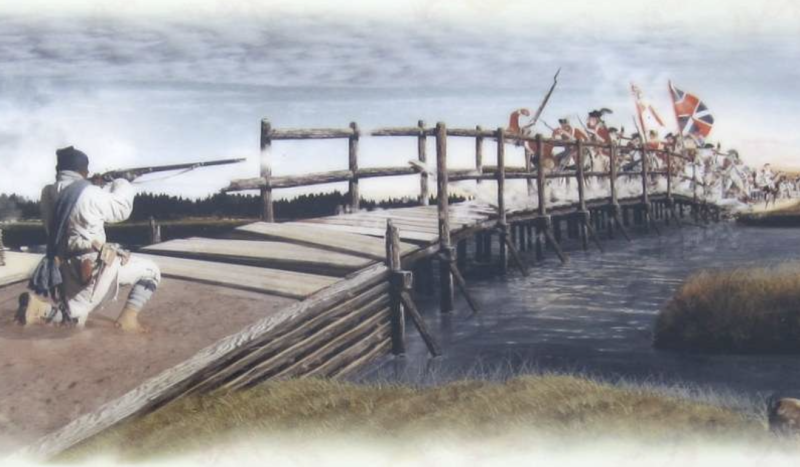
No images exist of William “Billy” Flora, but he is depicted in this painting by Jeremy Horne, featured on a historical marker in Great Bridge, Virginia. (Photo courtesy Jeremy Horne/The Historical Marker Database)
Fifty years ago, as Americans celebrated the bicentennial of this battle, Flora received little attention, thus ignoring the extensive documentation available from Black historians. This transformation in public knowledge confirms the importance of bringing diverse, inclusive, and equitable perspectives to commemorations of America’s semiquincentennial in 2026.
William “Billy” Flora was born in 1755 to free Black parents in Portsmouth, Virginia. At age 20, Flora joined a militia mobilized to challenge the royal forces of Lord Dunmore.
On December 9, 1775, Flora and other Virginians stood on the Great Bridge over the Elizabeth River facing a larger force of oncoming British soldiers. Flora fired eight times at the approaching soldiers, marching six abreast, before withdrawing back to the waiting Patriot forces. The Virginian marksmen fired at the soldiers, causing extensive casualties, forcing the British troops to retreat, and securing the first battlefield victory for the revolutionary forces in Virginia.
This version of the Battle of Great Bridge is easily accessible now through many resources, including VA 250, the American Battlefield Trust, Dictionary of Virginia Biography, and two historical markers in Portsmouth and Chesapeake. Yet this recognition of Flora is relatively new in historical and popular understanding.
Fifty years ago, as newspapers celebrated the bicentennial of the Battle of Great Bridge, Flora received little recognition in the mainstream press. A lengthy article in the Richmond Times-Dispatch on December 7, 1975, included a detailed account of the battle, yet it does not identify Flora’s role or acknowledge that a free Black man fought for Virginia.
Further reinforcing this erasure of Flora’s role, a widely circulated illustration shows a white man in the act of firing a musket, again ignoring the fact that a free Black man performed heroically at a critical point in this battle.
By contrast, Flora’s contributions have long been known in Black newspapers and in the publications of prominent Black historians.
The Portsmouth Star published an article in 1934 praising “Old Billy Flora” for his “heroic service,” with an account of his firing eight shots at British forces. Luther Porter Jackson’s 1944 book, “Virginia Negro Soldiers and Seaman in the Revolutionary War,” describes the “unusual bravery” demonstrated by Flora at the Battle of Great Bridge, which is confirmed by statements from fellow soldiers and officers.
Jackson’s biographical sketch was based on an 1853 article that drew upon first-hand accounts from the revolutionary era that credited “Billy Flora, a colored man” as the “last sentinel” to keep firing at the British, thus confirming Flora’s “good conduct during the Revolutionary War.”
Whereas Flora’s role in the revolution was visible in Black newspapers, the only mention of Black soldiers in most mainstream Bicentennial era accounts is the statement that Dunmore’s forces included runaway slaves. An article in the Fredericksburg Free Lance-Star on December 9, 1975, linked “loyalist and escaped slaves” without any recognition that enslaved people shared the same desire for freedom motivating the Patriot forces.
Flora’s subsequent life further enriches our understanding of this early stage of American history.
Flora fought as a free Black man for three years with revolutionary forces, earning distinction for his service. After the war, he became a prominent Portsmouth businessman. In 1807, when rumors spread of an attack by a British naval ship, Flora volunteered to fight, using the same musket deployed in 1775 at the Battle of Great Bridge. Flora died in 1820, and his remains were buried in an unmarked grave.
Appreciating Flora’s role in the revolutionary era leads to a more nuanced understanding of American history as we look ahead to the semiquincentennial observations in 2026. The final paragraph of Jackson’s history, addressed to Black men “going to war now just as Flora went 167 years ago” provides us with a way to think about the meaning of freedom, equality, and democracy as we recognize the 250th anniversary of the Battle of Great Bridge:
“They must remember also that the democracy for which they fight, though frequently violated in our country is a principle of life and a system of government worth fighting for. Without the basic democratic character of our American society and American government, Flora would never have become free nor would he have become the man of influence and power that he was.”
by Tom Ewing, Virginia Mercury
Virginia Mercury is part of States Newsroom, a nonprofit news network supported by grants and a coalition of donors as a 501c(3) public charity. Virginia Mercury maintains editorial independence. Contact Editor Samantha Willis for questions: info@virginiamercury.com.

Warner Files for Reelection, Launching Bid for Fourth U.S. Senate Term

Registrar Urges Residents to Stay Informed and Participate in Upcoming Elections

South River Forum Brings Residents and Leaders Together at Skyline

CHEO Garden Expands Mission of Food, Learning and Community

Sharing a Room: How to Avoid Sibling Conflicts

Laurel Ridge to Host Week of the Young Child Art Exhibit

Free $1,000 ‘Trump Accounts’ Draw 1 Million Families

‘The Revenant: A Novel of Revenge’

Virginia Lawmakers Close 2026 Session With Focus on Lowering Costs

The 10 Most Important Things That Happened in Virginia’s 2026 Legislative Session

Electric Vehicle Market Adjusts as Industry Rethinks the Road Ahead

Cultures Around the World Mark the Spring Equinox With Unique Traditions

Laurel Ridge to Host 46th Annual Spring Follies: “Back to the ’90s”

Love Revival to Host Free Community Easter Celebration in Front Royal

Salvation Army of Front Royal Plans Annual Dinner and Raffle Fundraiser

Stephen Paul Sill (1955 – 2026)

Virginia Seeks Public Input for 2026 Statewide Rail Plan

Front Royal Craftsmen Revive Centuries-Old Timber Framing Tradition

VDOT: Warren County Traffic Alert for March 16 – 20, 2026

Virginia Lawmakers End Session Without Final Budget

Your Personal Mission Statement: A Guide to Getting What You Want Out of Life
Disappointed In Our Olympic Spirit

How St. Patrick’s Day Became America’s Biggest Irish Party

Virginia State Police Urge Sober Plans for Saint Patrick’s Day Celebrations
