
Local News
Community weighs cameras-in-classrooms proposal for special ed students
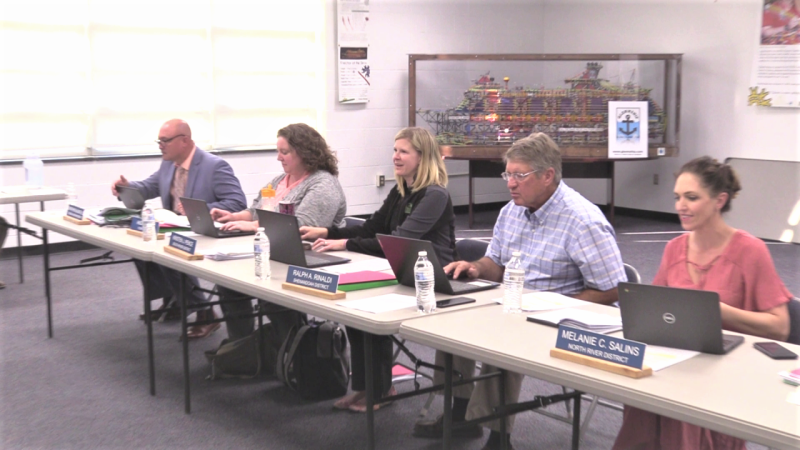
From left, WCPS Superintendent Christopher Ballenger and Warren County School Board members Andrea Lo, Kristen Pence, Ralph Rinaldi, and Melanie Salins meet on July 12.
Several residents and staff from Warren County Public Schools (WCPS) addressed whether the school division should install cameras in the classrooms for students in special education during the Warren County School Board’s Wednesday, July 12 meeting.
The School Board, at its June 21 work session, discussed possibly adding cameras in preschool and special needs classrooms and recommended that WCPS staff develop a potential board policy related to cameras in the classrooms. The school division’s legal team has provided a draft policy for review by the School Board, which also considered the proposed item later during its meeting.
“I appreciate the camera discussions that I’ve had and the opportunity to speak with several teachers and several parents over the past multiple weeks since this first came up,” said Board Chair Kristen Pence on Wednesday, noting she has received “lots of varying viewpoints and really good input from everybody.”
“And that’s really what we need because when I first heard about the cameras, I, as a parent, thought that it sounded like a great idea,” Pence said. “But I didn’t see everybody’s aspect of it. And so, of course, we’re still kind of working our way through it and looking forward to some more discussion as we go through this evening and the next couple of board meetings.”
School Board Vice Chair Ralph Rinaldi and board members Andrea Lo and Melanie Salins also were present at the meeting. Board member Antoinette Funk was absent on Wednesday.

Maria O’Brien (above), a Warren County resident in the Fork District, said that as a mother of a special needs student who has challenges with communication, she supports the proposed installation and monitoring of cameras in special needs classrooms. O’Brien expressed concerns about students needing more protection from abuse, such as what occurred recently in a WCPS elementary school.
“Children with special needs, especially those whose special needs involve the ability to communicate, cannot be expected to perfectly articulate what has happened in the classroom or their interactions with teachers,” O’Brien told the School Board. “Further, they may not recognize that what has happened to them or another student is wrong, especially if it’s something that’s ongoing. They may think that they are to blame.
“So in order to protect the children, we need to have something that’s more objective than what a child is saying to a parent,” she added. “And with different situations in the home, that communication can break down at home, as well.”
O’Brien added that having cameras in these classrooms could also be helpful for teachers if they’re falsely accused or threatened by older students in the high school setting. “So I don’t think this has to be parents versus teachers,” she said. “It can be something that’s mutually beneficial.”
Sarah Griffith, a special education teacher at Skyline High School, also spoke. She is a parent of four students who have graduated from WCPS and another who is still in school and has a 504 plan, which provides services and modifications to the learning environment so the child may access an education that’s equal to what other students receive.
“I would like to let you know that a growing number of our educators are becoming concerned with the conversation surrounding these policies,” Griffith told board members. “First and foremost, we feel this is a very discriminatory policy.”
Special education students already struggle to find their voice and a place in a general education setting, said Griffith, and putting cameras in their classrooms would further segregate them from their peers.
“Students will know the cameras are there. I work in a high school. They are very bright. Even the ones that do not speak,” she said, adding that some have anxiety and myriad other issues that may hinder them from entering a classroom if they see the cameras.
Griffith also said that using the terminology “special needs classrooms” is inappropriate because these students are not contained in one classroom. “Our students are dispersed throughout the building for much of their day. So unless we’re going to put cameras in every single part of that building, I do not feel that this policy is going to protect them,” she said.
Along those same lines, Joseph Adams, chairman of the Skyline Middle School Special Education Department and the learning center coach for WCPS secondary schools, said that the way the policy is written, his classroom would be considered a self-contained special education classroom.
“Having a camera in my room, it’s fine,” Adams said. “They’re going to see me teach, they’re going to see my kids grow, and they’re going to see the amazing activities we do in my room. But at the end of the policy, it says it’s here to protect the well-being and health of special education students. Where is that protection in their science class, their history class, their electives?”
Adams said he teaches sixth, seventh, and eighth-grade special education students, some with severe cognitive impairments and some with behavioral supports, who are in 15+ different classrooms in his building.
“Where is there protection in those rooms? They’re protected for only two hours with a camera in my room, but there are five other hours in a day,” he said. “If we’re going to do this, and we’re going to adopt this… we need to make sure all the special education students are protected, and that would mean putting cameras in every single classroom… not just those that would be defined as a self-contained classroom.”
Shea Steele-Kuhn, another Warren County resident, has a son in inclusion classes in seventh grade at Skyline Middle School. She agreed with Griffith and Adams. “I want my child, who is in all classrooms, to be protected in every classroom,” she said.
Steele-Kuhn also wants to ensure that if a child in special ed has a bad day in the classroom, that footage of such incidents isn’t randomly released on the internet.
“I understand that through the policy that the principal would be privy to this information, that other parents would be privy to this information,” she said. “I did see that the photos, that their images would be blurred, but it said ‘possibly be blurred.’ It doesn’t say that it would for sure be blurred. I’m worried about my child being in a fishbowl. I don’t want my child to be in the experiment for this, and then something goes completely wrong.”
Teachers also shouldn’t feel the need to leave WCPS because they are under additional scrutiny if cameras are installed in their classrooms, said Steele-Kuhn. “I have been very blessed to have a great team for my kid’s entire life, and I’m very nervous because his pre-k teachers are no longer in the county, and I’m nervous that we’re going to lose even more amazing teachers in this county over one incident.”
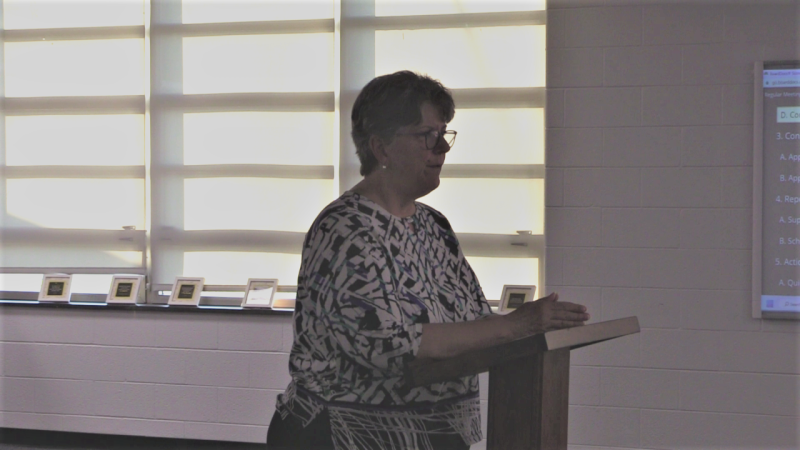
Jane Baker (above), the retired principal at Blue Ridge Technical Center (BRTC), said the center has had cameras in classrooms for at least the last 15 years. “And when I say classrooms, they are in our labs, such as our automotive lab, our electricity lab, those types of classrooms, where students are using a lot of different equipment,” Baker told the board.
“What I would say is that footage is never accessed unless there is some type of accident or a reason for it to be accessed,” added Baker. “I would also say that there is more likelihood of a student’s features and whatever we want to say, whatever people are afraid of, actions and activities, being put out into the public by other students with cell phones than there are from cameras that would be in the classroom.”
BRTC serves all students in special needs or regular ed classrooms, she said and has never experienced any issues with cameras in the classrooms.
The Draft Classroom Video Surveillance Policy
Later during the School Board meeting, WCPS Superintendent Christopher Ballenger and WCPS Assistant Superintendent of Administration George “Buck” Smith presented a draft board policy related to cameras in the classrooms known as Policy JOAA, which has been developed by the school division’s legal team.
No action was taken Wednesday on the draft proposal, which may be found here:
“This is just the first version, and since there was not a lot for our attorneys to go off of, they did pull from various areas,” Ballenger told the board. “If you notice, this policy starts out talking about pre-K and special needs classrooms, but then towards the end, it just focuses on special needs. That needs to be cleaned up, depending upon whatever direction the board wants to go. This is the first draft. This is the first shot.”
Ballenger said a survey will be sent out to help the School Board members decide how to proceed.
Actions Taken
The School Board did take action on several other agenda items and unanimously approved the following:
- The 2023-2024 Memorandum of Understanding between WCPS and Quiet Mind Psychotherapeutic Services Inc., a private agency that provides outpatient therapy and mental health services to individual students enrolled in WCPS. Fees for services are billed through individual insurances, through self-pay, or through an agreement between the company and WCPS, according to WCPS Interim Director of Special Services Shamika McDonald.
- The WCPS and Skyline CAP Contract, Warren County In-Kind Contributions, Special Education Memorandum of Understanding, and the Memorandum of Understanding between WCPS VPI and Skyline CAP Head Start. McDonald said that the agreements outline work and procedures that include the referral process, disability services, communication, and shared leadership at the local level.
- The amount of $20,668.26 to renew the PowerSchool Unified Talent Software System, which WCPS Personnel Director Jody Lee said offers a paperless solution for the application and hiring of employees and also serves as a storage location for all employee records.
- A $42,280.52 contract with Shenandoah Refrigeration Inc. of Winchester, Va., to install a new walk-in freezer at Skyline Middle School. Smith said it will be used for the school and for emergencies if another school walk-in would have a mechanical failure. “This would cut down on deliveries due to space limitations,” he said, adding that the funding for the project will come from the Food Service accounts.
- A total of $199,981 to purchase technology software and support services from several vendors that include firewall subscriptions, Microsoft licensing, a warranty for network switches, an internet filter, student self-harm monitoring, Chromebook inventory, classroom management, and network security, among other services.
- The mutual release and settlement agreement with Sodexo Operations, LLC regarding the 2022-2023 school year’s custodial services for WCPS. “Due to ambiguous wording in the original RFP and contract, a misunderstanding existed whether it was a fixed cost or a cost plus contract,” Smith explained. “Through negotiations with Sodexo, an agreement was arrived at that allowed both parties to participate equally” to split costs associated with overage services. The 2023-2024 Sodexo renewal specifies that the contract is a fixed cost contract agreed upon by both parties.
- Student fees for some classes at BRTC and at WCPS high schools. Baker said some fees increased and others stayed the same. “Some of the classes that are represented with a higher use of consumables because everything has gone up, so we had to ask for an increase in those fees,” she explained. “What I would say is that we’ve never refused a child entrance into a class when fee payment was not capable of being made by the family. So I just present those fees, which include dual enrollment, as well as the technical and career classes, as well.”
- Contract in the amount of $19,524.78 for the n2y Unique Learning System, which WCPS Special Services Deputy Director of Special Services Dena Lee said is a computer-based program designed specifically to help students with significant learning needs master their Virginia Essentialized Standards of Learning (VESOL). The system provides comprehensive and current instruction, including materials for teaching and learning every core subject, plus life skills.
- A contract renewal with Public Consulting Group Inc. (PCG) totaling $43,656.00 plus an 8 percent cost settlement to be paid at the end of the school year. PCG offers services to WCPS for its IEP generator system, a program provided by the Virginia Department of Education. Lee said the program also contains Virginia IUP, IEP translation, and EdPlan Parent Connect, among other services.
- The WCPS Special Service Restructuring Plan for 2023 is designed to respond to new demands, develop more effective programs, increase accountability, and increase student services provided by the school division, said Lee. As part of the restructuring, reclassifying duties will be assigned to the previous AT/Medicaid coordinator, and stipends will be added for six staff members who will coach staff on implementing programs, Lee said.
- Adding five more days to the 200-day teacher contract at Skyline Middle School for two instructional coach contracts will cost roughly $3,000. As part of Skyline Middle School’s schedule change to a seven-period class day, two teaching positions have been reassigned as instructional coach positions that will work to support teachers with strategies for instruction, classroom management, and student-centered coaching. Instructional coaches in the division work an additional five days beyond the 200-day teacher contract, said WCPS Assistant Superintendent of Instruction Heather Bragg.
- A copier lease contract in the amount of $89,964 will be awarded to Document Solutions Inc.
Speed cameras in school zones
Prior to the community participation portion of the School Board’s meeting, Front Royal Police Department Chief Kahle Magalis came to the podium to answer any questions from board members regarding speed camera enforcement.
The topic is being discussed by the Front Royal Town Council, Magalis said, and he wanted to answer any questions the School Board members might have.
“The Town Council is still batting it around, deciding which way they want to go with it,” he said, “but I understand that there are more questions, and I’d be happy to answer any of those.”
In comparison, Chair Pence said that School Board members are a different audience, and they wanted to hear about the potential for speed cameras being erected in several school zones.
“And just so parents and our community members can be aware of which school zones we’re talking about, we’d like a brief synopsis,” she said.
Magalis said the department has decided on locating the cameras at four locations: Skyline Middle School, Ressie Jeffries Elementary School, A.S. Rhodes Elementary School, and on Leach Run for Warren County Middle School.
“We weren’t going to try to do all of them at one time. We figured we’d start with the four where we kind of have the most issues that we typically see. Some of the bigger roads with the higher speed limit more frequently traveled roads,” the chief explained.
He added that a speed study was done in which five days’ worth of data was collected — from four days when school was in session and one day when school was not in session.
“The numbers were fairly, I wouldn’t say shocking, I’m not shocked by it, but I think a lot of people probably would be,” Magalis said. “I get complaints about speed in town every day. And a lot of those speed complaints typically come from people who’ve witnessed this in school zones, and of course, they’re concerned over children. So we looked at it, and this [solution] seemed to make the most sense for us.”
Once a contracted company sets up the cameras, tickets would be generated for speeds in excess of 10 miles per hour. “I don’t think it’s really asking that much to slow down 10 miles per hour for a quarter of a mile,” said Magalis. “At that point, if you were going to be late for something, you were going to be late anyway.”
Magalis said the topic has never been about generating revenue for the police department, and if there is a violation, it’s vetted by a front-row police officer who actually has to go through and look at the camera footage. The speed measurement equipment is calibrated every 35 minutes and is validated twice a year. And it’s the same technology that local police officers use in their cars when they’re writing tickets, he said.
It’s also a civil penalty if a person is caught speeding. They would be fined $100, the violation doesn’t count against a person’s license, and there are no points associated with it, he said. “It’s not even a criminal traffic violation,” he said. “It’s a civil thing.”
There would be no costs for WCPS related to an outside company coming in and setting up and operating the cameras, Magalis added.
Watch the School Board Meeting of July 12th on this exclusive Royal Examiner video.

Spanberger Joins Other Governors in Push for PJM to Prioritize Ratepayer Protections

Cannabis Testing Challenges Persist as Virginia Retail Market Nears

Quick Quiz on Tooth Decay

The Fat Facts: Busting Common Food Myths

Importance of Chiles v. Salazar and the Protection of Free Speech

MAGA Suicide?

Warnick Posts Natural Hat Trick as Shenandoah Downs Opens Spring Meet

Youngkin Returns to Campaign Trail, Calls for Court to Strike Redistricting Vote

‘We Have To Do Something’: Former U.S. Attorney General Eric Holder Supports Virginia Redistricting

3 Ways to Extend the Life of Your Electric Vehicle Battery

Serious Charges Highlight Warren County Grand Jury Indictments

Ducks, Flowers, and Fun: Redbud Festival Returns to Browntown

Potato-Crust Quiche Makes a Lovely Brunch

Faye Barr Vance (1930 – 2026)

James Christopher “Chris” Sain (1948 – 2026)
Alice “Maybelle” Henson (1938 – 2026)

How Sleep and Stress Affect Cancer Risk

Spanberger Signs Sweeping Public Safety and Gun Violence Bills

Horses, Fans Return as Shenandoah Downs Season Begins

Skill Games Halted Again as Spanberger Issues Veto

VDOT: Warren County Traffic Alert for April 13 – 17, 2026

The Cat Who Outlasted Six Prime Ministers
Front Royal, Virginia. Vacation Destination?

Virginia State Police Report Major Drug Seizures in Weekly Crime Suppression Effort
