
Local News
County fares relatively well in new Shenandoah River pollution report
The environmental watchdog group that released a 2017 report on hazardous levels of E coli bacteria and other contaminants in the Shenandoah River from cattle and farming practices has submitted an update titled “State Monitoring Data Show Shenandoah Valley Waters Remain Bacteria Hotspot” as the 2018 Labor Day weekend approaches.
The result of new measurements was mixed, showing some improvements – including at a Riverton measuring station in Warren County – but an overall continuation of sometimes hazardous levels of bacterial contamination along much of the length of the river, particularly at the southern end of the Shenandoah Valley.
Consequently, the Environmental Integrity Project (EIP) report cautions recreational river users to proceed with care in order to avoid potential illness from ongoing bacterial contaminant levels. A portion of the new report’s conclusions based on 2017-18 measurements of river bacteria levels states:
“In a previous analysis of state monitoring data released in April 2017, EIP found that 43 (90 percent) of 48 sampling locations in the Shenandoah River basin were unsafe for swimming or other water contact recreation between 2014 and 2016.
“This most recent analysis checked if E. coli levels at those locations had changed over the past year and a half (from January 2017 through June 2016), and results were similar, if slightly lower. Forty of the 48 locations (83 percent) were unsafe for water contact, according to Virginia’s standards.
“Virginia advises avoiding swimming, fishing, or boating in freshwater that exceeds 235 colony forming units (CFU) of E. coli per 100 mL of water more than 10 percent of the time, because the bacteria is often an indicator of fecal pathogens that can cause stomach and intestinal illnesses in children and adults who accidentally swallow water.”

Probably not the best spot for a dip in the Shenandoah River – Courtesy Photos/Environmental Integrity Project
The bottom line appears to be that while the river continues to be a viable recreational destination, the safest recreational uses are boating and tubing; and if you chose to swim, avoid swallowing water wherever you are, and use common sense in choosing a location away from signs of cattle access to or farmland runoff into the river, because as the EIP reports:
“In the Shenandoah River basin, animal manure is the major source of E. coli bacteria either from cattle wandering directly into rivers and streams or manure being spread onto crops and pastures as fertilizer, which runs off into waterways, according to a 2017 Environmental Integrity Project report, ‘Water Pollution from Livestock in the Shenandoah Valley’. Other sources, including wildlife, urban runoff, and sewage plant effluent, also contribute to the problem.”
As mentioned above, a North Fork measuring site in Riverton was one of four at which bacteria levels improved between the 2014-16 and 2017-18 samplings. The report states:
“In EIP’s 2018 follow up examination of state bacteria data in Shenandoah waterways, the organization found that E coli level improved at four of the 48 water quality monitoring sites between 2014-2016 and 2017-2018, while they worsened at one location. For an online map with data at each of the locations, click here.
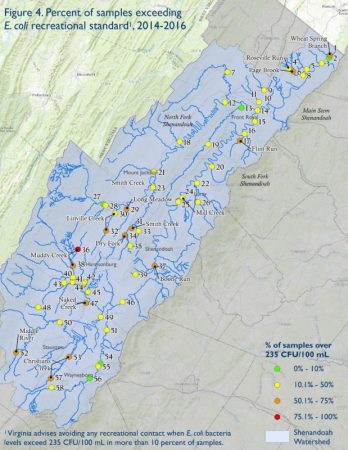
A map showing check points from the 2014-16 study of the river’s bacterial contamination. The yellow and green dots near Front Royal indicate points were pollutant levels measured above recommended levels less than 50% of the time, including only 0-10% at the green location.
“The four that improved recently were Cedar Creek near Marlboro in Frederick County; the North Fork near Mt. Jackson; the North Fork near Riverton; and the South River near Grottoes. All of these locations exceeded the recreational standard between 2014 and 2016, but did not exceed the standard between January 2017 and June 2018.”
The only site indicating worsening conditions between the two sampling periods was south of Waynesboro; and other major problems also appeared far south of Front Royal and Warren County:
“Only one of the 48 sites appears to have worsened between the 2014-2016 and 2017-2018 sampling periods. That was along the South Fork of the Shenandoah River downstream of Waynesboro. Here, 5 of 17 samples have exceeded the E. coli standard since January 2017. There were no transgressions of state health standards at that spot between 2014 and 2016.
“Sampling results from June 2018 show that the very highest E. coli levels at the 48 sites were at two sampling locations along Linville Creek between Edom and Broadway, where concentrations ranged from 6,131 CFU/100mL (26 times the numeric state standard for bacteria concentrations) to higher than 24,196 CFU/100mL (103 times the standard).”
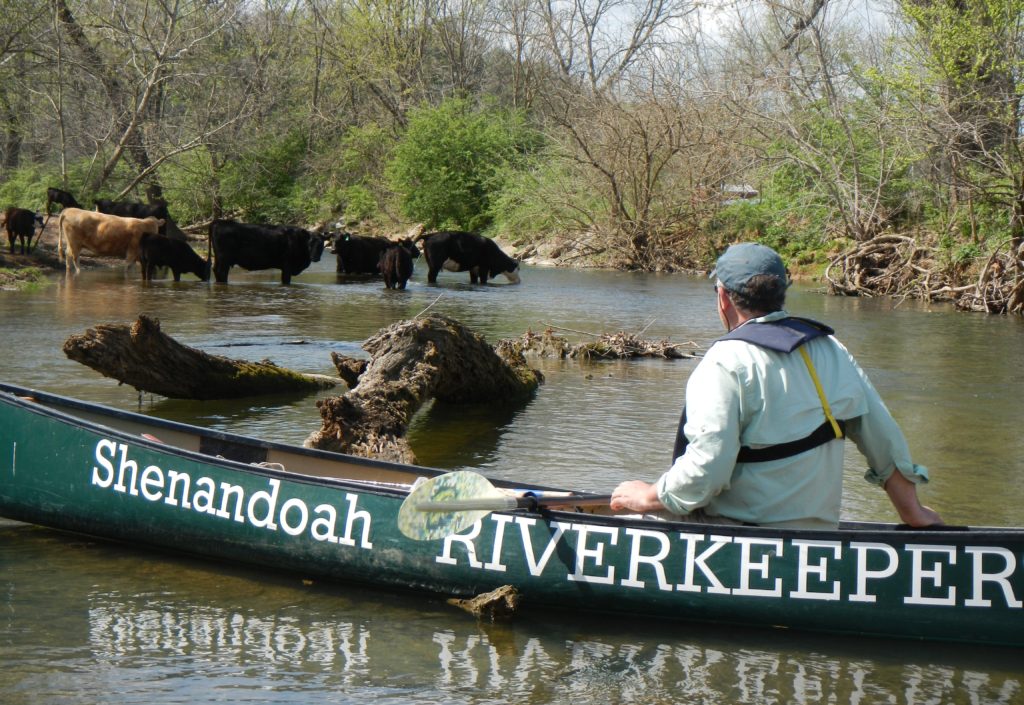
The Shenandoah Riverkeeper keeps an eye on cattle roaming into the river, a major indicator of higher E coli bacterial levels.
The report also notes a discrepancy in result analysis due to some sites not being present in both sampling periods:
“In total, the Virginia Department of Environmental Quality sampled 85 locations along Shenandoah Basin waterways between January 2017 and 2018. But 37 of those locations were not included in EIP’s 2017 study because they were not sampled between 2014 and the end of 2016.
“Of the 37 ‘new’ locations added since the end of 2016, 22 (59 percent) exceeded health standard for water contact recreation. Two newly-sampled hot spots are near McGaheysville, Virginia, along both South Fork, where the state in June 2018 measured bacteria concentrations of 24,196 CFU/100mL, and Cub Run, where concentrations hit 17,329 CFU/100mL.”
See this online map for more detailed information on bacteria levels at each location in the Shenandoah river system.
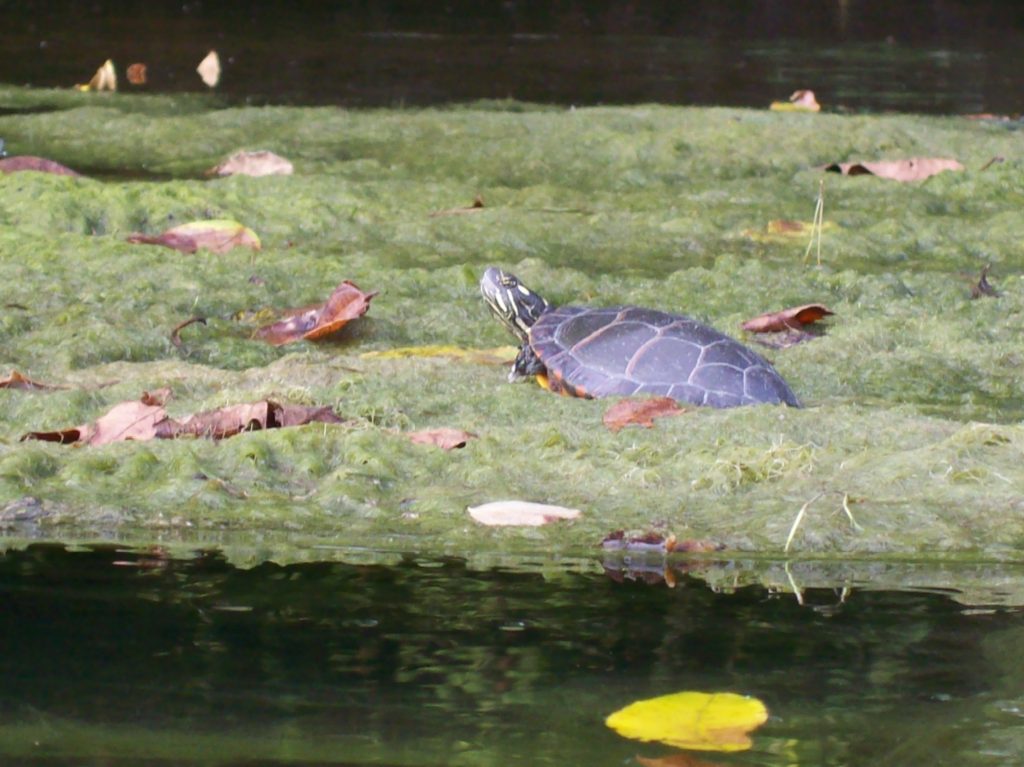
A turtle rides an algae bloom, an indicator of high phosphorous levels
In conclusion the EIP report calls upon state officials to do more to protect such a valuable natural resource and tourism economic-engine as the Shenandoah River, particularly from livestock and farming contamination.
Of the updated findings, Environmental Integrity Project Executive Director Eric Schaeffer said, “This is an indication that Virginia still isn’t doing enough to control manure runoff pollution from the growing livestock industry in the Shenandoah Valley and to help farmers fence cattle out of streams.
“While health warnings for the public are important, the bigger picture is that the Shenandoah watershed should be treated as more than just a drainage system for the livestock industry. With more effective controls on agricultural pollution, Virginia can keep its waterways clean enough for all citizens to enjoy,” Schaeffer, a former Director of Civil Enforcement at EPA, concluded.
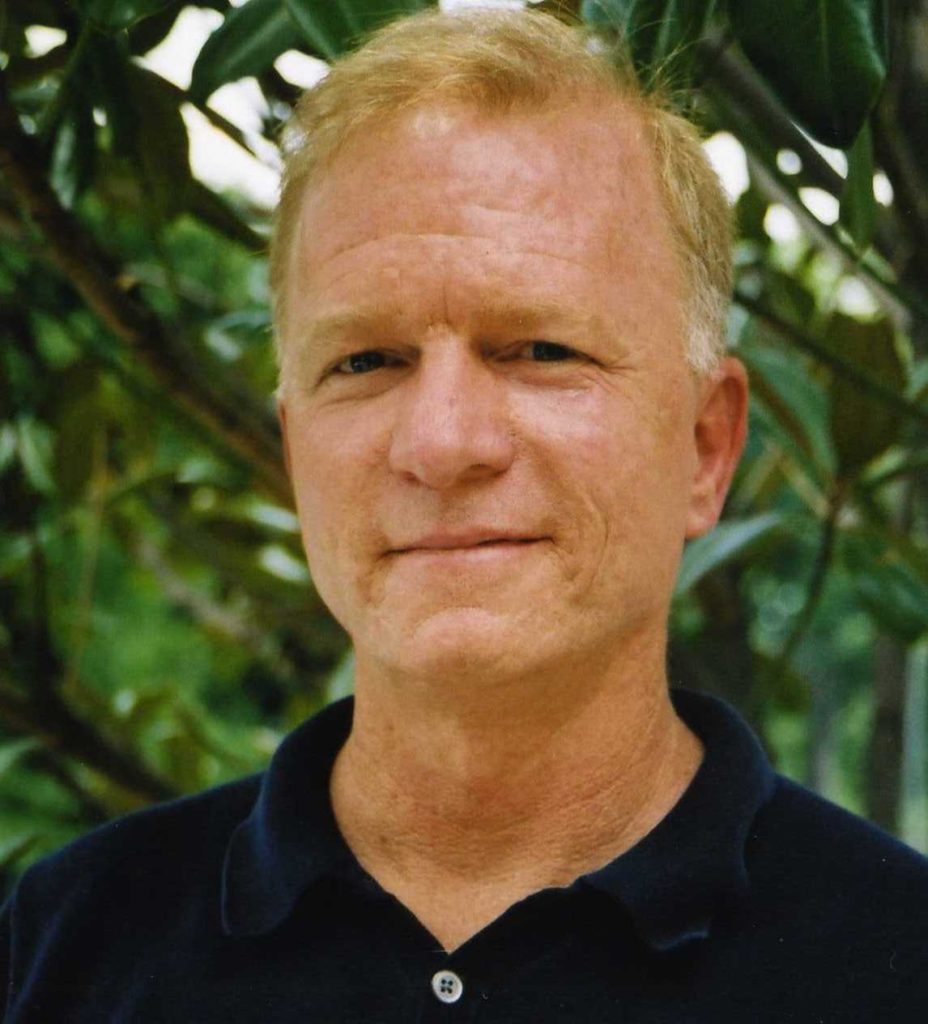
EIP Executive Director and former EPA official Eric Schaeffer believes the state can do more to regulate the valley’s growing livestock industry in protection of the Shenandoah River’s value as a tourism generator.
Among actions recommended in the EIP report to reduce agricultural pollution in the Shenandoah are: “establishment of a better system for collecting and disposing of surplus livestock manure; requiring fertilizer management plans for all farms that spread manure; increasing inspections and enforcement; and requiring all farmers to fence their cattle out of public waterways.”
(The Environmental Integrity Project is a nonprofit, nonpartisan organization that empowers communities and protects public health and the environment by investigating polluters, holding them accountable under the law, and strengthening public policy.)

Local NAACP Recalls Segregated Criser High/Elementary School During ‘Learn From the Past for a Better Future’ Event

Virginia Revenues Top Forecast, But Economic Concerns Remain

Governor Clarifies: Proposed Tax Changes Never Became Law

Driver Runs After Crash, Caught by Police Moments Later

Debate Continues Over Tax Rate as Supervisor Offers New Option

Spanberger Joins Other Governors in Push for PJM to Prioritize Ratepayer Protections

Cannabis Testing Challenges Persist as Virginia Retail Market Nears

Quick Quiz on Tooth Decay

The Fat Facts: Busting Common Food Myths

Importance of Chiles v. Salazar and the Protection of Free Speech

MAGA Suicide?

Warnick Posts Natural Hat Trick as Shenandoah Downs Opens Spring Meet

Youngkin Returns to Campaign Trail, Calls for Court to Strike Redistricting Vote

‘We Have To Do Something’: Former U.S. Attorney General Eric Holder Supports Virginia Redistricting

3 Ways to Extend the Life of Your Electric Vehicle Battery

Serious Charges Highlight Warren County Grand Jury Indictments

Ducks, Flowers, and Fun: Redbud Festival Returns to Browntown

Potato-Crust Quiche Makes a Lovely Brunch

Faye Barr Vance (1930 – 2026)

James Christopher “Chris” Sain (1948 – 2026)
Alice “Maybelle” Henson (1938 – 2026)

How Sleep and Stress Affect Cancer Risk

Spanberger Signs Sweeping Public Safety and Gun Violence Bills

Horses, Fans Return as Shenandoah Downs Season Begins
