
Local Government
COVID-related salary issues, emergency communications upgrades and AG land use draw supervisors’ attention
It was a three-pronged meeting of the Warren County Board of Supervisors on Tuesday evening, November 17, under re-implemented, more stringent state social distancing guidelines as Phase 3 of the COVID-19 pandemic continues. Those prongs were: 1/ COVID-related staff bonuses and salary adjustments; 2/ a partial upgrading of emergency services radios to facilitate cross-jurisdiction communications; and 3/ several, including one sometimes contentious, public hearings on commercial uses in more remote rural Agriculturally zoned neighborhoods.
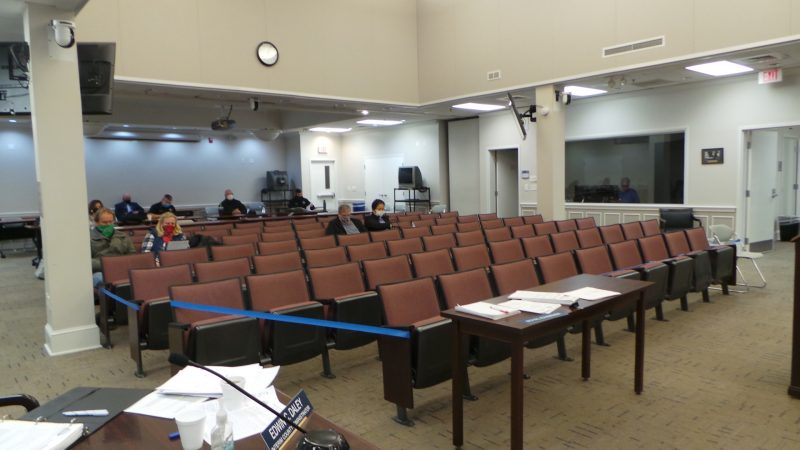
Above, once again every other row in the public seating section of the WCGC meeting room was roped off to maintain renewed social distancing standards as pandemic Phase 3 takes the U.S. toward a quarter-million dead from the COVID-19 virus. Below, the supervisors also maintained their distance. Royal Examiner Photos by Roger Bianchini – Royal Examiner Video by Mark Williams
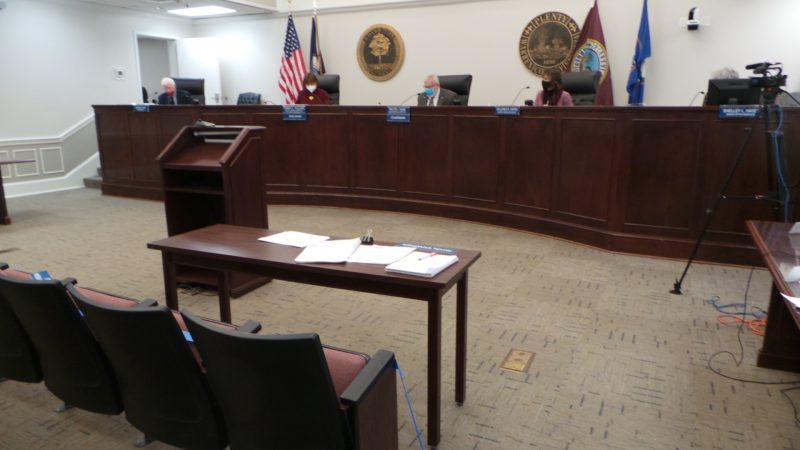
Following an update by Planning Director Taryn Logan on Coronavirus-related expenditures by the County, several staff compensation requests related to pandemic-impacted or delayed salary adjustments were heard by the supervisors.
Those included two public hearing presentations by Human Resources Director Jodi Saffelle seeking approval of “One-Time Acknowledgment Pay for Non-Hazardous Duty Employees”; and a similar “One-Time Bonus for Compensation Board-Funded Sheriff and Sheriff’s Deputies”; and a related item, a Resolution of support for a “One-Time Hazard Pay” bonus for employees of the Sheriff’s Office and Fire & Rescue who were not covered by the Compensation Board-sworn positions public hearing request, was included in the Consent Agenda.
The one-time bonuses in all three of the above requests were $1,000 for full-time employees and $500 for part-timers.
Human Resources Director Saffelle also presented a non-public hearing request that implementation of a Compensation Plan Cost of Living (COLA) increase delayed this past year out of revenue projection concerns related to mandated cutbacks on business operations related to COVID-19 pandemic public health precautions enacted statewide and locally.
All the requests were approved by the board by 4-0 votes, Tony Carter absent. Approval of delayed COLA increases as the evening’s last agenda item, drew some applause from county staff still present.
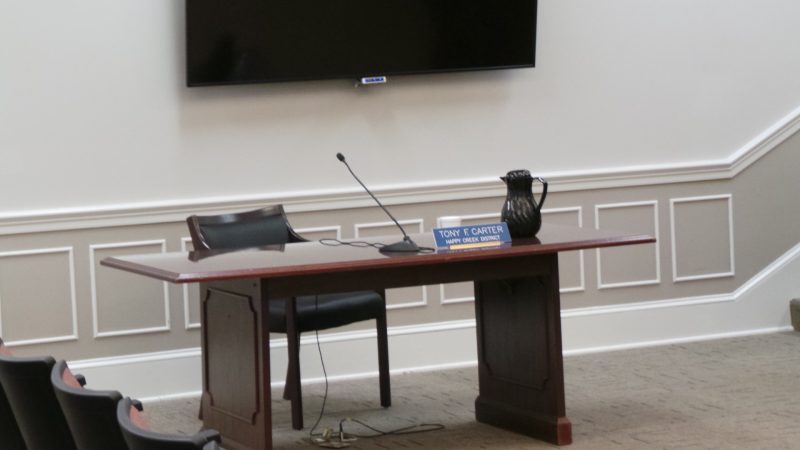
Happy Creek Supervisor Tony Carter had a very socially distanced seat but was even more socially distanced than that.
The increases dependent on the time of hiring are 1.5% or 2.5%, the latter number for employees hired prior to October 1, 2019. The Human Resources Department summary of the request noted that the current Fiscal Year-2021 budget has a total of $580,000 set aside for the implementation of phases of the Compensation Plan. While the initial implementation was estimated at $614,165.73, the staff summary noted that the annual figure moving forward would be fluid as longer-term employees retire and are replaced by people further down the compensation scale. Savings will also be realized this fiscal year with implementation not occurring until December 1, five months into the fiscal year.
Not related to salaries but emergency services, was the approval of a request for a partial upgrade of the Fire & Rescue Department’s radio communications system. The request was reviewed in detail at a November 10 work session. Chief Richard Mabie explained that a full system-wide upgrade has been estimated at a cost of a million dollars. So, as a short-term fix new all-band radios are just being requested for Companies with more frequent cross-county response calls. Those companies are Linden (Co. 4), Shenandoah Shores (Co. 5), Shenandoah Farms (Co. 6), and North Warren (Co. 10).
The total cost of the requested upgrades is $105,606.11. Mabie explained that if ordered prior to the end of the year the department would get a trade-in credit on the traded-in radios. While a relatively small trade-in at $5,600, the chief noted that covered about half the cost of the now obsolete radios when they were purchased 15 years ago.
Board Vice-Chair Cheryl Cullers worried that Front Royal Company One, which is often called to assist other departments’ calls including across county lines, wasn’t included in the request. But it was pointed out that Company One would be able to communicate with the originally called outlying Warren County company that was in communications with the out-of-county units, to be able to have necessary information relayed to it.
The board unanimously approved the requested all-band radio purchase from Motorola Solutions. The purchase price will come from the County General Fund, not from CARES Act funding, Interim County Administrator Ed Daley reminded Mabie and the board.
While the six-public hearing portion of the agenda started calmly enough with Human Resource Director Saffelle’s explanation of the COVID-staff bonuses requests and an eventually adjourned public hearing on a pending renewal of the county’s three Agricultural and Forestal Districts – Rockland, South River, and Limeton – things took a turn toward the contentious when a short-term tourist rental Conditional Use Permit (CUP) request on Panhandle Road in the Fork District was reached.
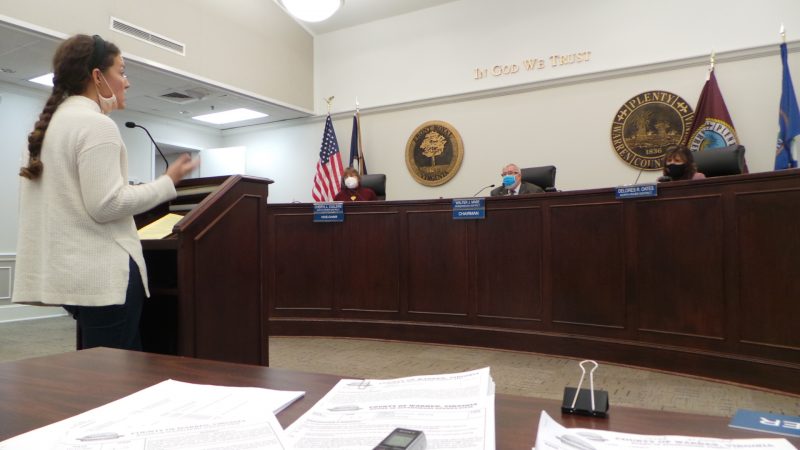
Short-term rental applicant Renee Roig explains the evolution of her D.C.-based group’s plan for the 4.8-acre home lot they purchased off Panhandle Road.
The applicants, two couples of young professionals from Washington, D.C., ran into almost universal opposition from neighbors in the larger parcel neighborhood, including the woman they bought the property from. That still-neighbor, Wendy Weir, told the board she felt the applicants had misled her into believing their intent was to buy the property as a second home for retreats out of the D.C. Metro area, and intermittent rentals solely to family or close friends. She was not happy at the short-term rental CUP application applied for “six weeks later” with no stipulation on who could or would be rented to.
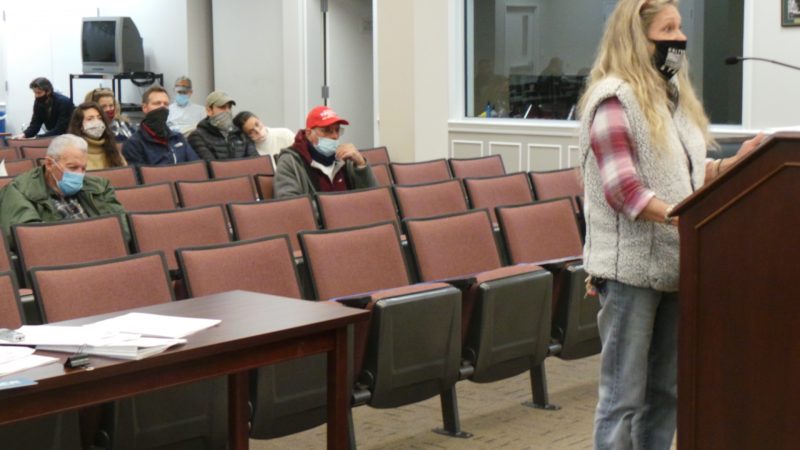
Wendy Weir, who sold the home to the D.C. quartet explains why she doesn’t feel they were forthright with her about their plans for the property.
However, planning staff told the board that there were two nearby approved short-term rental approved properties, setting somewhat of a precedent for approvals within prescribed guidelines. At issue for neighbors were D.C. Metro area natives out for short-term getaways with no experience of the transportation, open fire, trespassing and hunting variables involved in such a country setting near George Washington Forest.
The applicants asserted that the purchase was as a second home, but that they hoped to create enough rental income to help defray their costs. Kevin Roig told the supervisors that they were there to stay long-term and hoped to be able to work with their neighbors to see the short-term rentals weren’t an issue or a threat to neighboring properties.
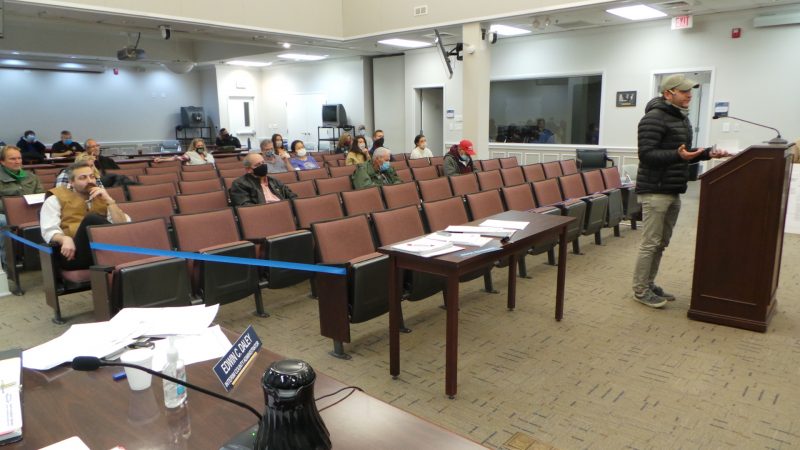
Kevin Roig takes to the podium to respond to some of the criticism he heard – we’re there for the long haul and want to be good neighbors regardless of what happens tonight, he told the supervisors.
See the debate leading to an eventual 4-0 vote of approval under prescribed conditions as recommended by the planning commission and tweaked by the supervisors, as well as two public hearings on the creation of a “rural events facility” for up to 300 people off Lee Burke Road, in this Royal Examiner video. While there were concerns expressed by neighbors of Shelley Cook’s CUP application for the rural events facility on 41.3 acres, overall it was much more well-received as a community addition than the Roig-Nobles request on a 4.8-acre parcel that preceded it.


CHEO Garden Expands Mission of Food, Learning and Community

Sharing a Room: How to Avoid Sibling Conflicts

Laurel Ridge to Host Week of the Young Child Art Exhibit

Free $1,000 ‘Trump Accounts’ Draw 1 Million Families

‘The Revenant: A Novel of Revenge’

Virginia Lawmakers Close 2026 Session With Focus on Lowering Costs

The 10 Most Important Things That Happened in Virginia’s 2026 Legislative Session

Electric Vehicle Market Adjusts as Industry Rethinks the Road Ahead

Cultures Around the World Mark the Spring Equinox With Unique Traditions

Laurel Ridge to Host 46th Annual Spring Follies: “Back to the ’90s”

Love Revival to Host Free Community Easter Celebration in Front Royal

Salvation Army of Front Royal Plans Annual Dinner and Raffle Fundraiser

Stephen Paul Sill (1955 – 2026)

Virginia Seeks Public Input for 2026 Statewide Rail Plan

Front Royal Craftsmen Revive Centuries-Old Timber Framing Tradition

VDOT: Warren County Traffic Alert for March 16 – 20, 2026

Virginia Lawmakers End Session Without Final Budget

Your Personal Mission Statement: A Guide to Getting What You Want Out of Life
Disappointed In Our Olympic Spirit

How St. Patrick’s Day Became America’s Biggest Irish Party

Virginia State Police Urge Sober Plans for Saint Patrick’s Day Celebrations

In a One-Party County, Internal Party Decisions Affect Us All

Virginia State Police Seize Nearly 100 Pounds of Narcotics, Recover Firearms in Weekly Crime Suppression Effort

Barton Charles “Bart” Haller (1940 – 2026)
