
Health
Pulitzer Prize Winner Barbara Kingsolver: The Hand Condition That Threatens Her Ability to Write
For Pulitzer Prize-winning author Barbara Kingsolver, writing a novel is more than a creative process. She physically depends on her hands to do it.
But for years, a hereditary condition has slowly pulled her fingers toward her palms, making everyday activities increasingly difficult. She has undergone repeated hand surgeries, adapted her work, and given up signing books to protect her ability to keep writing.
Now, that personal experience has connected her latest novel, Partita, with a surgeon at the University of Virginia.
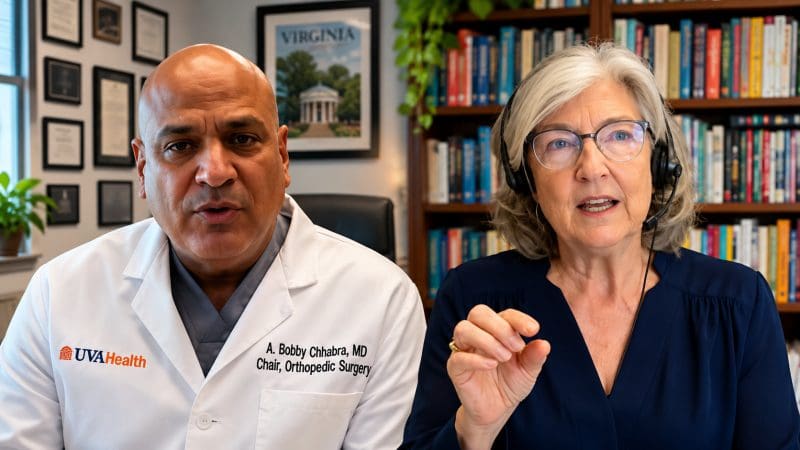
Dr. Bobby Chhabra (left), UVA Health hand surgeon and chair of the Department of Orthopedic Surgery, joins Pulitzer Prize-winning author Barbara Kingsolver (right) to discuss her treatment for Dupuytren’s contracture and how his medical expertise helped shape details in her latest novel, Partita.
During a November 23 media briefing hosted by UVA Health, Kingsolver and Dr. Bobby Chhabra, chair of UVA’s Department of Orthopedic Surgery, discussed her treatment for Dupuytren’s contracture, the challenges of living with the condition, and how Chhabra helped her accurately portray a devastating hand injury in her new book.
Their conversation revealed something that readers might never have imagined: behind Kingsolver’s celebrated novels is an ongoing effort to preserve the use of her fingers.
When Your Hands Are Essential to Your Work
Kingsolver, whose novel Demon Copperhead won the 2023 Pulitzer Prize for Fiction, has lived with Dupuytren’s contracture for years.
The condition causes tissue beneath the palm’s skin to thicken and tighten, gradually pulling one or more fingers inward. Over time, affected fingers may become difficult or impossible to straighten completely.
For a novelist who works at a keyboard and also enjoys playing the piano, losing that movement is especially challenging.

“Because I type, I write my novels on a keyboard, and I really can’t do it any other way,” Kingsolver explained.
She has undergone seven hand surgeries at UVA Health, six on one hand and one on the other, along with an additional procedure to remove a pin. She estimated that she has been receiving treatment at UVA for 15 or 16 years.
The condition runs in her family, and she described her own case as particularly aggressive.
Some relatives have chosen to live with their contracted fingers rather than undergo treatment. Kingsolver, however, has pursued repeated procedures because maintaining hand function is essential to her life and career.
And the difficulties extend well beyond typing.
She described being unable to slip a hand into a pocket, brush crumbs from a table, push herself up from a chair, or pat someone on the back without an awkwardly bent finger getting in the way.
“There are a million little things, in day-to-day life, that it interferes with,” she said.
Even something as familiar as signing books eventually became too much.
Kingsolver recalled signing approximately 60,000 books during one promotional effort. Repeatedly gripping a pen put considerable strain on her hands, and she said she often needed additional treatment after book-signing tours.
After discussing the problem with her medical team, she stopped signing books.

She said her right hand has done better since making that change.
A Novelist Who Won’t Give Up Her Keyboard
Kingsolver has also found ways to continue working while recovering from surgery.
After one procedure, she used an adaptive keyboard that let her type with one hand and a single finger.
Friends and readers have suggested speech-to-text technology, but she said dictation doesn’t fit the way she creates fiction.
For Kingsolver, composing a sentence connects her thoughts, her hands, and the keyboard.
Changing that process, she explained, would change the writing itself.
“My brain goes to my hands, goes through the keyboard, and it puts words on the screen,” she said.
She hopes future procedures can be scheduled around her writing rather than interrupting a draft.
“As long as I’ve got them, and as long as I can keep them, I’m gonna keep writing books,” she said.

How Her Medical Experience Helped Shape Partita
Kingsolver’s latest novel, Partita, published in October, tells the story of a woman whose life and ambitions are deeply connected to music.
The central character is a pianist who suffers a devastating hand injury involving an industrial dough roller.
That experience is different from Kingsolver’s own condition. Dupuytren’s contracture develops gradually, while the fictional character suffers a sudden, traumatic injury.
Kingsolver was careful to explain that her diagnosis did not inspire her to write the novel.
Instead, her personal experience became useful as she developed parts of the story involving lost hand function, surgery, rehabilitation, and the emotional consequences of physical limitations.
She had already researched and written the novel’s medical portions when she asked Chhabra to review them.
The request apparently came during one of her own surgical visits.
Kingsolver recalled mentioning that she needed to create a convincing hand injury for a fictional character. Chhabra immediately began discussing possibilities, including injuries much more severe than she wanted for her story.
She laughed while remembering having to redirect him toward something less gruesome.

What she ultimately needed was an injury serious enough to change a pianist’s life but not so destructive that the hand would necessarily require amputation.
Chhabra reviewed her descriptions of the injury, emergency treatment, surgery, and long recovery.
He suggested adjustments involving bone stabilization, damaged tendons, rehabilitation, and sensory retraining after nerve injuries.
The physician said Kingsolver had already done impressive research.
“I think I just edited what she had written, because she was very accurate,” Chhabra said.
His role was to make the injury and treatment medically believable while letting Kingsolver tell the story she wanted.
Kingsolver thanked Chhabra and the UVA Health team in the book’s acknowledgments.
For her, medical accuracy matters even in fiction.
Although the characters and events may be invented, she wants readers to trust the real-world details and develop compassion for people facing experiences similar to those described in her stories.
What Is Dupuytren’s Contracture?

During the briefing, Chhabra explained that Dupuytren’s disease often begins with a small lump, or nodule, beneath the palm’s skin.
Over time, a thickened band of tissue called a cord can develop. As it tightens, it may gradually pull a finger toward the palm.
The ring and little fingers are commonly affected, although other fingers can be involved.
The condition is generally painless, but the resulting loss of movement can interfere with ordinary activities.
People may have trouble grasping objects, typing, shaking hands, or placing their hands flat on a surface.
There is a strong hereditary component, and the condition can run through generations. However, it does not progress at the same rate in everyone.
Some people develop only mild symptoms that change little over many years. Others progress faster or develop recurring contractures after treatment.
Chhabra said he commonly sees several patients with the condition during a clinic session.
Treatment depends on the severity of the contracture and how much it interferes with daily activities.
Options can include procedures that use a needle to release tightened tissue, injections of an enzyme that breaks down certain cords, or surgery to remove affected tissue.
Not every procedure suits every patient.
Kingsolver’s condition has affected joints farther out in her fingers, making some less invasive treatments less appropriate for her particular case.
Chhabra emphasized that rehabilitation is also an important part of treatment.
Straightening the finger is only one goal. Patients must also regain sufficient movement and strength to grip objects and perform everyday tasks.
There is currently no cure for Dupuytren’s disease, and contractures can return after treatment.
The American Academy of Orthopedic Surgeons advises people with symptoms affecting hand function to discuss treatment options with a qualified healthcare professional.
A Seven-Hour Round Trip for Care
Kingsolver lives in rural Southwest Virginia, approximately three and a half hours from Charlottesville.
That means each visit to the UVA Health Hand Center involves about seven hours of driving.
She described the distance as her one complaint about receiving care there.
But she said the willingness to make the trip reflects how much she values being able to continue using her hands.
Her experience also raised a broader concern about access to specialized medical services in rural communities.
Kingsolver noted that rural residents often have to travel long distances for specialty care. She also expressed concern about the future of smaller regional hospitals.
For her, the challenge is personal: maintaining the use of her hands while living far from the specialists who treat her.
She praised not only Chhabra but also the nurses, physician assistants, anesthesiologists, therapists, and other members of the UVA team who have helped her through years of treatment.
Chhabra said helping patients return to the activities they love is one of the most rewarding parts of his work.
Whether that means returning to an occupation, caring for family members, enjoying a hobby, or writing another novel, preserving function can make an enormous difference in someone’s life.
A Story About More Than a Hand Injury
Although Partita includes a serious hand injury, Kingsolver said the novel is ultimately about something much larger.
It explores what happens when people must confront lost ambitions, relationships, and dreams that once seemed central to their lives.
For Kingsolver, the story’s broader theme is learning to live with loss and finding ways to move forward.
“All of us have broken parts, and we all have to put them back together,” she said.
That idea resonated with Chhabra, who regularly treats patients frightened that an injury could prevent them from working, caring for loved ones, or enjoying activities that give their lives meaning.
The novelist and surgeon approached the subject from different perspectives, but both spoke about the importance of helping people recover what they can and adapt to what has changed.
For Kingsolver, that means protecting the hands that have allowed her to tell stories for decades.
With help from her medical team, she intends to keep putting words on the page—one keystroke at a time.




Pulitzer Prize Winner Barbara Kingsolver: The Hand Condition That Threatens Her Ability to Write

From Thanksgiving Dinner to Christmas Lights, Front Royal Volunteers Are Bringing the Community Together

Virginia School Health Committee OKs Plan to Require a Nurse in Every School; Funding Concerns Linger

How a Tiny Virginia Grassroots Group Helped Oust a 19-Year Congressman

A Thanksgiving Treat in the Offing: Lower Gas Prices

National Outages, Emergency Alerts Become Fodder for Doomsday Conspiracy Theories

Sally Bost Cable (1931 – 2026)

Why America’s Trucks Still Run on Diesel Despite Record Fuel Prices

Why Egg Whites Make Angel Food Cake Rise—and the Secret to Keeping Them Fluffy

Jest A Moment: What if America Had Taken the Turkey Under Its Wing for a National Symbol?

Overtime Tax Break Gets Easier to Claim in 2026, but Not All Extra Pay Qualifies

The Surprising History Behind Two Thanksgiving Dishes We Think Have Always Been There

Small Hands, Big Hearts: Young Bell Ringers Bring Christmas Cheer to Front Royal

Israel: The Fourth Aliyah

Taxing Talent and Farmland is Bad Policy for Virginia

Wings of Excellence Academy Turns Holiday Food Drive into Year-Round Mission

Maria Lane Himes Miller (1942 – 2026)

JFK & The Woman Who Knew Too Much

Can a Dog Really Have Its Own Smartphone? Meet the PetPhone

How Thanksgiving Leftovers Helped Pave the Way for LASIK Eye Surgery

Joyce Bailey Evans (1940 – 2026)

Cannabis Ordinance Goes Forward with Recommendation of Approval from Town Planning Commission

VDOT: Warren County Traffic Alert for Nov. 23 – Dec. 4, 2026

Avtex Trail Advisory Subcommittee Emerges at FR-WC EDA Meeting
