
Hometown Faces
Native American Military Veteran Brings Native American Heritage Month to Front Royal’s Stone Branch Arts Center
Able Forces Director Skip Rogers alerted Royal Examiner to an Indigenous American arts and cultural event in mid-November 2024, at the Stone Branch Arts Center at 114 East Main Street next door to the Front Royal Town Hall. The event, which coincides with national Native American Heritage Month signed into law in a joint resolution by President George H.W. Bush in 1990, was organized by an Able Forces client, Patrick Littlewolf Brooks.
“Patrick is an indigenous Tuscarora Indian, a combat-injured veteran, and an outstanding artist and indigenous Indian historian,” Rogers told us. Of this heritage month a quick online search told us: “This month is dedicated to recognizing and celebrating the culture, traditions, and contributions of Native American and Alaska Native people.”
Rogers also forwarded us a Stone Branch Arts Center social media posting on the event: “This is a weekend for your entire family (Nov. 16-17, Saturday-Sunday). We are honored to have Patrick Littlewolf Brooks, his wife Ashleigh, and children (indigenous Tuscarora indians) as residents of Front Royal. This weekend will be an exciting opportunity of indigenous history, stories, dancing, food, and artwork. Don’t miss it and don’t forget to bring your children.”

The front entrance to the Stone Branch Arts Center at 114 E. Main St. Below, this family didn’t forget to bring the kids. Royal Examiner Photos Roger Bianchini

Our interest piqued, we dropped in on day 2, Sunday, November 17, to meet event organizer Patrick Littlewolf Brooks and experience the event presented through his Five Feathers Productions company. We soon learned it was a family affair with Brooks’ wife Ashliegh stationed at the Stone Branch Arts Center entrance, and his sister “Little Snowbird” Jones with her own historical-cultural display area, which she introduced us to while her brother was busy overseeing the multi-faceted event that included arts projects targeting the younger event visitors, with parental input welcomed.
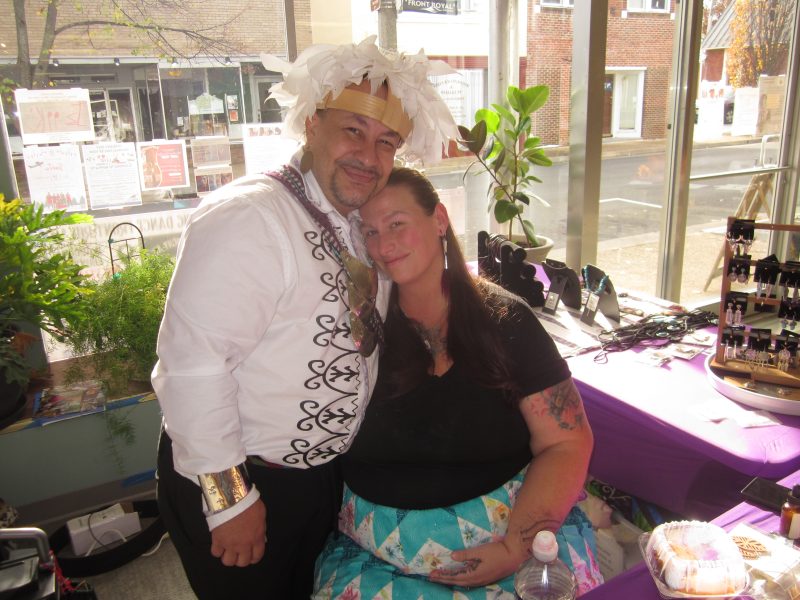
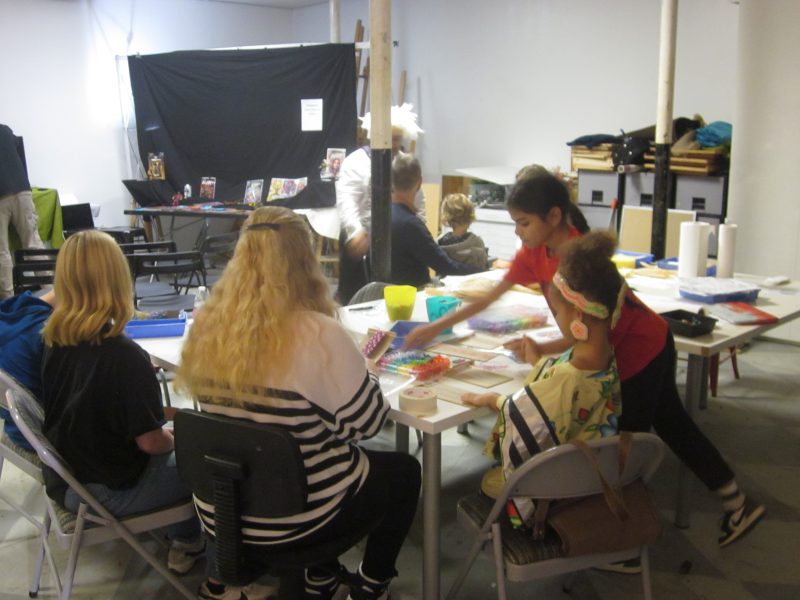
Patrick Littlewolf Brooks and wife Ashliegh, who is expecting the couple’s next child imminently. Below, arts and craft table set up where kids and their parents can compete on who’s got that best Native American craft-making knack.
When he was available we asked Littlewolf about his personal history and the impetus for the event in his current hometown of Front Royal, Virginia. “Well, my name is Patrick Littlewolf Brooks, I’m of the Tuscarora nation in upstate New York. I’ve been educating now for about 35 years, travelling and sharing native culture and history about what we do, and more importantly who we are.
“You know when people think of native people and native history they see us as caricatures. They don’t see us as real life people that we still exist, that we’re in Congress, at the White House, and now we have an astronaut, that native people still exist, and not just in the past,” he observed of a mainstream American cultural disconnect.
“We may have traditional belief systems that we still follow but we still live in the modern world, we work in two worlds. And through my whole life I’ve travelled and I’ve seen the way our native people are treated, or understood — John Wayne movies or ‘Little House on the Prairie’ you know, round up the wagons, wagon burners.” I mentioned my earlier conversation with his sister, Little Snowbird, and how it had been eye-opening to me on the disconnect between my perception and the reality of the current Native American experience still having some very disturbing life and death statistics. And I don’t consider myself a naive, living in John Wayne movies perceiver of the Native American experience either, I told him.
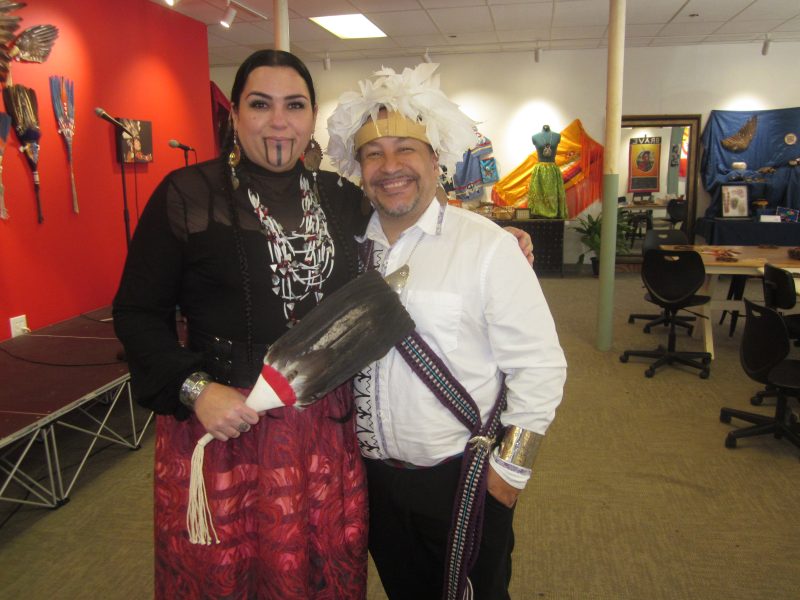
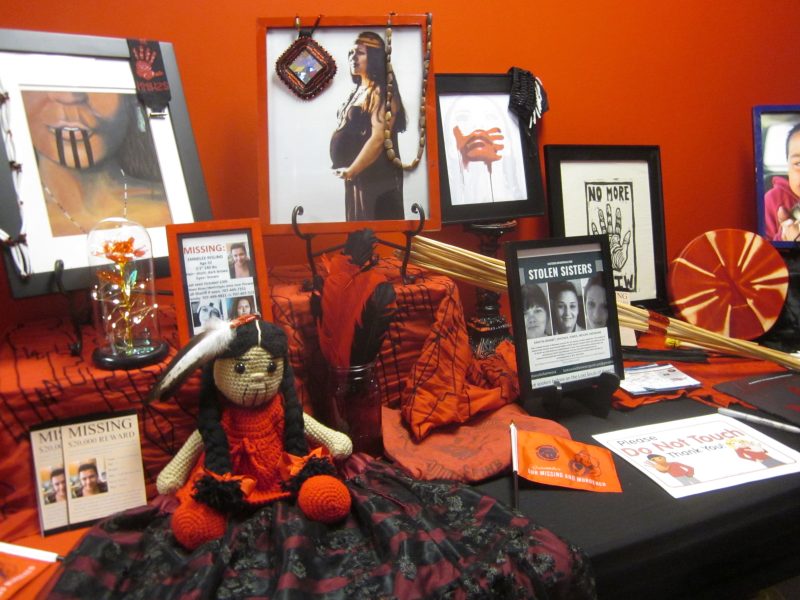
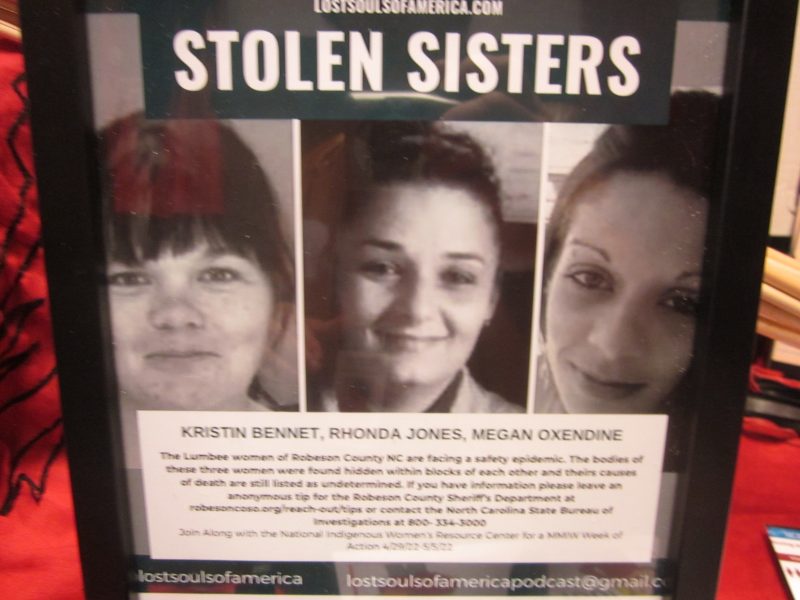
Sister-brother team of Little Snowbird and Littlewolf take a short break to pose for the media entranced by their arts-crafts, cultural, and historical Indigenous People’s showcase at the Stone Branch Arts Center. Below, a shot from one of Little Snowbird’s table displays illustrating the unusually high percentage of Native American women and girls who have gone missing or been found murdered in the modern era.
“Absolutely, because we’re the forgotten race. It’s often whenever colonization comes in and native peoples survive with their traditions and are hanging on for dear life,” he replied, observing, “The good and the bad is hidden from the American eye when it comes to native people. They don’t tell you in school that native people make up a humongous part of the volunteers in the military. That we’re the only race of people who have fought in every single major conflict on this soil even though this soil has tried to eradicate us. We still fight for this country; and that we’re the only people that have ever defeated the United States in the United States, at the Battle of Little Bighorn. The native people are warriors, we come from a warrior society and we pick up the rifle and put on our boots, we go overseas and fight for the nation. They don’t teach that in the history books.
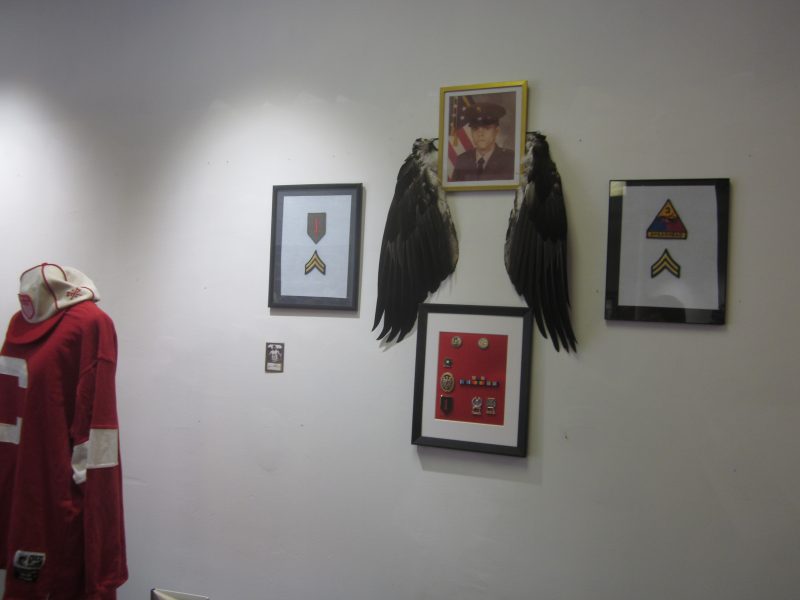
Wall displays acknowledging the U.S. military service of two Indigenous Americans. The first is Little Snowbird’s father, the second her brother, Littlewolf.

“They don’t say the United States Constitution is based after the Iroquois Confederacy. They just talk about the Founding Fathers, they don’t talk about the Founding Fathers four failed attempts at a Constitution until they came up north to the Seneca nation and borrowed our Constitution and made it into the United States Constitution.
“We don’t talk about those things in school,” Littlewolf observed of a long-existing gap in our mainstream educational systems, adding spookily, “It’s almost like living in a house and you’re a ghost. Everyone’s walking through, everyone’s using everything, and they never acknowledge your existence even though you’re screaming with your loudest voice, you’re just a ghost in a roomful of people.”
Tired of being that ghost, Patrick Littlewolf Brooks explained to us the creation of his “Five Feathers Productions” company <Fivefeathersproductions@gmail.com>. “So, I designed this company, me and my wife Ashliegh both, to travel and to teach. We go to elementary schools, high schools, colleges, veterans centers, everywhere we can to share who we are. We moved here about a year ago. I chased my wife like most men do, and she lived here and I wanted to be close to her, so I moved from New Jersey,” he explained of landing in the clouds, or at least on Cloud Street, in the Town of Front Royal, Virginia.
“And it has been a blessing. Front Royal is so beautiful, and some of the most amazing people. You know you get bad wherever you go, but Front Royal has been so welcoming to us,” he observed with a nod to Stone Branch Center for the Arts Director Terre Jenkins and Able Forces Director “Skip” Rogers.
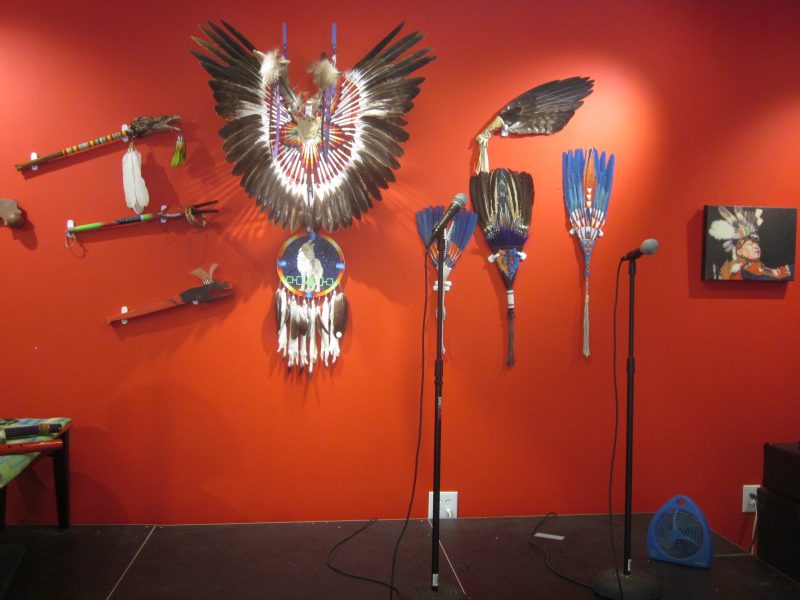
Wall displays of Indigenous arts, crafts, and clothing design. Last photo below, Little Snowbird greets two visitors to the show in front of several more displays.


“This art studio display happened through Mr. Skip Rogers. He has helped so many veterans like myself,” Littlewolf Brooks said of the veterans assistance group Director. “Skip gave me a call and he said, Patrick you need to meet this lady that works at this arts studio, Miss Terre, she’s just so open. And we all clicked.” Here, our host introduced a slice of that Native American culture that has survived at a perhaps spiritual level.
“And native people, we don’t believe in coincidences and accidents. What happens, happens and it’s supposed to happen that way. And when you meet someone you’re supposed to get something from them and you’re supposed to pass something on to them,” Brooks said of such non-coincidences, perhaps including the fortuitous chain of events bringing his Five Feathers Productions arts, culture, and historical display to the Stone Branch Arts Center in downtown Front Royal, Virginia, during the Native America Heritage month of November 2024.
“And when I met Ms. Terre, she’s got the light of the world, she just wants to help everybody … So, when I told her what I did, she said, ‘Please come into the arts studio and put an exhibit together’.” That led Brooks to reach out to some of his long-term contacts, including a professor at Penn State University, an Apache tribal member he calls “Uncle John” who conducts annual “Pow wow” events that help raise money to fund Native American students’ college education.
Which is important, as Brooks told us there are misconceptions about government financial support of the Native American population. “I think they’ve put over 300 native students through college,” he said of Uncle John’s Pow Wows. “People have this mindset that if you’re native you get free college — Not true. Or native people get money from the government — Not true,” he said explaining cash exchanges between the government and Native American tribes:
“The money they’re talking about is per-cap. And that’s only money that if the government uses tribal lands for something, tracking oil, tracking minerals, they pay that tribe an amount of money to use those resources. A lot of tribes don’t get per-cap,” he pointed out noting a one-in-four chance for Native American youth to commit suicide before the age of 18.
Earlier, we noticed Brooks sister Little Snowbird looked a tad grim when we sought a photo op at her display table. We soon found out why, as the table featured another troubling aspect of contemporary Native American history that continues into this current day. That history is an unusually high percentage of Native American women and girls who have gone missing or been found murdered. Statistics displayed cited “murder as the third leading cause of death for Native American women,” with a total of 5,487 reported cases still open at the end of 2022, 4,089 of those girls aged 17 or younger.
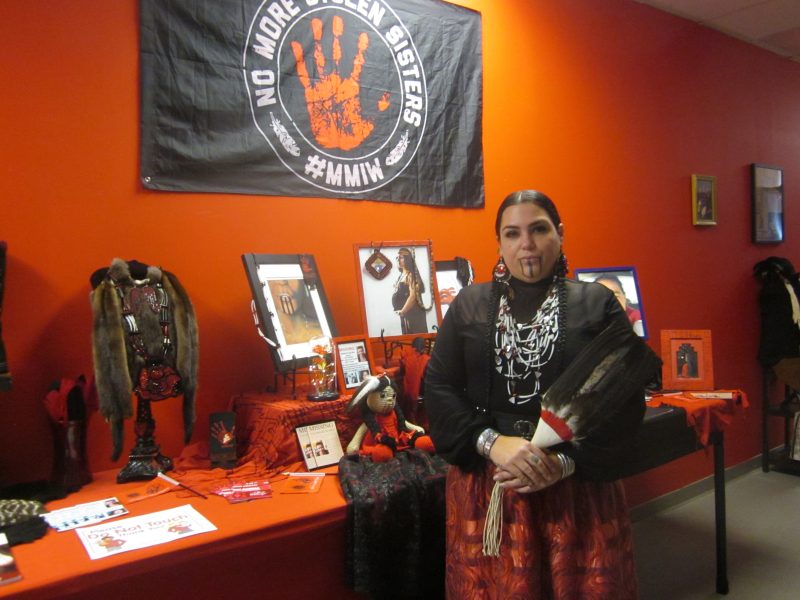
Little Snowbird at table display of a disturbing trend of MMIW – Missing and Murdered Indigenous Women, and girls, that continues to this day. She is, in fact, an MMIW survivor.


We asked Little Snowbird to introduce herself to our recorder: “My name is Little Snowbird, I’m from the Yurok Nation, that’s in Humboldt County, California, all the way to the Redwoods at the top of California,” she said of the Northwest coastal California location. We asked her about the disturbing information on missing and murdered Native American girls and women on her end of the display.
“I do a lot of education speaking on MMIW, Missing and Murdered Indigenous Women, and also Every Child Matters, so that’s going to be your residential schools; also on native food sovereignty and the struggles that native peoples go through with the U.S. government and society here in states and this country,” she summarized, then adding to the disturbing statistics cited above.
“Indigenous women go missing 12 times more than any other ethnicity on this planet, despite making up 3% of the population. Four out of five native women have experienced violence and sexual assault in their lives,” she told us adding more disturbing numbers on the age range of MMIW females, from 92 years to two weeks.
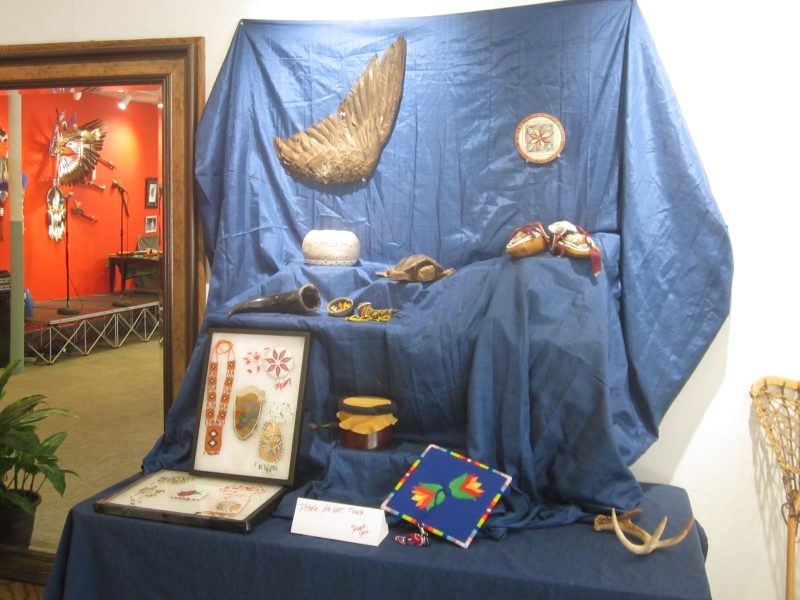
Three display table shots for the road, the last one of books ‘Not for Sale’ but available on Amazon.


“My job and my goal in life, what I love to do is to bring this to the forefront and say, there is a problem. We have thousands of missing women and children. And no one, no one is caring,” she said of a discrepancy in how this group’s situation is generally ignored versus how missing children or women from the mainstream U.S. culture are aggressively reported and widely circulated seeking a positive resolution.
“It is the John Wayne era, white-washed history, and that is us. And we’re more than that,” she paused with a sigh, “We’re more than that.”
And yes, they are, as are we all in the best of all possible worlds. And here’s a nod to Patrick Littlewolf Brooks, his wife Ashliegh, sister Little Snowbird Jones, Arts Center Director Terre Jenkins, and Able Forces Director Skip Rogers for their respectiven roles in bringing that point forward as part of a wonderful indiginous prople’s arts, cultural, and historical presentation to the Town of Front Royal during Native American Heritage Month, November 2024.
We understand this is likely to become an annual tradition at the Stone Branch Arts Center, though perhaps at different times of the year to facilitate a wider Five Feathers Productions Native American contacts participation.

4 Stimulating Activities for a Healthy Brain After 50

The First Amendment: America’s Unique Foundation of Freedom

How to Tackle Credit Card Debt

Summer Enrichment Camp Gives Teens Hands-On Learning Opportunities

VDOT: Warren County Traffic Alert for April 6 – 10, 2026

David Silek to Remain in Chairman’s Seat of WC Republican Committee Pending 6th District Appeal Decision

Sales Set to Bloom Like Daffodils This Spring

America 250: The Bookseller Who Helped Save the Revolution

Business Growth Series: Why Good Businesses Still Struggle to Grow

Brownies with Mini Chocolate Easter Eggs

Shenandoah Downs Opens 11th Season April 11 with Tribute to Roger Hammer

We Don’t Know Everything About DNA

How PAAS Came to Dominate the Easter Egg Dye Tradition

Spanberger Signs Bipartisan School-Safety, Student Support Bills Into Law

Melanie J. Pomeroy (1958 – 2026)

David Benjamin Heller (1990 – 2026)
1776 Wasn’t Just About Independence

Three-Tiered System for Urban Agriculture Based on Lot Size Takes Shape at Town Planning Commission Work Session

Child Abuse Awareness Month Brings Focus to Reporting, Prevention in Warren County

National Dental Hygienists Week: Is Your Oral Care Routine Optimal?

The Coin That Traveled Through Time and Space

One “What If?” Question Is Changing the Future of Farming

AA Speaker to Explain Recovery Program at United Methodist Men’s Dinner
Jeannette M. Hyland (1944 – 2026)
