
Punditry & Prose
The White House Plumbers (Watergate-50 Years Later)
 Some of us are ancient enough to remember the Watergate burglary that brought down the President of the United States 50 years ago, June 17, 1972. The burglary became the ostensible reason for President Richard Nixon’s political downfall. Shortly after the burglary, Nixon’s handlers initiated a series of schemes to insulate the White House from responsibility for the bungled political espionage plot. No one knows if Nixon ordered the Watergate break-in or if he was aware of it beforehand – but we do know that he participated in covering it up or ‘containing’ information once it occurred.
In hindsight, the intelligence gathering mission against the Democrats wasn’t necessary at all and revealed that Nixon’s paranoia had gotten the best of him in the end. Nixon ended up winning the 1972 Presidential Election by a landslide margin against George McGovern. Unfortunately, this incident consumed his remaining time in office and ruined what till then had been a rather impressive presidential legacy. This tale is steeped in intrigue and has been portrayed in various movies and tons of books over the last 50 years. Allow me to provide a small Cliff Notes version for now. It all started with the White House “Plumbers”.
The White House Plumbers: Late in 1971, Attorney General John Mitchell and White House chief of staff H. R. “Bob” Haldeman decided that J. Gordon Liddy should be given the green light to lead an espionage program against the Democrats at the Democratic National Convention (DNC) headquarters at the Watergate Office Complex.
Gordon Liddy had a colorful past and was one of several men referred to as “the Plumbers” for their ability to “stop leaks” in the White House. Amongst White House staffers, these men were referred to by several names: The Plumbers, The Room 16 Project, and more officially, the White House Special Investigations Unit.
The Plumbers were a covert White House unit created to respond to the infamous leaking of the “Pentagon Papers” that revealed the secret U.S. expansion of the war in Vietnam. At the time, that was an enormous embarrassment and the resulting public outcry threatened to impede Nixon’s re-election. There is one thing that every first-term president wants and that is a second term. With that in mind, the Plumbers transitioned their efforts to assisting the Committee to Re-elect the President.
Gordon Liddy – became general counsel on the Committee to Re-elect the President and worked with Campaign political-intelligence operations. John Ehrlichman, the Assistant to the President for Domestic Affairs and Special Investigations Unit gave the Okay for Liddy’s intelligence-gathering operations against the Democrats during the 1972 election year.
During the pre-dawn hours of June 17, 1972, Frank Sturgis, Virgilio Gonzalez, Eugenio Martinez, Bernard Baker and James McCord were apprehended by guards while installing electronic listening devices in the national Democratic Party campaign offices located in the Watergate office complex in Washington, D.C. Liddy controlled this operation from another location. A phone number found on the burglars led reporters to E. Howard Hunt, a man that worked for the White House. Soon tips started coming in to reporters within the Washington Post. Bob Woodward, a reporter working for the Post, was assigned the story. He was subsequently informed by a secret source that senior aides of President Nixon had directed these men to obtain information about Nixon’s political opponents. At this point, the story took on a life of its own with unimaginable consequences and intrigue. Woodward began working with a fellow Washington Post reporter, Carl Bernstein on the Watergate case. As time went by, their secret source became known as Deep Throat. But where pray tell did Deep Throat get his information? That piece of the puzzle was a secret that intrigued Washington for the next 30 years. The results of this steady supply of information mesmerized the nation while the U.S. was engrossed in getting out of Vietnam and in the wake of Nixon’s strategic overtures with Mao Tse-Tung’s Red China.
Deep Throat: Washington Post reporters Carl Bernstein and Bob Woodward pursued the Watergate burglary story for two years – stoking the public’s thirst periodically with juicy information coming from within the White House – provided by their informant – Deep Throat. The continuous volume of damning information positively drove the President and his cabinet out of their minds. They could not figure out how the Washington Post was getting the information and accusations and finger pointing mounted.
Soon many of the President’s inner circle began turning on each other. One of them, White House counsel John Dean, fearful that he was being made a scapegoat – resigned. Soon after, he exchanged leniency for testimony against his former Nixon aides. By now, the country was in a frenzy with ongoing congressional investigations revealing wrongdoing and a cover up. As more and more evidence mounted, the scandal eventually implicated many members of Nixon’s White House, culminating in Nixon becoming the first United States president to resign.
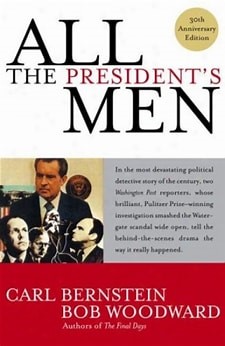
Woodward and Bernstein wrote a book about the Watergate drama a few years later entitled, All the President’s Men. It was followed by a movie thriller with the same name starring Robert Redford and Dustin Hoffman as Woodward and Bernstein. In the book, they noted that key information in their investigation had come from an anonymous informant whom they dubbed “Deep Throat”. The transition of information from the informant to the reporters was rather elaborate and clandestine. Woodward and Deep Throat often met in secret at an underground garage at 1401 Wilson Boulevard in Rosslyn, VA at 2 a.m.
Today, a historical marker is at the location. Interestingly, Deep Throat’s identity remained secret for more than 30 years and was one of the biggest mysteries in American politics until 2003. Woodward and Bernstein insisted that they would not reveal his identity until he died or consented to reveal it. Alas on May 31, 2005, former FBI agent, Mark Felt revealed that he was Deep Throat in an article published in Vanity Fair magazine. Felt was a highly placed FBI agent and had access to all FBI investigative findings surrounding the Watergate drama. His disdain for the Nixon administration prompted his actions. Shortly after Felt’s confession, Woodward and Bernstein corroborated the fact and detailed their relationship with him in Woodward’s book, The Secret Man: The Story of Watergate’s Deep Throat.
The “Smoking Gun” – White House Tapes: President Nixon secretly recorded tapes of daily conversations and phone calls during his administration – presumably for posterity purposes. The tapes Nixon made of his White House meetings became a central element in the drama when their existence was leaked to the press. Investigators wanted access to them. The White House resisted. Later, the White House gave up some of them grudgingly but refused to release all of them. When one tape was found to have an 18 minute gap, the public immediately assumed the President was erasing key information about the Watergate burglary cover-up.
This prompted the U.S. Supreme Court to direct Nixon to turn over all of the tapes. The result was the discovery of the “smoking gun” long sought by prosecutors. One of the tapes revealed a conversation that occurred just a few days after the break-in in which Nixon discussed with H.R. Haldeman a plan to have the CIA tell the FBI to stay clear of the situation because it involved national security. It proved that Nixon himself was involved in the cover-up. With impeachment looming on the horizon, after being told by key Republican Congressmen they now supported that impeachment, Nixon resigned from office.
When the dust cleared: Watergate is usually considered shorthand for a story about five burglars caught in the midst of a covert operation to impact the outcome of the 1972 presidential election. Yet the reality of the case is obviously much larger than that.
First, the burglars went to jail. J Gordon Liddy — along with Bernard Barker, Virgilio Gonzales, E. Howard Hunt, Eugenio Martinez, James McCord and Frank Sturgis – were all indicted in 1972 by a grand jury for involvement in the break-in at the DNC headquarters. In 1973, Liddy and former CIA employee James McCord, security director of the Committee to Re-elect the President, were found guilty of conspiracy, burglary and bugging the DNC headquarters. They went to jail. Next the President’s inner circle were found guilty.
The full scope of Watergate boggles our mind. By the time the scandal’s flames had finished consuming Richard Nixon’s administration, 69 people had been charged with crimes, including two of Nixon’s Cabinet secretaries, Attorney General John Mitchell and Commerce Secretary Maurice Stans. Nearly all pleaded guilty or were convicted at trial. The White House tapes implicated dozens of companies, from Goodyear to American Airlines for illegally financing Nixon’s reelection campaign. Nixon aides, H.R. Haldeman and John Ehrlichman were subsequently convicted of conspiracy and obstruction of justice by other White House disclosures – largely from John Dean’s testimony. All of the aides served jail time as well.
The evidence that forced Nixon to resign — the famous “smoking gun” conversation — proved that Nixon tried to prevent the FBI from investigating the matter by lying about it. The tapes and subsequent testimonies from aides also revealed that Nixon approved giving hush money to Watergate conspirators. Simply put, that’s obstruction of justice. But how high White House involvement went in planning the break-in was never established. Given the scale and breadth of the crime and corruption that surrounded Nixon’s presidency, it’s all the more surprising that no one was ever charged with ordering the burglary of the DNC.
Today most of the key players in the Watergate drama have passed on but we do have a few that are still with us. Only John Dean survives from the Nixon inner circle, but both reporters, Woodward and Bernstein are still around. Meanwhile, you can be sure the Washington Post and the Watergate Hotel will take time out to commemorate the 50th anniversary Friday on June 17, 2022.
Now you know.
LanceLot Lynk