
State News
‘This Is About Equity’: In Richmond, Virginia Workers, Lawmakers Push for Inclusive Labor Rights for All
Andy Gneiting values his recycling job at the University of Virginia, but he wants his work, associated with waste and physical demands, to matter more by gaining a seat at the table to negotiate his labor rights.
“My job at UVA is not undignified because of digging through used tissues, pouring out half-full cans of Bush Light, and scraping maggots out of TV dinner boxes,” said Gneiting. “My job is undignified because we are providing a clean learning and working environment on poverty wages.”
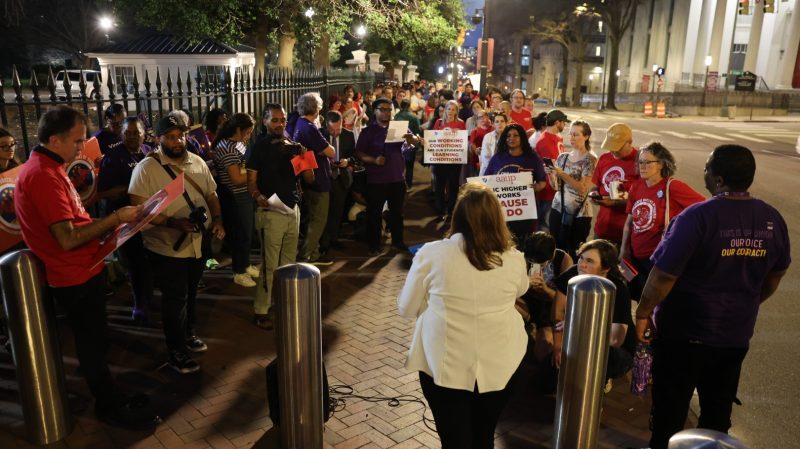
Virginia workers call on lawmakers to expand collective bargaining to all employees outside of the state Capitol building in Richmond on March 11, 2026 (Photo by Nathaniel Cline/Virginia Mercury
Gneiting’s message, demanding that representatives “invest in an adequate, equitable, and just Virginia,” is in response to state lawmakers’ current efforts to repeal a law banning collective bargaining for most public employees.
Those efforts are driven by House Bill 1263 and Senate Bill 378, which have advanced steadily but hit roadblocks when legislators attempted to combine the measures. Two significant differences between them: The House version excludes university employees and home health care workers from the Senate bill.
On Wednesday evening, students, staff, and faculty from Virginia’s public colleges and universities gathered alongside home health care workers to hold a “Unions for All” vigil, calling on the General Assembly to pass legislation that includes all state employees, including workers like the rally goers, near the state Capitol in Richmond.
Supporters of the bills say removing the ban would help protect workers, raise wages, and strengthen the middle class, while opponents — who were not present at Wednesday’s rally — say repealing the ban could lead to higher employer costs, reduced managerial flexibility, and a shift in political power.
Some leaders, including Prince William County Supervisor Victor Angry, who are advocating to try to preserve local-decision making, are concerned the measure would “undermine” their authority by creating a mandatory, statewide collective bargaining system overseen by a new state board, and put smaller localities at risk financially.
“Virginia is strongest when it respects the diversity of its communities and allows solutions to grow from the ground up, not be imposed from the top down,” Angry wrote in an Op/Ed published in Cardinal News.
But between songs and chants Wednesday evening, speakers like medical student Jake Mikesell emphasized that collective bargaining also affects students at Virginia’s schools and patients in hospitals and in-home care.
“When we advocate for the right to unionize, we aren’t just bargaining for ourselves. We are bargaining for the better safety and patient outcomes that come with it,” Mikesell said, highlighting the broader impact.
Senate Majority Leader Scott Surovell, D-Fairfax, and House Majority Caucus Chair Kathy Tran, D-Fairfax, both of whom introduced the proposals, were working to finalize the details of the legislation on Wednesday morning.
“They were telling us something, that our nation is invisible, but we are not invisible,” said Jeanne Robinson, a member of SEIU Virginia 512, at the rally.
Tim Gibson, president of the Virginia Conference of the American Association of University Professors, shared stories of how unions have impacted institutions’ decisions and why collective bargaining is necessary to give faculty and workers a voice.
“A university is researchers, it’s graduate assistants, it’s students, and that is the beating heart of a university,” Gibson said. “No one cares more about the university than we do. This is why faculty and graduate assistants need collective bargaining rights. We care. We are here for the mission.”
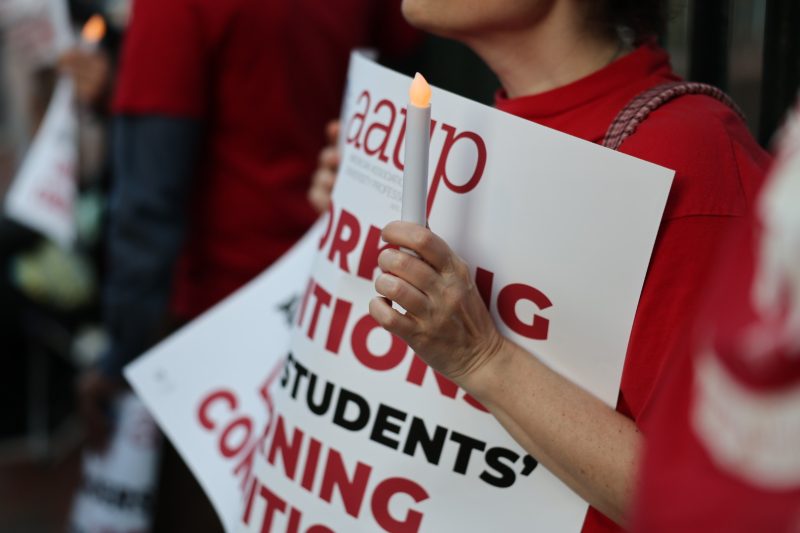
Virginia workers calling for expanded collective bargaining hold candles outside of the Capitol Building in Richmond on March 11, 2026 (Photo by Nathaniel Cline/Virginia Mercury)
Legislation
Prior to the vigil, Tran said she, Surovell, and members of the Virginia Public Sector Labor Coalition are focused on reaching a resolution in coordination with the governor’s administration. The proposals have also gained support from some members of the legislature and at least one member of the executive branch.
“We have an opportunity to make history and lift up our hard-working civil servants across Virginia at a time when (President Donald) Trump is disrespecting our federal employees,” Tran told the Mercury on Wednesday. “We’re working really hard to address the differences in the House and Senate bills and make sure as many public sector employees as possible have collective bargaining rights.”
Del. Charlie Schmidt, D-Richmond, and Sen. Kannan Srinivasan, D-Loudoun, spoke in favor of including all workers in collective bargaining at Wednesday’s vigil.
Schmidt said the measure “is a seat at the table,” and Srinivasan added, “we need to include everyone… this is about fairness. This is about equity.”
Workers also have support from Lt. Gov. Ghazala Hashmi, a former educator, who described them in an earlier statement as the “backbone of local economies.”
“The people who teach our students, maintain the health, safety, and sanitation of dormitories and classrooms, prepare meals and feed the campus community, all deserve a seat at the table,” Hashmi wrote.
Lawmakers have until Saturday to wrap up any legislation before it heads to Gov. Abigail Spanberger for consideration.
by Nathaniel Cline, Virginia Mercury
Virginia Mercury is part of States Newsroom, a nonprofit news network supported by grants and a coalition of donors as a 501c(3) public charity. Virginia Mercury maintains editorial independence. Contact Editor Samantha Willis for questions: info@virginiamercury.com.

CHEO Garden Expands Mission of Food, Learning and Community

Sharing a Room: How to Avoid Sibling Conflicts

Laurel Ridge to Host Week of the Young Child Art Exhibit

Free $1,000 ‘Trump Accounts’ Draw 1 Million Families

‘The Revenant: A Novel of Revenge’

Virginia Lawmakers Close 2026 Session With Focus on Lowering Costs

The 10 Most Important Things That Happened in Virginia’s 2026 Legislative Session

Electric Vehicle Market Adjusts as Industry Rethinks the Road Ahead

Cultures Around the World Mark the Spring Equinox With Unique Traditions

Laurel Ridge to Host 46th Annual Spring Follies: “Back to the ’90s”

Love Revival to Host Free Community Easter Celebration in Front Royal

Salvation Army of Front Royal Plans Annual Dinner and Raffle Fundraiser

Stephen Paul Sill (1955 – 2026)

Virginia Seeks Public Input for 2026 Statewide Rail Plan

Front Royal Craftsmen Revive Centuries-Old Timber Framing Tradition

VDOT: Warren County Traffic Alert for March 16 – 20, 2026

Virginia Lawmakers End Session Without Final Budget

Your Personal Mission Statement: A Guide to Getting What You Want Out of Life
Disappointed In Our Olympic Spirit

How St. Patrick’s Day Became America’s Biggest Irish Party

Virginia State Police Urge Sober Plans for Saint Patrick’s Day Celebrations

In a One-Party County, Internal Party Decisions Affect Us All

Virginia State Police Seize Nearly 100 Pounds of Narcotics, Recover Firearms in Weekly Crime Suppression Effort

Barton Charles “Bart” Haller (1940 – 2026)
