
Local Government
Town COVID-19 ordinance proposals – what do they really mean?
Following a nearly hour-and-forty-minute closed session on a variety of topics including the “disposition” status of the Afton Inn; the legal challenge of Jacob Meza’s January 4 appointment to council; and board and commission appointments, the Front Royal Town Council covered a variety of matters at its Town Hall work session of Tuesday, February 16. And while council adjourned to closed session at 6:34 p.m. with a four-person quorum, Meza and Letasha Thompson absent, when it reconvened to open work session at 8:12 p.m. both Meza and Thompson were present.
While it was a multi-faceted agenda (that will be covered in a related story), three items at that agenda’s conclusion related to COVID-19 Coronavirus pandemic public health guidelines seemed of perhaps the most immediate interest and import to all town citizens.
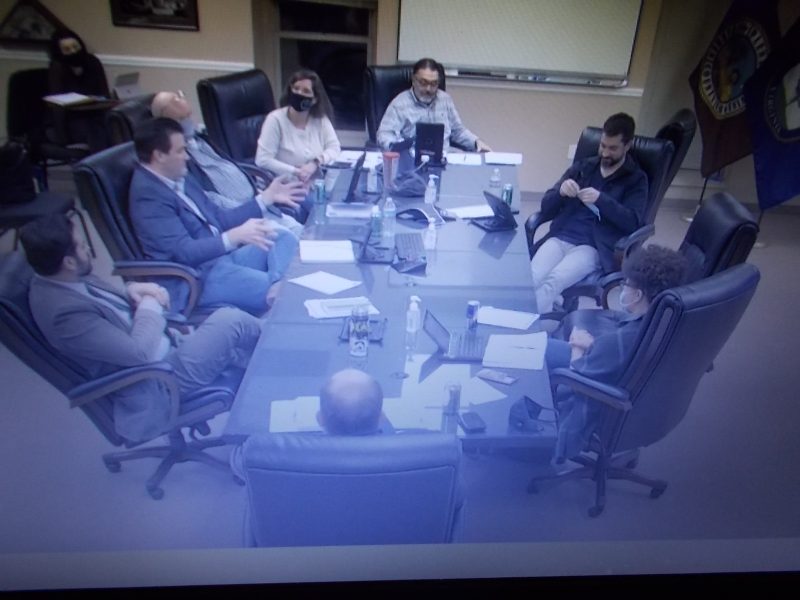
As seen on the Town’s live video broadcast Scott Lloyd, hands extended center left, explains initiatives as council gets down to work session business on Feb. 16. Royal Examiner Photos by Roger Bianchini
Two of those items were ordinance proposals forwarded by first-term Councilman Scott Lloyd, who made waves in his first month in office with a proposal to rename a town street after his former boss at the federal level, Donald J. Trump. This time Lloyd took aim at pandemic public health safety precautions originating at the State level, starting with a gubernatorial Executive Order loophole on a medical exemption to public mask-wearing.
The second Lloyd ordinance proposal would prohibit any business or organizational “entity” operating within the town limits “from requiring its employees, volunteers, members, etc. to receive any of the COVID vaccines as a condition of employment, membership, etc.” once those vaccines are available to them.
The third pandemic item co-sponsored by Lloyd, Meza, and Joseph McFadden took aim at allowing more people into council meetings or work sessions, though under exactly what, if any, social distancing parameters was not initially clear from the agenda summary or subsequent discussion.
Thompson raised questions about where the no vaccination mandate might lead. She noted that currently, Valley Health requires some employees exposed to vulnerable segments of the public to get flu shots and wondered if starting with COVID vaccines, council might move to expand a vaccination prohibition for other diseases or illnesses as well.
As to the increased public participation at council meetings or work sessions, the Town has implemented fairly harsh public meeting social-distancing guidelines that include no admission of non-council or town staff members to Town Hall meeting room work sessions or meetings.
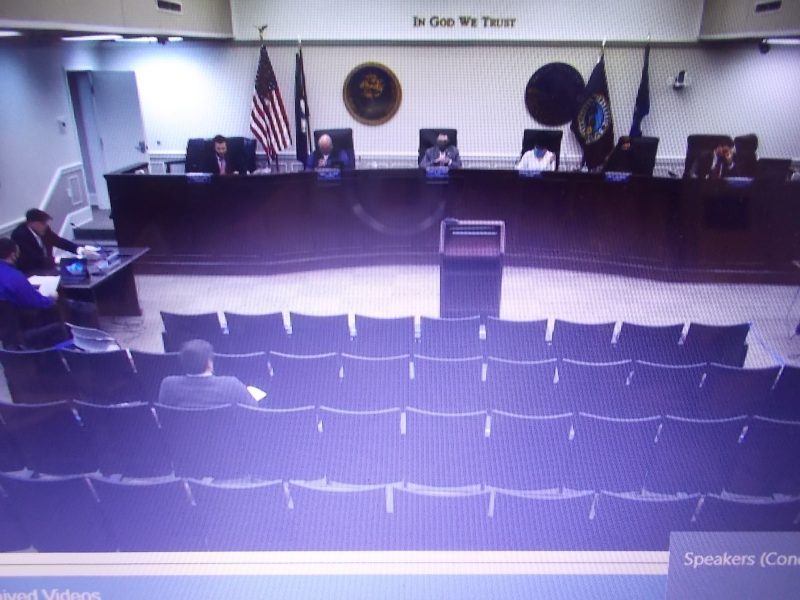
File photo of a largely empty WCGC meeting room at council’s first meeting of 2021 on Jan. 4.
Thompson noted that were council to suggest removal of the installed social-distancing parameters in the Warren County Government Center meeting room to allow full capacities” or something less restrictive than the County has in place, it would need authorization from the county supervisors who have installed the distancing parameters there.
But it was the first of those COVID-related agenda items that really caught our attention.
Presume what?
In introducing his mask ordinance proposal to his colleagues Tuesday, Lloyd said, “Really I think the purpose of this … would be to clarify what the existing legal structure is from the Executive Order (EO) … especially when you consider the health exceptions that I mentioned in the written material.”
The specifically referenced part of Governor Ralph Northam’s Executive Order 72 exempts people who have “health conditions or disabilities” that would create a physical hazard and significant breathing difficulty from having one’s nose and mouth covered per otherwise EO-mandated Coronavirus pandemic masking health precautions.
Lloyd’s “mention” and “clarification” of health exemptions to mask-wearing originates in the Governor’s Executive Order 72’s perhaps over-broad interpretation of HIPAA (Health Insurance Portability & Accountability Act) guidelines passed in the late 1990s.
HIPAA was initially designed to “establish a national set of security standards for protecting certain health information that is held or transferred in electronic form” according to the federal Health and Human Services (HHS) department website. Over the ensuing decades in more than one reporter’s opinion, it has been expanded to withhold information on individual medical conditions or status that used to be routinely released related to public incidents or actions across a broad spectrum previously considered in the public interest. A step in the right or wrong direction? – Depends on one’s perspective and the nature of the information being sought.
In this case, it has led Virginia’s governor to, not only include language in Executive Order 72 that a person claiming a medical exemption to mask-wearing “shall not be required to produce or carry medical documentation verifying stated condition”, but also “not be required to identify the precise underlying medical condition.”
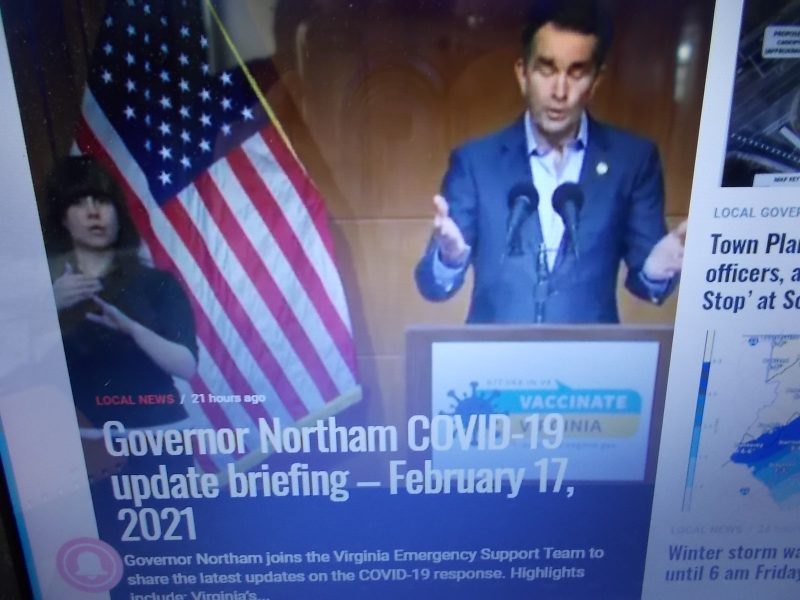
A familiar sight on the Royal Examiner website and elsewhere, as Virginia Gov. Northam conducts another press conference on the status of the statewide COVID-19 pandemic response. Are his Executive Orders infringements on personal liberties or an expression of a majority will toward public health safety precautions, THAT is the question.
“If we were able to clarify through an action like this that okay, this is where the government stands and this is how our attitude is going to be in our town properties,” Lloyd elaborated of the impetus for his proposal.
The proposed Town legislative “attitude” according to the agenda staff summary of Lloyd’s mask ordinance proposal is that: “The proposed ordinance would create a town-wide presumption in the interpretation of the Order that those who are not wearing masks are declining for health reasons …” adding that “nobody shall be required to disclose or identify the medical condition in question.”
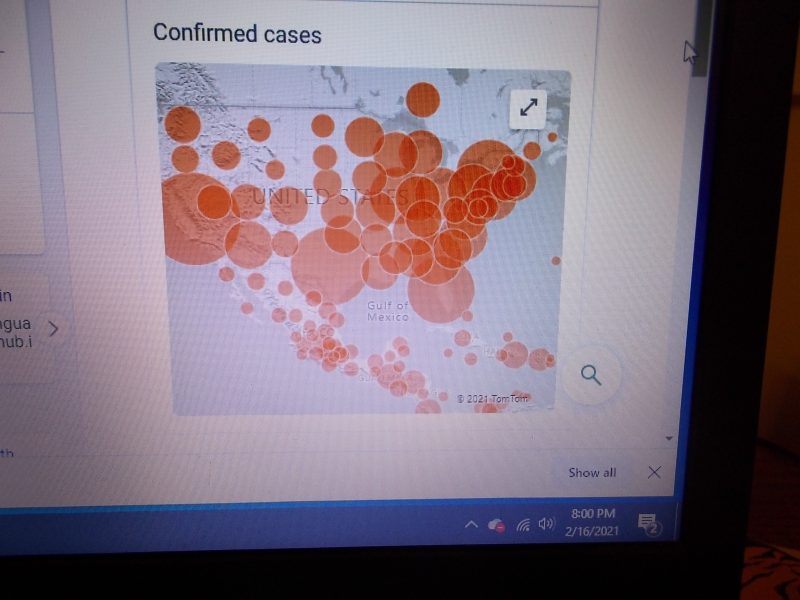
Now call me a cynic – but it appears that Lloyd would have council pass an ordinance taking the governor’s language a step further, in creating a Town Code presuming no one in Front Royal not wearing a mask would lie to cover the fact they just don’t want to and/or don’t believe it necessary to wear face coverings as mandated at the State level. Those public health mandates are a result of the ongoing COVID-19 Coronavirus pandemic that as of February 18, are reported by the U.S. Center for Disease Control (CDC) to have claimed 495,180 lives nationally, of those 7,075 in Virginia and 40 in Warren County over the course of about one year. Globally over 2.43 million deaths are attributed to the pandemic.
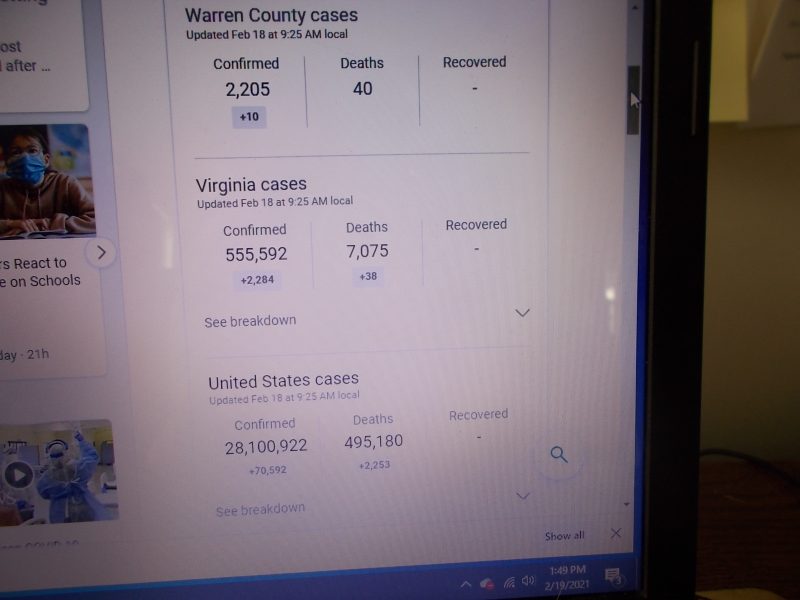
Above, CDC COVID-19 stats of Feb. 18, for the county, state, and nation; below a CDC graphic illustration of confirmed COVID cases in the U.S. and neighboring countries – ‘What, Me Worry?’
So, following the meeting, this reporter contacted Lloyd by email about that concern that a “presumed” medical condition legislative ordinance could be utilized as a different kind of “cover” – cover for a lie that someone who just doesn’t want to wear a mask as a public safety measure, actually has a medical condition to justify the absence of a mask.
His initial response was, “I don’t see it as one party lying. The party is not representing anything about why they are not wearing a mask–the other party is presuming that it is because of health reasons.” – The “other party” apparently being any impacted business, organization, or local public health/safety official operating within the town limits.
In fact, during work session discussion Councilwoman Thompson asked Lloyd if his proposal would limit town business owners from requiring face masks of customers or employees, as some do. She said she wanted to be assured that their right to institute precautions was not limited, so as to protect them and perhaps vulnerable employees, customers, or elderly family members in their homes.
Here McFadden entered the conversation, turning Thompson’s inquiry around. “How do we deal with businesses that infringe upon people’s ADA rights? You know, if they have American Disabilities Act rights to not do something … How do we prevent that, then?” he said, pointing to actual respiratory discomfort from an actual health condition or disability a potential customer might suffer from.
Thompson responded, pointing to alternative service options including call-in orders, curbside pickups, or deliveries that some businesses with mask requirements offer customers who can’t wear masks. While part of Virginia Governor Northam’s Executive Order 72 references a perhaps overbroad interpretation of HIPAA, it continues to elaborate on compromise solutions under the presumption that people claiming medical exemptions actually have a justifying health condition.
“Adaptations and alternatives for individuals with health conditions or disabilities should be considered whenever possible to increase the feasibility of wearing a mask or to reduce the risk of COVID-19 spreading if it is not possible to wear one,” EO-72 states.
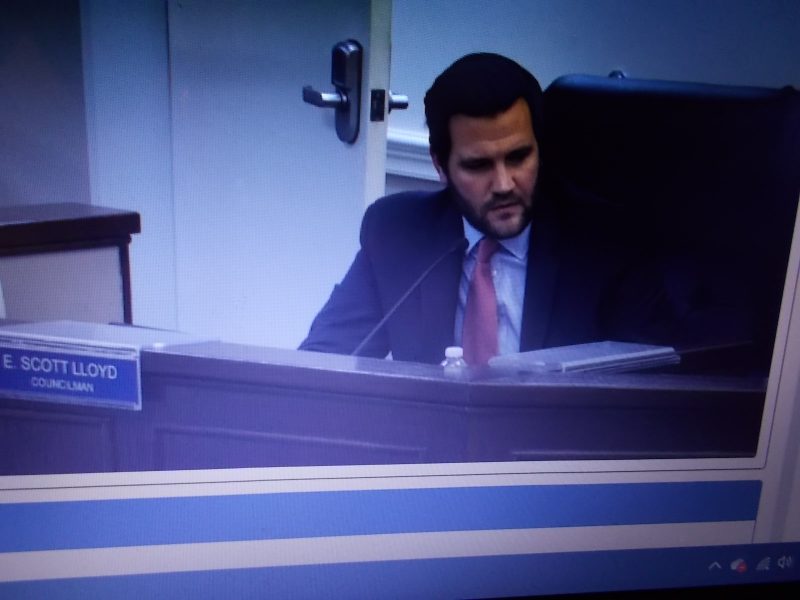
File photo of Councilman Lloyd at his first, post-election council meeting on Jan. 4, at the WCGC
Asked later about Thompson’s concerns on the flip side of his proposal as it might affect businesses wanting to mandate mask-wearing, Lloyd said, “They would be free to do so, as indicated many times in the discussion.” Also in introducing his mask-exemption ordinance Lloyd noted that he was “mindful of our time and the things that we should stick our nose in and keep out of.”
We also later asked Councilman McFadden by email about his perception of the evening’s discussion, particularly the mask ordinance. “My perspective on the mask ordinance is that people are not well informed. Too many people get their information from memes on Facebook or from the unchecked opinions of their peers. And depending on how well their brain responds to fear, people will believe whatever they want to and act however they feel will be in the interest of their survival often regardless of facts, statistics, or long proven and accepted science – some of which now seems to be ‘COVID Logic’ as we discussed and identified in the meeting.”
During the discussion, McFadden said he perceived Lloyd’s clarification ordinance as relieving business owners tasked by State mandates to require masking along sometimes confusing or inconsistent parameters, from having to do so if it is not their choice to do so.
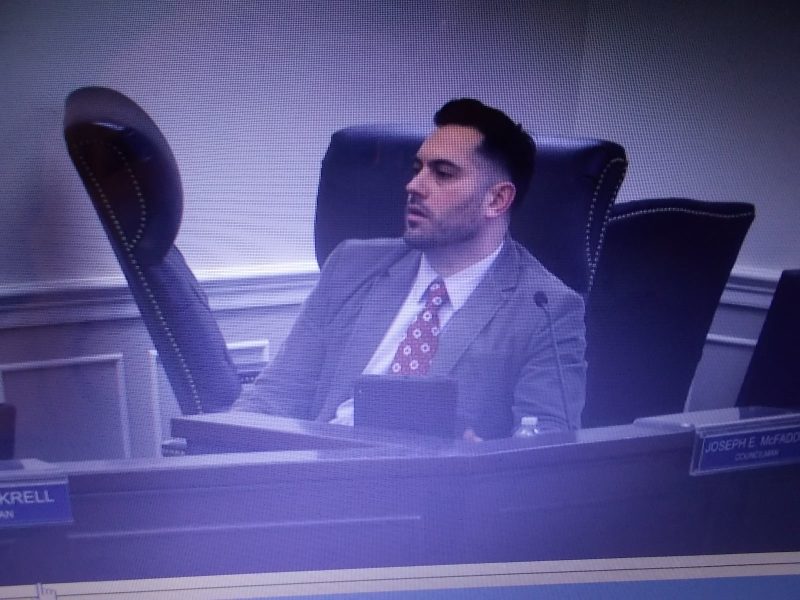
Joe McFadden, also seated at his first meeting as an elected councilman on Jan. 4. During Feb. 16 work session discussion McFadden pointed out that he is part of a new self-identified libertarian council majority, along with Lloyd, Jacob Meza, and Letasha Thompson, seeking to balance federal and state Constitutional rights with local governmental concerns.
Of the mask ordinance proposal, McFadden added, “We’d simply be ensuring that citizens know what the actual Executive Order 72 states regarding mask enforcement. And if it were an ordinance, it would require policing – which is not what Scott was aiming at.”
However, the proposed ordinance language referenced above seems to indicate a lack of policing as the end result of an ordinance “presumption” that someone not wearing a mask has an exempting health condition which they cannot even be questioned about. Of course, I guess there would have to be “policing” to see that the “no-ask, no-tell” mandate wasn’t being violated.
Asked for a council consensus by the mayor, it appeared the proposal was fizzling for now. McFadden suggested that if revisited, council look at approaching the matter at a Constitutional level.
During a subsequent discussion of Lloyd’s proposed mandate against employee or member sanctions for refusing to be COVID-19 vaccinated, McFadden referenced a new four-member council “libertarian” majority among whom such matters and Constitutional perspectives on solutions was a priority. Queried about that four-member majority, both McFadden and Lloyd identified it as including themselves, along with Meza and Thompson.
Of the vaccination ordinance proposal, one of those four, Meza, expressed concern that if approved, council would be “mandating” that impacted businesses or organizations “not mandate” a particular action – “That gives me some concern,” Meza told his colleagues.
Watch these COVID-related discussions in their entirety beginning at the 58:40 mark of the work session video, as well as the earlier discussions and a PowerPoint presentation on town utilities.
Watch the February 16, 2021, Town Council Work Session here.

Warner Files for Reelection, Launching Bid for Fourth U.S. Senate Term

Registrar Urges Residents to Stay Informed and Participate in Upcoming Elections

South River Forum Brings Residents and Leaders Together at Skyline

CHEO Garden Expands Mission of Food, Learning and Community

Sharing a Room: How to Avoid Sibling Conflicts

Laurel Ridge to Host Week of the Young Child Art Exhibit

Free $1,000 ‘Trump Accounts’ Draw 1 Million Families

‘The Revenant: A Novel of Revenge’

Virginia Lawmakers Close 2026 Session With Focus on Lowering Costs

The 10 Most Important Things That Happened in Virginia’s 2026 Legislative Session

Electric Vehicle Market Adjusts as Industry Rethinks the Road Ahead

Cultures Around the World Mark the Spring Equinox With Unique Traditions

Laurel Ridge to Host 46th Annual Spring Follies: “Back to the ’90s”

Love Revival to Host Free Community Easter Celebration in Front Royal

Salvation Army of Front Royal Plans Annual Dinner and Raffle Fundraiser

Stephen Paul Sill (1955 – 2026)

Virginia Seeks Public Input for 2026 Statewide Rail Plan

Front Royal Craftsmen Revive Centuries-Old Timber Framing Tradition

VDOT: Warren County Traffic Alert for March 16 – 20, 2026

Virginia Lawmakers End Session Without Final Budget

Your Personal Mission Statement: A Guide to Getting What You Want Out of Life
Disappointed In Our Olympic Spirit

How St. Patrick’s Day Became America’s Biggest Irish Party

Virginia State Police Urge Sober Plans for Saint Patrick’s Day Celebrations
