
Seasonal
The Angel Band
 Above a lonely field of shepherds and grazing sheep, the heavenly host could hardly contain its joy and excitement.
When the angel of the Lord announced the birth of the Messiah, and suddenly the glory of the Lord filled the sky, the host of angels began praising God and singing the first Christmas carol.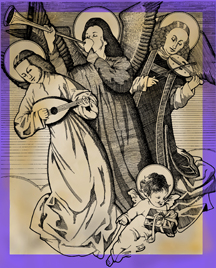
“Glory to God in the Highest and on earth peace to those on whom his favor rests.”
Early Christians knew these words as ‘The Angel’s Hymn.’ It became part of every Christmas celebration as early as 129 AD.
Of course, the Gospel writer Luke actually doesn’t say the angels were singing. Still, through the centuries, artists have depicted the host of angels, joyous at the birth of Christ, as filled with music and song; heraldic angels with trumpets; winsome angels with violin; and the heavenly host as a choir.
The Angel Band, subject of art both ancient and modern, forms the basis of the Christian tradition of caroling, or singing songs on streets and in churches.
In the late 19th century, adults and families went door-to-door singing Christmas songs to their neighbors. Since the 1950s in America, the tradition is mainly continued by Christian youth groups.
In the 21st century, on YouTube, that great chronicler of pop culture, you’ll find movies of young people singing carols while driving down the street in open topped buses.
And, finally, still another new form of caroling has appeared, right in step with technology: The Flash Mob, or we might say the Secret Carolers. One of the most famous such groups performed Nov. 13, 2010, in a Michigan mall. Right between Arby’s and A&W Root Beer, an accomplished soprano soloist suddenly stood up among the mall crowd and began the lovely first phrase of the Hallelujah Chorus. She was joined by soloists and choristers all scattered among the lunch area. At this writing, a video of the carolers has been seen on YouTube 34 million times.
The Angel Band would be proud.

Ideas for Nurturing — or Rediscovering — Your Inner Child

Protein Takes Center Stage in Updated U.S. Dietary Guidelines

Blue Ridge Wildlife Center Acknowledges a Quarter of a Century of Work in Wildlife Preservation & Human Education

What Does A ‘Fair Share’ Really Mean?

South Warren Ruritan Club Hosts 20th Annual Spaghetti Dinner Fuels Scholarships for Local Teens

Trees Take Root as Virginia’s Frontline Defense Against Urban Heat

Virginia Set to Rejoin RGGI as Utilities Prepare to Pass the Cost Back to Ratepayers

Virginia Joins Multi-State Lawsuit Challenging Trump’s Election Order

Trump Budget Seeks 43% Boost in Defense Spending, Cuts in Many Domestic Programs

Virginia Sees 33,000 ACA Enrollment Drop Since Subsidies Expired, More Likely on the Way

Annual Dental Checkups and Cleanings: Essential Appointments

4 Stimulating Activities for a Healthy Brain After 50
The First Amendment: America’s Unique Foundation of Freedom

How to Tackle Credit Card Debt

Summer Enrichment Camp Gives Teens Hands-On Learning Opportunities

VDOT: Warren County Traffic Alert for April 6 – 10, 2026

David Silek to Remain in Chairman’s Seat of WC Republican Committee Pending 6th District Appeal Decision

Sales Set to Bloom Like Daffodils This Spring

America 250: The Bookseller Who Helped Save the Revolution

Business Growth Series: Why Good Businesses Still Struggle to Grow

Brownies with Mini Chocolate Easter Eggs

Shenandoah Downs Opens 11th Season April 11 with Tribute to Roger Hammer

We Don’t Know Everything About DNA

How PAAS Came to Dominate the Easter Egg Dye Tradition
