
Local News
Knocking Down Walls: Desegregation in Warren County Remembered at Royal Cinemas
“Knocking Down Walls”, a student-produced film that takes its title from a quote by Thurgood Marshall, who argued the case against segregation for Brown v. Board of Education, was viewed on the evening of Thursday, February 20 by an audience that nearly filled Royal Cinemas to capacity. This film featured a montage of inspiring images of young colored people approaching Warren County High School and was interspersed with candid reflections from the very people who experienced that history and put on a brave face to fight for their right to an equal education. Some of those people were present for a Q&A panel discussion after the film. “The legal system can force open doors and sometimes knock down walls,” Marshall famously said. “But it cannot build bridges. That job belongs to you and me.” The event was facilitated by Beau Dickerson, Social Studies Supervisor for Rockingham County Public Schools and mentor to the Spotswood High School students who researched, wrote, and produced the film. He said that the evening was intended to build those bridges to perpetuate the achievements of civil rights and to push back against a massive resistance that is not exactly dead.
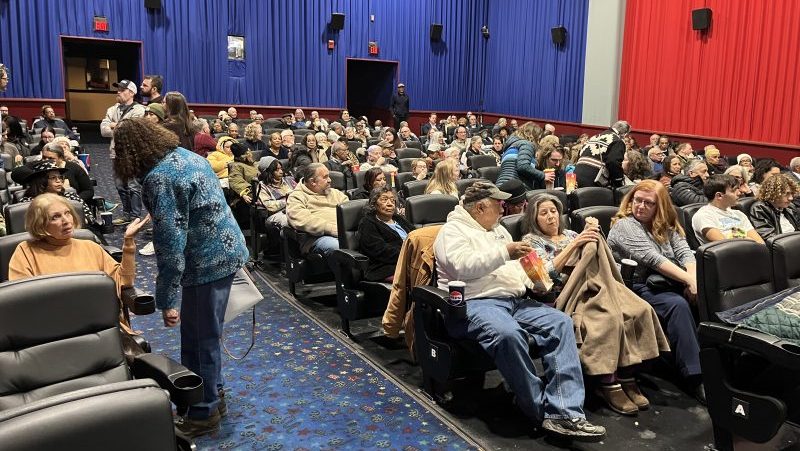
Royal Cinemas was nearly full for a screening of a film on desegregation, followed by a Q&A with people who experienced that chapter of history. Royal Examiner Photo Credits: Brenden McHugh.
The panelists expressed how glad they are that children today can stand on the shoulders of a previous generation and never experience the indignity of walking between two rows of spitting, name-calling white people. Or to reach the doors of Warren County High School only to find them locked, as the governor ordered the school closed eight days after federal judge John Paul ruled in favor of desegregation in relationship to Kilby v. Warren County School Board in 1958. The following year, Judge Paul would order the school reopened, thereby forcing integration, but despite this victory, the colored students, shunned and threatened, would develop memories that would haunt them for a lifetime. This massive resistance to the take-down of “separate but equal” continues to this day as colored people fight to find their way out of the most menial jobs. A woman on the panel expressed that she and her children deserve better than factory work or a fast-food shift. The availability of government jobs in D.C. seems to offer some hope for that journey out of mere servanthood. And there may even be hope of leaving Front Royal, an existence that can be onerous depending on the color of one’s skin and socioeconomic advantages or lack thereof.

Gene Kilby, president of the Warren-Page NAACP, makes opening remarks for the civil rights history event at Royal Cinemas.

One gentleman in the audience on Thursday evening stood up to make a poignant point about the fact that not all colored people wanted to integrate, as many of them had their own schools. He was one of them and now finds it interesting that his legacy is remarkably different than the legacy of the women sitting on the panel that night. Dickerson thanked him for an important history lesson. Indeed, there are different schools of thought among colored people about the best way of reacting to social injustice. While Booker T. Washington argued that the wisest approach for blacks is to develop their own schools and communities and to grow strong in that kind of isolation, his contemporary W.E.B. Du Bois argued passionately that his people should grow up alongside their white brethren, afforded all of the same opportunities and building a community that is not isolated or splintered, but woven together.

With history teacher and patron of the student-produced film, Beau Dickerson, on the far left, Ann Rhodes Baltimore, holding the mic and displaying her school ring, relates her struggle to acquire that ring after a jeweler refused to give it to her.
This documentary presents a powerful story of history and civics—a story about high school students as told by high school students.




Oatmeal: Why Some Swear by It and Some Swear at It

This Week’s Showtimes at Royal Cinemas as of July 24th

Marcelene Fay “Marci” Pinion (1958 – 2026)

Buford “Bo” Lynn Kibler (1942 – 2026)

A Path to Fiscal Responsibility and Public Wellness

Moving Data Center Regulations and Permitting Forward a Dominant Topic of Conversation for County’s Elected Officials

Screen Rules That Actually Work

Blue Ridge Wildlife Center Patient of the Week: American Barn Owl

After Taking Off in Charlottesville, Feds Plan National Electric Aircraft Charging Network Rollout

POLICE: 7 Day FRPD Arrest Report 7/20/2026

FDA: Taylor Farms iceberg lettuce sample produced a false positive for cyclospora

Data Centers Want to Build Their Own Gas Turbines. Would That Skirt State Renewable Energy Laws?

Legal Notice: Virginia Alcoholic Beverage Control (ABC) Authority

Removing a Senator
The Dillon Rule Doesn’t Say What Mr. Cuddeback Implies

Test Your Balance Before the Job Tests It for You
Legal Notice: Virginia Alcoholic Beverage Control (ABC) Authority

Late On Rent? New Virginia Law Gives Tenants More Time and Protection From Eviction

Virginia Schools Gain Spending Flexibility Under Federal Program

Three Useful Car Gadgets for a Better Summer Road Trip

When He Retires, Who Runs the Kitchen?

State of the Assistants: The Second Great Voice-Assistant War

Front Royal Family Practice Files $5-Million Civil Claim Against Valley Health and Warren Memorial Hospital

Virginia Violent Crime Fell Nearly 6% in 2025, State Police Report Shows
