
State News
Plug Pulled: Federal Funding Halt Leaves Virginia’s EV Future in Limbo
Virginia’s push to expand electric vehicle charging stations has hit a major roadblock — 51 of 53 planned projects are now on hold after a federal freeze, jeopardizing efforts to build out the state’s public EV infrastructure.

One of Pilot’s EV Charging Stations on Interstate 95. (Photo by Nathaniel Cline/Virginia Mercury)
The halt comes as experts stress the urgent need for more charging access, arguing it’s critical for reducing carbon emissions generated and accelerating the shift to clean transportation.
Trip Pollard, a senior attorney at the Southern Environmental Law Center, called the freeze both harmful and legally questionable.

“I think it’s problematic, this freeze, both because of the significant environmental and health benefits of electrifying transportation, but also, I think this freeze is illegal,” said Pollard. He pointed to the NEVI statutory language, which he says makes it clear states should be allowed to move forward once their plans are approved — unless Congress intervenes.
With Virginia’s growing number of electric vehicle registrations, Pollard warned that delaying the program will leave the state without the charging infrastructure needed to keep pace.
“I think there’s a real issue about the legality of what they’re doing, in addition to it being a very bad policy move,” he said.
The decision to freeze funding was outlined in a Feb. 6 letter from the U.S. Department of Transportation and Federal Highways Administration, stating that the agency has “rescinded” all guidance of the National Electric Vehicle Infrastructure (NEVI) program. The move is part of President Donald Trump’s broader review of federal transportation programs.

“The FHWA is updating the NEVI Formula Program Guidance to align with current U.S. DOT policy and priorities,” the letter states.
Just days earlier, on Jan. 29, the transportation department revised its policies to mandate economic analysis and ensure all DOT-funded projects provide clear financial benefits to the American economy.
Virginia House Transportation Committee Chair Karrie Delaney, D-Fairfax, isn’t mincing words about the federal government’s decision to halt EV charging projects. The move, she says, defies logic.
“Blocking funds dispersed by Congress doesn’t save taxpayer money, nor does it change the fact that demand for electric vehicles is only increasing — an industry I believed had robust support from the administration,” Delaney said in a statement.

She urged the commonwealth to press forward with the NEVI program despite the freeze and to challenge the decision in court.
“Given that a memo does not supersede law, I strongly encourage Virginia to continue using NEVI funds to build charging infrastructure, as congressionally-directed, and to join in any legal efforts challenging the illegal actions by this administration,” Delaney said.
Before the FHWA pulled the plug, Virginia was slated to receive $100 million over five years from the Infrastructure Investment and Jobs Act to expand EV charging statewide. The funding was meant to ensure stations were available every 50 miles along interstate highways and within one mile of federally designated alternative fuel corridors.
The freeze has already stalled projects. Electrify America, which had applied for funding to install charging stations at the Spotsylvania Towne Centre Mall along Interstate 95 in Fredericksburg, never received the obligated funds before the directive took effect.

“Electrify America is continuing to engage with stakeholders to understand the ongoing developments impacting the National Electric Vehicle Infrastructure program,” said Tara Geiger, a spokeswoman for Electrify America and Electrify Canada. “We remain committed to growing our coast-to-coast Hyper-Fast network to support transportation electrification.”
Despite the setback, Geiger has noted that Electrify America currently operates more than 45 charging stations in the commonwealth, with additional locations set to open this year.
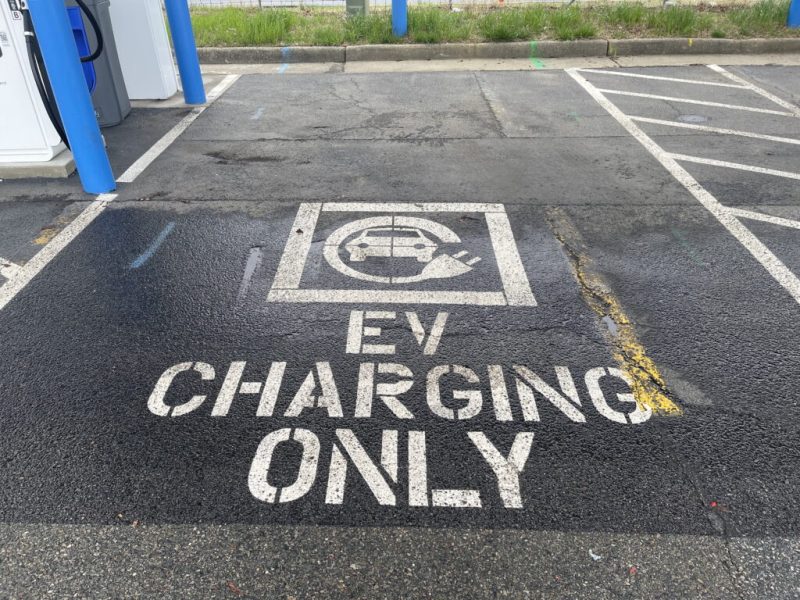
A parking area at one of Pilot’s EV Charging Stations on Interstate 95. (Photo by Nathaniel Cline/Virginia Mercury)
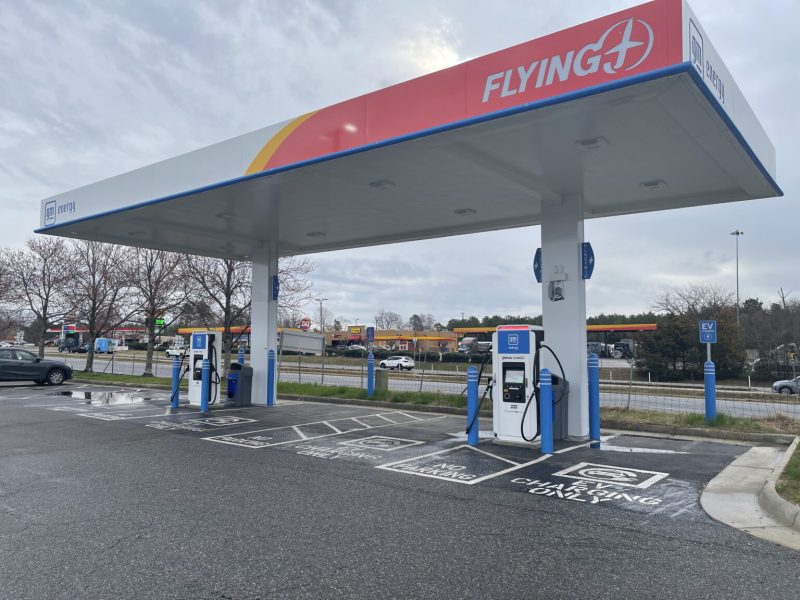
While most EV charging projects in Virginia are stuck in limbo, one is moving ahead. Pilot Travel Center’s planned charging station along Interstate 95 in Skippers was among the few nationwide to receive federal authorization and funding before the freeze took effect, allowing it to proceed.

“Pilot is committed to being the leading energy and experience provider for all drivers,” said Brandon Trama, head of the company’s vehicle electrification and infrastructure.
“While government programs may change over time, we try to anticipate and adapt to those shifts to best serve our guests. With travel centers conveniently located along all major interstates, our charging network aims to fill a need for long-distance EV travelers and we plan to continue building out our EV network.”
With federal funding now on ice, experts say the responsibility falls to states to drive EV infrastructure forward.
Stuart Gardner, executive director of Generation 180, which educates consumers on making the switch to electric, warned that without state leadership, progress could stall.
“Not only does it ensure current and future EV owners have the confidence to drive electric, but it provides Virginia’s industry and workforce the long-term stability to plan for investments and training,” Gardner said.
One way Virginia is stepping up is through House Bill 1791, sponsored by Del. Rip Sullivan, D-Fairfax. The bill aims to assist private developers to cover non-utility costs for installing EV charging stations in rural areas. Gov. Glenn Youngkin is currently weighing the measure, which carries a $2 million funding request.
Sullivan argues that said the bill is a necessity, especially in light of the federal freeze.
“The suspension of the federal NEVI program makes the program established by HB 1791 even more important, and the case for the governor to sign it even more compelling,” he said.
“Whether you like EV’s or not, the number of EV’s on Virginia’s roads continues to grow. Expanding EV charging infrastructure is important to local businesses, and increasingly important to Virginia’s tourism industry, one of Virginia’s largest economic drivers.”
According to the Virginia Department of Motor Vehicles, as of mid-2022, about 311,000 electric, plug-in hybrid or traditional hybrid vehicles were registered in the commonwealth — out of 6.9 million total vehicles.
Sullivan stressed that boosting charging access isn’t just about sustainability — it’s an economic imperative.
We need to ensure that visitors — from Virginia and elsewhere — who want to drive to (and spend money in) our gorgeous rural areas can be confident that they will be able to charge their EV. The program created by HB 1791 will do just that,” he said.
by Nathaniel Cline, Virginia Mercury
Virginia Mercury is part of States Newsroom, a nonprofit news network supported by grants and a coalition of donors as a 501c(3) public charity. Virginia Mercury maintains editorial independence. Contact Editor Samantha Willis for questions: info@virginiamercury.com.




Patricia Ann “Patty” Vaught Brown (1961 – 2026)

Warren County Fire and Rescue to Kick Off Fire Prevention Week Oct. 4

Literacy Volunteers Students Earn Publication in Statewide Magazine

Virginia Transportation Board Schedules Fall Meetings, Including Stops in Weyers Cave and Culpeper

VDOT: Warren County Traffic Alert for September 14 – 18, 2026

Shenandoah River State Park Packs September With Fishing, Night Hikes, Pawpaws and More

How 9/11 Changed the Way America Surveils Its Citizens

Virginia General Fund Revenues Up 5.4% Through August

Virginia State Police Report More Than $580,000 in Drug Seizures During Weeklong Operations

The Night British-Held New York Burned

Spanberger Marks 25th Anniversary of 9/11 at Arlington Fire Station

Frustrations, Remorse and Pain Surface on 25th Anniversary of Sept. 11 Attacks

Twenty-Five Years After the Towers Fell
9/11: Honoring Our First Responders and Remembering the Role of Our Teachers

How the US House Could Overturn the Midterm Election Results

Front Royal Marks 25 Years Since 9/11 With Remembrance at the Gazebo

Beth Macy Discusses Sixth District Campaign, Health Care, Farming and Data Centers

Neurofeedback Specialist to Offer Free Community Program at Samuels Public Library

Warren County Wildcats Host Strasburg Under Friday Night Lights – September 11

Seeing, Listening and Supporting Our Seniors
Virginia’s 6th District Deserves Better Representation

David James “Dave” Lyons (1972 – 2026)

Two Killed in Fiery I-81 Crash Near Exit 310 in Frederick County

Business Growth Series: If You’re Not Listening, You’re Losing Customers
