
Local Government
Town, County work toward a ‘same page’ on dog treatment standards
On March 16, Town and County officials got together for their alternating month liaison committee meeting. Prominent on the 12-item agenda to keep both municipalities abreast of actions by the other that might impact both were:
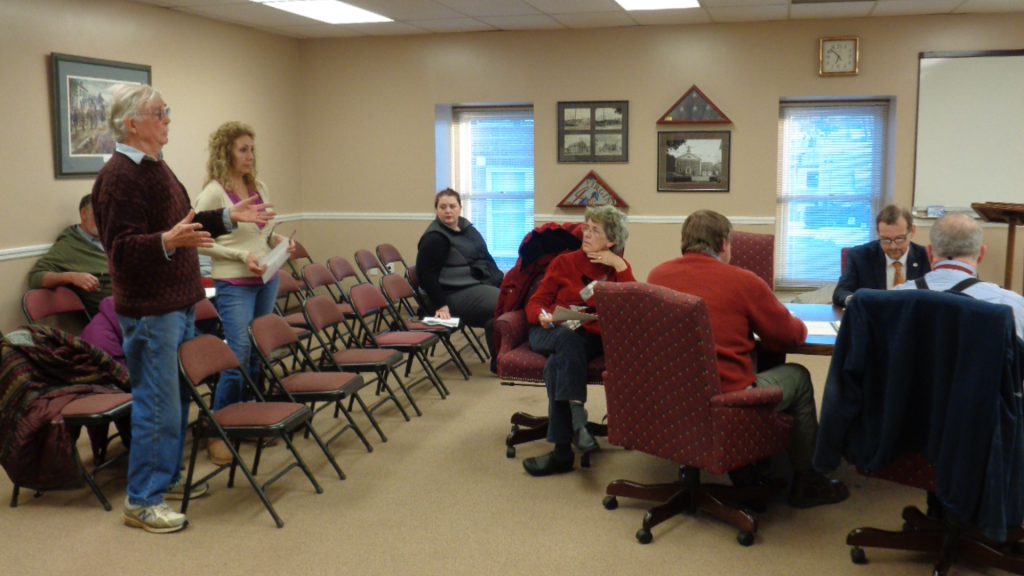
Malcolm Barr Sr. and Carol Vorous make their case on stricter standards on owners of dogs left outside in weather extremes. Photos/Roger Bianchini
- Carol Vorous’s initiative to establish minimum standards of care for dogs during weather extremes;
- progress on Leach’s Run Parkway and the new middle school that will be accessed off the north-south connector road;
- consideration of establishment of a joint municipality Towing Board and preferred list of tow companies;
- establishment of outdoor lighting at a portion of the County’s Soccerplex off Kerfoot Avenue in town;
- and stemming from an update on implementation of the County’s Building Inspection software, discussed the Town utilizing the County Building Maintenance Department to enforce new property maintenance codes, particularly in expanding enforcement standards for rental properties.
Animal Cruelty
Perhaps the most frustrating discussion revolved around Vorous’s dog treatment initiative, first brought to the County on February 7. At both the board of supervisors meeting and work session that day, Vorous proposed establishing minimum standards for the treatment of dogs during weather extremes of cold and heat. It was pointed out during that work session that the town would have to establish its own code to allow Sheriff’s Office Animal Control to enforce standards both in and out of town.

At liaison, the issue of what state codes allow municipalities to do on the issue of minimum standards of treatment for dogs, and tethering in particular, was raised. Virginia is a Dillon Rule state, meaning that localities cannot exceed authority outlined in state codes.
“The state may not let us,” County Administrator Doug Stanley said of setting weather-related tethering standards. However, question later on such difficulties, Stanley acknowledged that there are state animal cruelty statutes that could be utilized in defining standards related to being left outside in weather extremes. The difficulty may be in establishing what is cruel for different breeds in being exposed to those weather extremes, Stanley noted.
“We don’t want put an ordinance of the books that we can’t enforce,” Carter said.
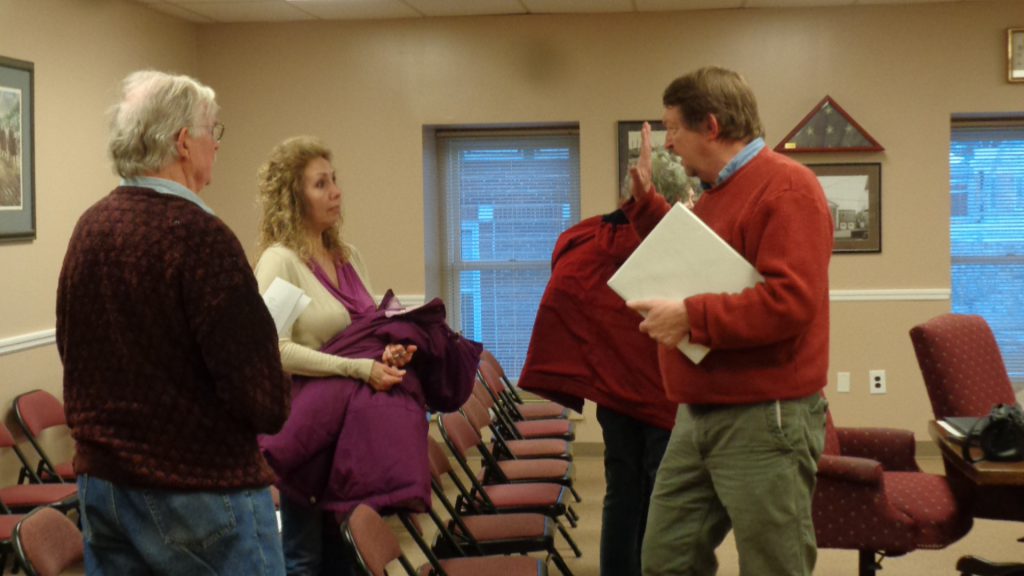
Following the liaison meeting, Tony Carter, to right, right hand up, appears to be illustrating his encased-behind-glass mime impersonation, perhaps illustrating the limitation on localities due to vague state codes on what constitutes abuse or animal cruelty. Photo/Roger Bianchini

Appearing as a former President of the Board of the Humane Society of Warren County, our Malcolm Barr Sr. also addressed liaison about Vorous’s initiative. He suggested a local code not be confined to tethering, but a broader standard of treatment in being kept outside as Vorous has suggested as far as bedding, enclosures, length of tethering, and perhaps even length of time left chained outside.
A little common sense can go a long way in establishing standards for breeds, and shouldn’t be viewed as a roadblock by town and county legal staffs, Barr said. He suggested that a plethora of information might be gathered from the national Society for the Prevention of Cruelty to Animals.
One couple also observing noted they were present because they had working dogs that needed to be kept outside in even weather extremes, as in protecting livestock from coyotes. Barr and Vorous both later acknowledged that exceptions for working dogs that were actually working should certainly be a part of the common sense attached to any eventual code.
Vorous pointed out that until she began working on her current initiative she hadn’t realized how limited animal control was in enforcing complaints about animal cruelty based on vague existing statutes at the state or local level.

Carter suggested that perhaps the best venue to begin the process she was suggesting was at the state level; and to recruit a number of state municipalities to partner in the effort with their state house and senate legislators across the commonwealth.
Contacted after the meeting Barr told us, “Even the huskies like I own and other heavy coated dogs must be protected from weather extremes. I’m pleased that our two jurisdictions are cooperating to accomplish this. A simple tethering law is not sufficient, although it may be a good start.”




Support Scott Lloyd in Warren GOP Leadership Vote

Mexican-Style Grilled Corn on the Cob Adds Bold Flavor to Summer Cookouts

This Week’s Showtimes at Royal Cinemas as of July 31st

Definition and Prohibition of Data Centers Recommended Unanimously at Special Town Planning Commission Meeting

Assistant F&R Chief Gerry Maiatico Responds to South Warren Citizen Concerns About Service Reduction

Virginia Launches New Unit Targeting Illegal Vapes and Intoxicants

Charity, Refugees & Our Constitution

How the 8th Congressional District Democratic Primary Reflects Party’s Shifting Identity and Priorities

Virginia’s Disability Services Gap Persists Despite Progress, Leaves Young Adults Vulnerable

Loudoun County, Other Virginia Localities Consider Hitting the Brakes on Data Center Development

Opposite Shores to Perform July 30 at Gazebo Gatherings

‘People Movers’ Out, More Parking In: Trump Announces $22.5B Washington Dulles Makeover

TSA Shares Passengers’ Personal Information With Immigration Enforcement, Documents Show

Obamacare Enrollment Declines in 49 States; Virginia Saw 8% Drop

Virginia Voters Could Gain a Bigger Voice in Choosing the 2028 Presidential Nominees

Virginia Education Department Seeks New Student Assessment Vendor

Pro-Data Center Industry Group Behind Ad Campaign in Oregon, Virginia, Five Other States

Grilled Beef Salad Makes a Fresh, Protein-Rich Summer Meal

Warren County Welcomes Nearly 50 New Teachers, Looks Ahead to New School Year

Naomi Ruth Davis Eaton (1934 – 2026)

Scott Edward “Scotty” Taylor (1971 – 2026)

Brown Water, Dust and Loud Noises: Louisa Homeowner Sues Amazon Over Data Center Construction

Does Extreme Heat Cause Train Derailments? A Virginia Railroad Expert Weighs In

Administration Asks US Supreme Court to Uphold Sweeping Trump Order Restricting Vote-By-Mail
