
State News
Across Virginia, circuit courts try to reverse an old way of preserving documents
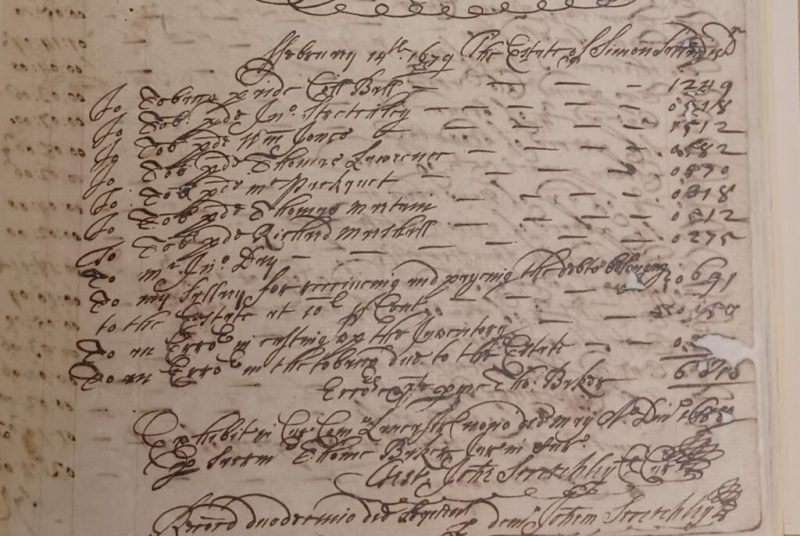
A damaged cellulose acetate volume titled Lancaster County Wills, etc. No. 5, 1674-1689, stored at the Library of Virginia. (Photo courtesy Gregory Crawford / Library of Virginia)
Virginia is home to some of the nation’s oldest documents, squirreled away for centuries on the shelves of its 120 circuit courts.
But encasing many of the pages of the volumes stored on those shelves is an unlikely and unwelcome material: a form of plastic known as cellulose acetate that was used between the 1930s and 1990s to laminate aged and delicate documents. Once seen by archivists and conservators as a cutting-edge form of preservation, cellulose acetate lamination today is known to be a major threat to the conservation of documents because of the damage it causes over time.
“If not addressed now, records that managed to survive three centuries of wars, courthouse fires, and natural disasters will not survive another three centuries,” said a report from the Library of Virginia to the General Assembly this December.
So far, the Library of Virginia has found more than 1500 volumes of documents laminated with cellulose acetate in circuit court collections. Most of those are concentrated in the eastern part of the state, with especially large numbers in Richmond County on the Northern Neck (142 volumes), Essex County (91), and Chesapeake (80).
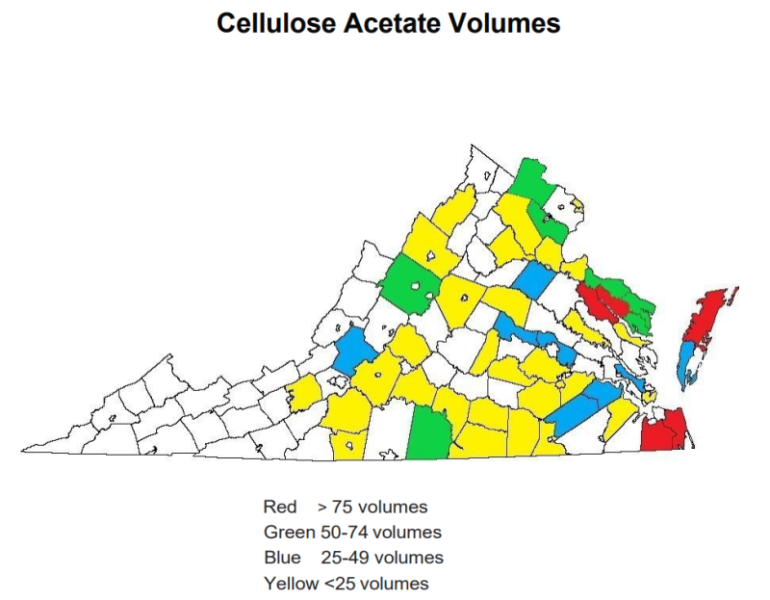
The number of volumes of documents with cellulose acetate lamination. (Library of Virginia)
“These are the oldest records of the locality,” said Greg Crawford, state archivist, and director of government services for the Library of Virginia. “These are records that date back to the early 1700s and even the 1600s in some cases.”
To date, Crawford said he isn’t aware of any Virginia documents that have been wholly lost because of damage associated with cellulose acetate lamination. But because restoring records laminated with the material is a lengthy and costly process, the library has, over the past few years, been working to increase awareness of the problem so circuit court clerks can secure funding to fix it.
“It’s not something that can be done in a couple of weeks,” he said. “It’s a very small number of conservators who can do this type of work.”
A Virginia champion
Cellulose acetate lamination wasn’t unique to Virginia. States up and down the East Coast enthusiastically adopted the practice beginning in the 1930s as the newest innovation in the field of records restoration.
“At the time in the 1930s, the 1940s, and the 1950s, it was believed to be something that was good, something that was valuable,” said Crawford. “At one time, asbestos was thought to be good.”
Virginia, however, was home to one of the most prominent champions of the process: William J. Barrow, a Brunswick County native who became a major figure in records conservation and for several decades ran the Barrow Restoration Shop out of the Library of Virginia, then known as the Virginia State Library.
During the 1930s, the National Bureau of Standards and National Archives began recommending cellulose acetate lamination as a key tool for records conservation. The process was both “harsh and destructive,” said librarian Sally Roggia in a dissertation on Barrow for Columbia University in 1999.
“The document was sandwiched between sheets of cellulose acetate and then subjected to both high pressure and high heat,” wrote Roggia. “The plastic foil was thus melted and forced into the document itself.”
Barrow became interested in the process while working at the Mariners’ Museum in Newport News. After the National Archives constructed a massive, hydraulic laminating press to conduct cellulose acetate lamination on a large scale, Barrow built his own incorporating rollers. His prototype, Roggia reported, “was homemade at Mariners from surplus ship parts of heavy gauge steel.” He later also established a press at the Virginia State Library in Richmond.
As time passed, cellulose acetate lamination was used by more and more conservationists.
“Libraries and archives that had the means purchased their own hydraulic presses or one of Barrow’s patented roller laminators,” the Library of Virginia noted in a fall 2018 newsletter for Virginia’s Circuit Court Records Preservation Program. “Thus began the cellulose acetate lamination craze that swept the nation.”
‘Meticulous and time-consuming’
If the lamination process seemed too good to be true, it was.
Over time, cellulose acetate can cause documents to become discolored, clouded, warped, or brittle. A vinegar odor, said Crawford, is a sure sign deterioration is occurring.
Getting rid of the old lamination isn’t easy, however. Unlike more modern restoration approaches that put a premium on “reversibility” — the idea that anything done to a document today should be able to be easily reversed — cellulose acetate can become permanently adhered to paper fibers if lamination is left long enough.
The Library of Virginia report to the General Assembly called the removal “meticulous and time-consuming, taking anywhere between three months to a year to remove cellulose acetate from one volume.” The estimated cost of treating the roughly 1,500 volumes in Virginia laminated with plastic is between $15 million and $20 million over the next decade.
“You’ve got to be almost like a chemist,” said Crawford. “There’s a lot of variables in this situation. When was this laminated? Was the paper de-acidified prior to lamination? They were constantly rejiggering the ingredients for this over the decades.”
Crawford said he believes the necessary restoration work can be carried out over the next 10 to 15 years using grant funds from the Circuit Court Records Preservation Program, which is funded by the General Assembly and overseen by the Library of Virginia.
The most recent state budget, which also required the library to report on the extent of cellulose acetate lamination in the commonwealth, puts just over $1 million in each of the next two years toward the program.
“It’s a lot of volumes,” said Crawford. “It’s a lot of intense work that’s involved.”
by Sarah Vogelsong, Virginia Mercury
Virginia Mercury is part of States Newsroom, a network of news bureaus supported by grants and a coalition of donors as a 501c(3) public charity. Virginia Mercury maintains editorial independence. Contact Editor Sarah Vogelsong for questions: info@virginiamercury.com. Follow Virginia Mercury on Facebook and Twitter.

5 Tips to Prevent Sports Injuries

Standardbred Owners Ainspan, McDonald Each Score Thoroughbred Wins at Colonial Downs’ Virginia Derby Meet

Most Dangerous Cycling Scenarios Involving Cars

VDOT: Warren County Traffic Alert for March 23 – 27, 2026

Virginia State Police Seize $22.4 Million in Drugs, Recover Firearms in Weeklong Operation

Virginia Home Sales Rise in February as Inventory Grows, Spring Outlook Uncertain

Bing Crosby Stadium Hosts Warren County–Skyline Baseball Battle Tonight

Warren Supervisors Address Audit Contract, Permits, and Property Sale at March 17 Meeting

Here’s How Virginia Lawmakers Suggest the Next State Budget Handle Federal Health Care Funding Fallout

Spring Essentials Checklist: Prepare Your Home for Summer

Virginia Joins National Push for Refunds After US Supreme Court Voids Trump Tariffs

Four Reasons to Consider Hiring a Professional Cleaning Company

Ask the Expert : We Are Applying for a Mortgage Soon. What Kind of Documents Will We Need?

Charles Michael “Rusty” “Chuck” Fischbein (1944 – 2026)

Jerrold E. “Jerry” Groves (1931 – 2026)

Town Planning Commission Moves Forward with Industrial Zoning, Holds Preliminary Discussion of Urban Agriculture

Schools Push for Budget Flexibility, Consistent Funding as Needs Grow

Skyline High Teams, Athletes Successful Seasons and Performances Acknowledged – Oh, and Those Roosters

School Board Seeks to Restore Meals Tax Funding for School Facilities

Wasting Drinking Water: 3 Habits to Eliminate From Your Daily Routine

Medicare Launches TEAM Program to Improve Recovery After Surgery

Izaak Walton League Promotes Conservation and Outdoor Programs at Community Forum

POLICE: 7 Day FRPD Arrest Report 3/16/2026

Blue Ridge Wildlife Center Patient of the Week: Great Horned Owl
