
Local News
Blue Ridge Wildlife Center Patient of the Week: Barred Owl
Have you ever seen an owl’s ears?
Some owl species, like the Eastern screech owl pictured here, have feather tufts on their heads, known as plumicorns (PLOO-mi-korn).

They are often erroneously called “ears”, but their function has nothing to do with hearing.
Plumicorns help with camouflage by breaking up the silhouette and they can also be used to communicate aggression, fear, and more.
Barred Owls do not have plumicorns, but their ears are still an important part of a physical exam.
An owl’s ears are located just behind the eyes, along the edge of the facial disk.

Because the bony structures that support the eyes are visible from inside the ear canal, this area must be carefully evaluated for bruising or injury, especially following trauma.
The facial disk itself is a remarkable adaptation.
Specialized auricular feathers are angled to funnel sound toward the ears. This works much like a satellite dish and allows owls to detect even faint sounds made by prey.
Owls rely heavily on their hearing when hunting. In many owl species, the ear openings are not symmetrical.
One ear is positioned slightly higher than the other.
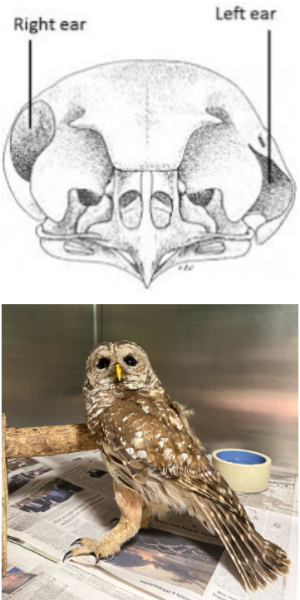
This offset allows owls to detect tiny differences in when sound reaches each ear, helping them determine both the direction and the distance of their prey. In low light or complete darkness, an owl can successfully hunt using sound alone.
This Barred Owl was found on a roadway, likely after being struck by a vehicle. Thanks to the quick response of Loudoun County Animal Services and Kristi’s Caring Hands Wildlife Rehabilitation and Education this owl was safely secured and transported to our hospital for evaluation and treatment.
Our veterinary team identified injuries consistent with a vehicle strike, including a small laceration near the eye and an injury to the coracoid, a bone that plays an important role in shoulder and wing movement. With appropriate care and rest, this owl is responding well to treatment.
We are hopeful that with continued rehabilitation, this patient will be able to make a full recovery and return home to the wild.
Want to know how to become a permitted rehabilitator in VA?
Join us for a webinar from our very own Rehab Director, Jessica Andersen, to get your rehabilitator journey started! Wednesday, January 14, 2026 at 6:00 PM.

We’ll discuss the requirements and expectations of becoming a wildlife rehabilitator, with a simplified, easy-to-understand discussion of the laws, permit conditions, and a step-by-step process and checklist to follow!
Webinars are just $5 for individuals or $10 for a group, and your registration directly supports the care of all of our patients.
Looking for an easy way to help native wildlife? Become a monthly BRWC donor! For as little as $5/month, you can provide year-round, sustainable support that helps us fulfill our mission.

‘The Revenant: A Novel of Revenge’

Virginia Lawmakers Close 2026 Session With Focus on Lowering Costs

The 10 Most Important Things That Happened in Virginia’s 2026 Legislative Session

Electric Vehicle Market Adjusts as Industry Rethinks the Road Ahead

Cultures Around the World Mark the Spring Equinox With Unique Traditions

Laurel Ridge to Host 46th Annual Spring Follies: “Back to the ’90s”

Love Revival to Host Free Community Easter Celebration in Front Royal

Salvation Army of Front Royal Plans Annual Dinner and Raffle Fundraiser

Stephen Paul Sill (1955 – 2026)

Virginia Seeks Public Input for 2026 Statewide Rail Plan

Front Royal Craftsmen Revive Centuries-Old Timber Framing Tradition

VDOT: Warren County Traffic Alert for March 16 – 20, 2026

Virginia Lawmakers End Session Without Final Budget

Your Personal Mission Statement: A Guide to Getting What You Want Out of Life
Disappointed In Our Olympic Spirit

How St. Patrick’s Day Became America’s Biggest Irish Party

Virginia State Police Urge Sober Plans for Saint Patrick’s Day Celebrations

In a One-Party County, Internal Party Decisions Affect Us All

Virginia State Police Seize Nearly 100 Pounds of Narcotics, Recover Firearms in Weekly Crime Suppression Effort

Barton Charles “Bart” Haller (1940 – 2026)

Dawn Lee Dodson (1970 – 2026)

Mary Helen “Nanny” Spires Johnt (1954 – 2026)

Another Round of ‘Momnibus’ Bills Are Headed Towards the Governor This Year

Virginia Joins States Challenging Trump Admin Regulations That Limit Free Birth Control Access
