
Local News
Blue Ridge Wildlife Center Patient of the Week: Big Brown Bat
These insectivores make great neighbors!
This Big Brown Bat came to us after being accidentally power washed from behind its roosting site. The homeowners found two bats, including this one, blown out from behind a shutter on their home. They were wet and cold and immediately brought to us for care.

Photos / Blue Ridge Wildlife Center
After cleaning and warming these bats, we waited for a warm enough day to release them back at their found location.
As we often can’t reach the colony, most bats are released from nearby trees or structures from which they will fly back home. We were extremely fortunate in this case to know exactly where the colony was and to be able to easily access it.
These two bats were placed next to the shutter where they had been blown out of with the power washer and both quickly scrambled back in to join their friends!
Releases are always more enjoyable when we get to witness families reuniting first-hand and ensure that everything went well.
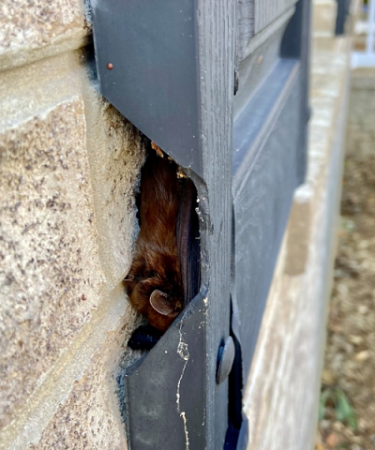
This photo (taken at release) shows both bats rejoined with their family!
Thanks to the homeowners who not only ensured these bats made a recovery, but were happy to allow them back home!
Did you know big brown bats aren’t as “big” as their name implies? In fact, they weigh anywhere between 16-20 grams on average (the same as about 4 nickels), and their wingspan is only 14 inches. However, compared to Little Brown Bats, who are about half their size, their name rings true!
This species is highly social and can live to 20 years old or more, so getting them back home to their friends and family is incredibly important. In the summer, the females live in maternity colonies (with males roosting mostly alone), which studies have shown consist largely of closely-related individuals.
This time of year, even though they’re preparing for hibernation, they’re also preparing for spring! Hibernation colonies consist of both females and males, allowing for mating now and pregnancy later, as the females will store sperm in the reproductive tract over the winter.

Big brown bats are great neighbors! They consume large numbers of agricultural pests (around 1/3 of their weight each night).
Bats in general have been valued at a low-end estimate of $3.7 BILLION/year for their pest-reducing services by the agricultural industry.
If you want to help our native bats and the 3,000+ other patients we treat each year, please donate to BRWC on #GivingTuesday!
Wildlife Centers don’t receive state or Federal funding for what we do. We rely on your donations to save wild animals and return them to the wild.
This year on #GivingTuesday (November 30th) starting at 8am, donations made through Facebook will be matched with an $8 million dollar pledge by the social media platform until the matching funds are exhausted. Your donation will ALSO be matched by our generous board of directors until those funds are met as well.
Please save the date to make a big impact for wildlife!

Blue Ridge Wildlife Center Acknowledges a Quarter of a Century of Work in Wildlife Preservation & Human Education

What Does A ‘Fair Share’ Really Mean?

South Warren Ruritan Club Hosts 20th Annual Spaghetti Dinner Fuels Scholarships for Local Teens

Trees Take Root as Virginia’s Frontline Defense Against Urban Heat

Virginia Set to Rejoin RGGI as Utilities Prepare to Pass the Cost Back to Ratepayers

Virginia Joins Multi-State Lawsuit Challenging Trump’s Election Order

Trump Budget Seeks 43% Boost in Defense Spending, Cuts in Many Domestic Programs

Virginia Sees 33,000 ACA Enrollment Drop Since Subsidies Expired, More Likely on the Way

Annual Dental Checkups and Cleanings: Essential Appointments

4 Stimulating Activities for a Healthy Brain After 50
The First Amendment: America’s Unique Foundation of Freedom

How to Tackle Credit Card Debt

Summer Enrichment Camp Gives Teens Hands-On Learning Opportunities

VDOT: Warren County Traffic Alert for April 6 – 10, 2026

David Silek to Remain in Chairman’s Seat of WC Republican Committee Pending 6th District Appeal Decision

Sales Set to Bloom Like Daffodils This Spring

America 250: The Bookseller Who Helped Save the Revolution

Business Growth Series: Why Good Businesses Still Struggle to Grow

Brownies with Mini Chocolate Easter Eggs

Shenandoah Downs Opens 11th Season April 11 with Tribute to Roger Hammer

We Don’t Know Everything About DNA

How PAAS Came to Dominate the Easter Egg Dye Tradition

Spanberger Signs Bipartisan School-Safety, Student Support Bills Into Law

Melanie J. Pomeroy (1958 – 2026)
