
Local News
Blue Ridge Wildlife Center Patient of the Week: Black Vulture
What is Imping?
This first year Black Vulture was brought into care after being found down and unable to fly. Exam revealed the reason why—the flight feathers on the left wing were completely singed, preventing flight. They were also covered in ectoparasites, dehydrated, and very skinny, all signs they were not doing well as a result of the flight loss.

At the Center, we collect full sets of feathers from birds that do not survive so that they can be donated to a bird in need—a process called imping!

Imping is a method used by wildlife professionals to temporarily replace severely damaged flight feathers with species-specific donor feathers. This allows for recipients to regain flight much quicker than through natural molting. It allows non-flighted birds to fly immediately, helping them maintain muscle condition and return home MUCH quicker!
Luckily, we had a full set of primaries collected from a deceased donor Black Vulture in our feather catalog—feathers must in good condition, species specific, and labeled (regarding order on the wing, type of feather, etc.) in order to be useful. Donated feathers are only placed in the exact position of the destroyed feather, so it is very important to have the right feather!
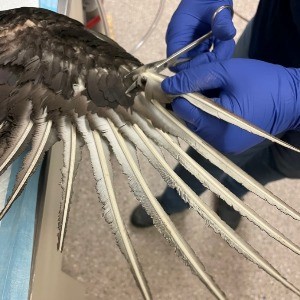
The damaged feather is cut high up on the shaft and, in this case, the remaining shaft itself is used like a dowel to help secure the donor to the original shaft remaining in the follicle.
Donor feathers are secured directly into the recipient’s feather’s shaft using epoxy to secure the dowel (the old feather’s shaft in this case) into the original remaining shaft and the donor shaft.
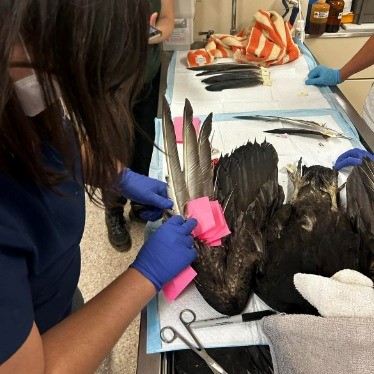
Because the original shaft is connected to the bone in the follicle, the entire feather (original shaft and donated portion) will molt out naturally and without damage and a new feather will grow in.
To prevent damaging feathers, we used Post-it notes to keep the feathers separate while the epoxy cures.
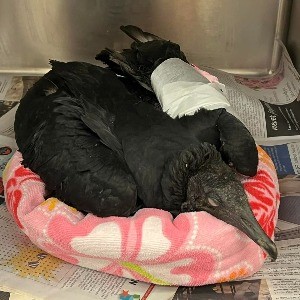
This photo was taken while recovering from anesthesia after feather imping. The bandage is placed for 24 hours to ensure the imped feathers are fully secured.
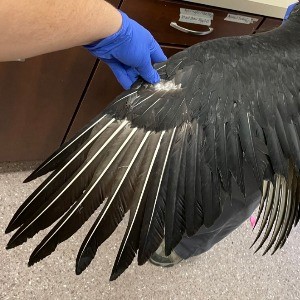
After 24 hours, the bandage comes off and the wing looks as good as new!
This patient is now up and alert and will be moving outside shortly to test out these new wings!
Looking for an easy way to help native wildlife? Become a monthly BRWC donor! For as little as $5/month, you can provide year-round, sustainable support that helps us fulfill our mission.

Electric Vehicle Market Adjusts as Industry Rethinks the Road Ahead

Cultures Around the World Mark the Spring Equinox With Unique Traditions

Laurel Ridge to Host 46th Annual Spring Follies: “Back to the ’90s”

Love Revival to Host Free Community Easter Celebration in Front Royal

Salvation Army of Front Royal Plans Annual Dinner and Raffle Fundraiser

Stephen Paul Sill (1955 – 2026)

Virginia Seeks Public Input for 2026 Statewide Rail Plan

Front Royal Craftsmen Revive Centuries-Old Timber Framing Tradition

VDOT: Warren County Traffic Alert for March 16 – 20, 2026

Virginia Lawmakers End Session Without Final Budget

Your Personal Mission Statement: A Guide to Getting What You Want Out of Life

Disappointed In Our Olympic Spirit

How St. Patrick’s Day Became America’s Biggest Irish Party

Virginia State Police Urge Sober Plans for Saint Patrick’s Day Celebrations

In a One-Party County, Internal Party Decisions Affect Us All

Virginia State Police Seize Nearly 100 Pounds of Narcotics, Recover Firearms in Weekly Crime Suppression Effort

Barton Charles “Bart” Haller (1940 – 2026)

Dawn Lee Dodson (1970 – 2026)

Mary Helen “Nanny” Spires Johnt (1954 – 2026)

Another Round of ‘Momnibus’ Bills Are Headed Towards the Governor This Year

Virginia Joins States Challenging Trump Admin Regulations That Limit Free Birth Control Access

Update: Charlotte Swanson Smith (1951 – 2025)
Why We are Challenging the Republican Mass Meeting

Bruce Norman Showman (1954 – 2026)
