
Local News
Blue Ridge Wildlife Center Patient of the Week: Eastern Screech Owl
Seeing with One Eye, Hearing with Two

This owl was initially found down on New Year’s Eve in Petersburg, Virginia, and was first taken to Richmond Wildlife Center before being transferred to us for specialized care.
Upon examination, our medical team discovered severe damage to one of the owl’s eyes and a fracture at the tip of the beak—both injuries consistent with being struck by a vehicle.
Our Associate Veterinarian, Dr. Emily Hsieh, performed a delicate evisceration procedure to remove the damaged eye. Our team was invited to be present for the procedure—it’s not something we see every day, and it was an incredible opportunity to witness such specialized care firsthand.

An evisceration involves removing the contents of the eye while leaving the outer structures, such as the eyelids and eye muscles, intact. This procedure helps prevent infection and allows the bird to maintain a more natural appearance, which can help reduce stress by preserving normal behaviors like blinking and preening. These natural actions are essential for comfort and can aid in a smoother recovery process.
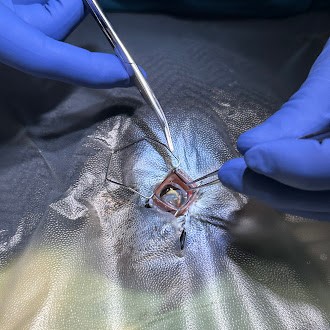
In wildlife medicine, we carefully evaluate whether an animal can survive in the wild after such an injury. For most raptors, losing vision in one eye makes successful hunting and survival nearly impossible. However, owls are the exception!
Owls are uniquely equipped to thrive with monocular vision due to their exceptional hearing. Unlike other raptors, owls have asymmetrically placed ears—one higher and one lower on their heads—which allows them to pinpoint the exact location of sounds.

While hawks, falcons, and eagles rely heavily on precise depth perception from both eyes to hunt, owls use their acute hearing to locate prey. Their facial discs funnel sound directly to their ears, allowing them to detect the slightest movements. This specialized adaptation gives owls an incredible advantage, even with the loss of an eye.
Many vehicle collisions with wildlife happen at dawn and dusk when animals are most active. To help prevent injuries like this, please stay alert while driving, especially in wooded or rural areas.
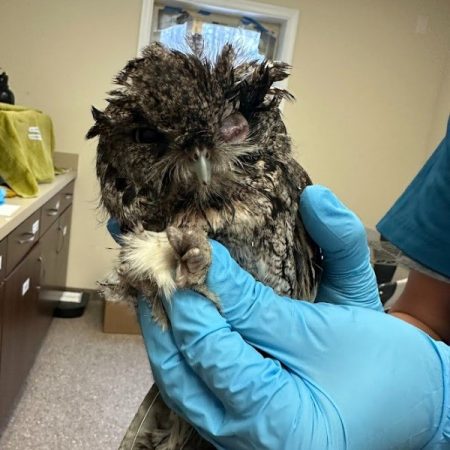
We are hopeful that we can release this one-eyed wonder soon!
Looking for an easy way to help native wildlife? Become a monthly BRWC donor! For as little as $5/month, you can provide year-round, sustainable support that helps us fulfill our mission.

Laurel Ridge to Host Week of the Young Child Art Exhibit

Free $1,000 ‘Trump Accounts’ Draw 1 Million Families

‘The Revenant: A Novel of Revenge’

Virginia Lawmakers Close 2026 Session With Focus on Lowering Costs

The 10 Most Important Things That Happened in Virginia’s 2026 Legislative Session

Electric Vehicle Market Adjusts as Industry Rethinks the Road Ahead

Cultures Around the World Mark the Spring Equinox With Unique Traditions

Laurel Ridge to Host 46th Annual Spring Follies: “Back to the ’90s”

Love Revival to Host Free Community Easter Celebration in Front Royal

Salvation Army of Front Royal Plans Annual Dinner and Raffle Fundraiser

Stephen Paul Sill (1955 – 2026)

Virginia Seeks Public Input for 2026 Statewide Rail Plan

Front Royal Craftsmen Revive Centuries-Old Timber Framing Tradition

VDOT: Warren County Traffic Alert for March 16 – 20, 2026

Virginia Lawmakers End Session Without Final Budget

Your Personal Mission Statement: A Guide to Getting What You Want Out of Life
Disappointed In Our Olympic Spirit

How St. Patrick’s Day Became America’s Biggest Irish Party

Virginia State Police Urge Sober Plans for Saint Patrick’s Day Celebrations

In a One-Party County, Internal Party Decisions Affect Us All

Virginia State Police Seize Nearly 100 Pounds of Narcotics, Recover Firearms in Weekly Crime Suppression Effort

Barton Charles “Bart” Haller (1940 – 2026)

Dawn Lee Dodson (1970 – 2026)

Mary Helen “Nanny” Spires Johnt (1954 – 2026)
