
Local News
Blue Ridge Wildlife Center Patient of the Week: Golden Eagle
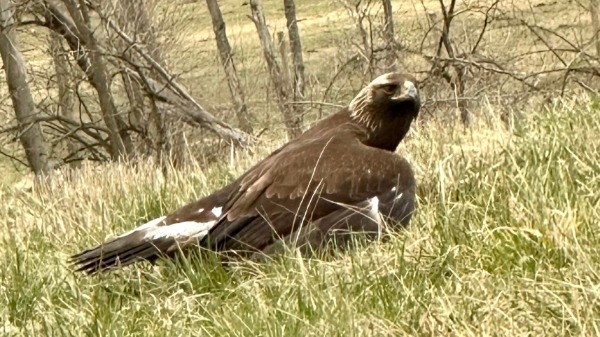
“This is the FIRST Golden Eagle we’ve ever admitted!” Photos / BRWC
This immature Golden Eagle was found down in a field last week, very close to the Center. Staff followed the property owner to the found location and easily contained the extremely weak bird.
The intake exam revealed no obvious fractures or trauma, yet the eagle was very thin and covered in mites and lice.
In-house testing ruled out lead as the cause of the signs, though there was some lead in this bird’s system, but revealed a heavy burden of blood parasites, anemia (low red blood cell count), and an extremely high white blood cell count indicating infection. While we awaited results from additional laboratory testing, we supported this eagle with intravenous fluids and antibiotics.
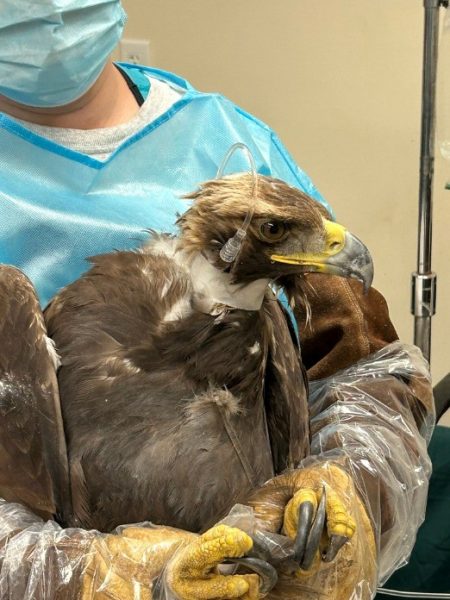
Shortly after placing an intravenous catheter and starting fluids, this patient perked up a bit. We were hopeful they would continue to improve.
After hours of receiving fluids, this eagle attempted to stand, though you can see the bird was still too weak to lift their head.
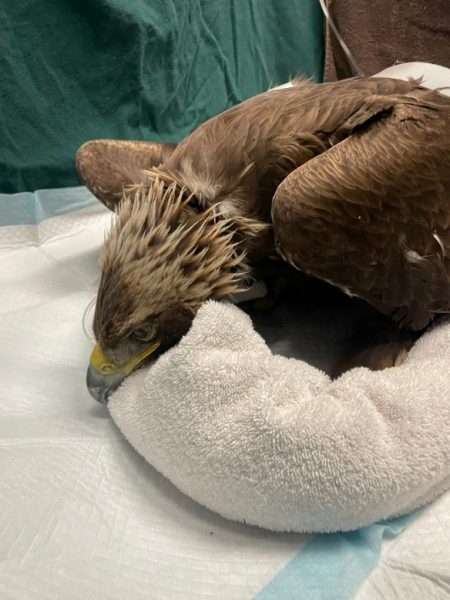
Sadly, this eagle passed away within about 24 hours of care despite treatment.
While some diagnostics are still pending, we have since learned that this eagle was negative for Highly Pathogenic Avian Influenza (HPAI). The patient did have mildly elevated levels of lead and mercury, but both were too low to be the cause of the signs we noted. In addition to the extremely high white cell count, indicating infection, the liver values were also astronomically high.
Based on the liver biopsy we obtained and a minimally-invasive examination of the surrounding tissues, we believe that this eagle died from coelomitis, an infection in the body cavity likely caused, in this case, by liver trauma and necrosis. This eagle was simply too far gone to recover by the time they were admitted.
Often mistaken for immature Bald Eagles, Golden Eagles can be identified by a few key characteristics.
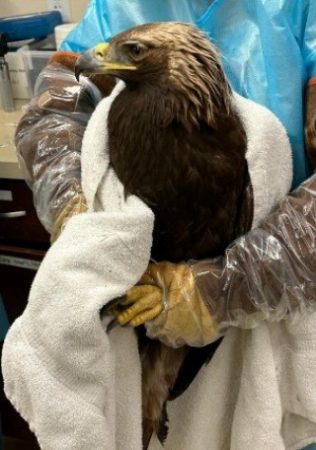
Golden Eagles have smaller heads than our more common Bald Eagles, with more proportional beaks, golden feathers on the nape that do not change with age, and a bright yellow cere (base of upper beak).
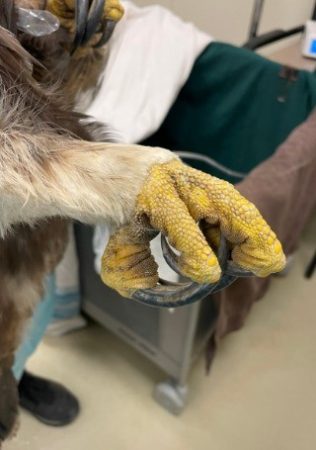
Golden’s have feathers all the way down to their feet (unlike Balds that have naked legs). They are also more closely related to hawks than Balds, who are classified as “fishing eagles”. Check out the insane talons on this bird – no surprise they are a fierce hunter and predator!
Looking for an easy way to help native wildlife? Become a monthly BRWC donor! For as little as $5/month, you can provide year-round, sustainable support that helps us fulfill our mission.

South Warren Ruritan Club Hosts 20th Annual Spaghetti Dinner Fuels Scholarships for Local Teens

Trees Take Root as Virginia’s Frontline Defense Against Urban Heat

Virginia Set to Rejoin RGGI as Utilities Prepare to Pass the Cost Back to Ratepayers

Virginia Joins Multi-State Lawsuit Challenging Trump’s Election Order

Trump Budget Seeks 43% Boost in Defense Spending, Cuts in Many Domestic Programs

Virginia Sees 33,000 ACA Enrollment Drop Since Subsidies Expired, More Likely on the Way

Annual Dental Checkups and Cleanings: Essential Appointments

4 Stimulating Activities for a Healthy Brain After 50

The First Amendment: America’s Unique Foundation of Freedom

How to Tackle Credit Card Debt

Summer Enrichment Camp Gives Teens Hands-On Learning Opportunities

VDOT: Warren County Traffic Alert for April 6 – 10, 2026

David Silek to Remain in Chairman’s Seat of WC Republican Committee Pending 6th District Appeal Decision

Sales Set to Bloom Like Daffodils This Spring

America 250: The Bookseller Who Helped Save the Revolution

Business Growth Series: Why Good Businesses Still Struggle to Grow

Brownies with Mini Chocolate Easter Eggs

Shenandoah Downs Opens 11th Season April 11 with Tribute to Roger Hammer

We Don’t Know Everything About DNA

How PAAS Came to Dominate the Easter Egg Dye Tradition

Spanberger Signs Bipartisan School-Safety, Student Support Bills Into Law

Melanie J. Pomeroy (1958 – 2026)

David Benjamin Heller (1990 – 2026)
1776 Wasn’t Just About Independence
