
Local News
Blue Ridge Wildlife Center Patient of the Week: Red Fox
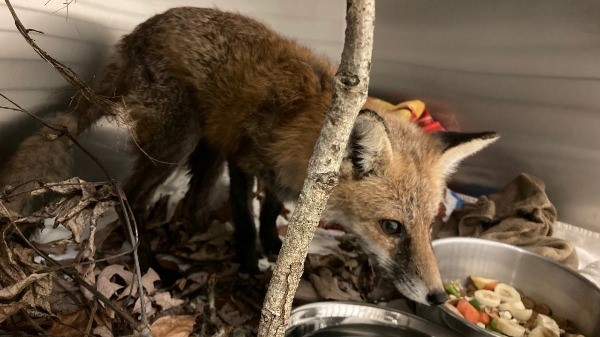
This fox needed a blood transfusion. Photos BRWC
This young fox was brought to us on Thanksgiving Day, after she was contained for removal from an unusual situation.
She had been frequenting a busy establishment for several weeks, where the finder reported multiple observations of her scavenging from their dumpster. While foxes scavenging in an urban area isn’t too uncommon, our level of concern jumped significantly after we discovered that many patrons of this establishment had been seen feeding her directly out of their hands. After associating humans with receiving these easy meals, she had become increasingly bolder to the point of regularly entering the building for food, ignoring attempts to shoo her away.
Her habituation to people made containment abnormally easy—when the finder set a dog crate in front of her, this fox voluntarily walked right in.
While she was relatively alert and afraid of our staff on intake, she was quiet and not showing normal fear behaviors like a healthy, adult fox should. Although her radiographs revealed she had had an old traumatic injury that caused broken ribs, and her mites and emaciation explained her desperation for food, she wasn’t showing much improvement, and in some ways her behavior had gotten worse.
During rechecks on blood, Dr. Emily found many of her red blood cell percentage to be critically low, to the point we were shocked that she was as active and mobile as she was. It was determined she would need a blood transfusion in order to give her the best chance at recovery.
But how does one give a blood transfusion to a wild animal?
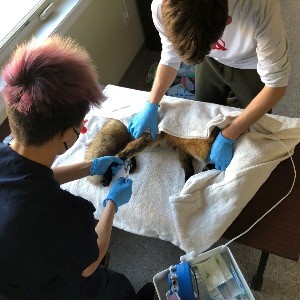
Unlike human blood, there are no blood banks or methods of storing wild animal blood for moments like these. Instead, blood must be taken from a donor and transfused shortly after. Thankfully, the first blood transfusion has low reaction risk and does not require type-matching, and we luckily had an appropriate donor on site.
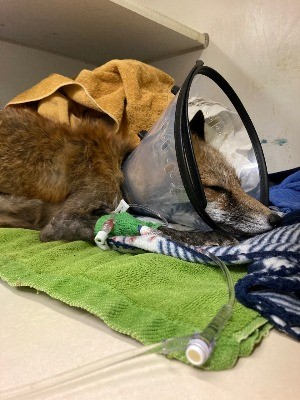
This procedure required multiple teams to be set up both to sedate and restrain the donor for drawing blood (top photo), as well as to sedate and monitor the patient while waiting for the transfusion as well as during the entire set up (bottom photo).
Then monitoring was required afterwards to make sure both animals recovered appropriately and there were no adverse reactions.
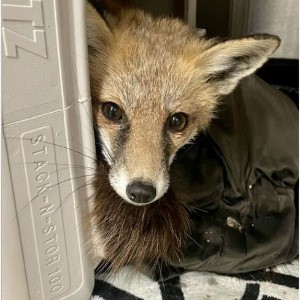
While we can’t be sure exactly what caused this fox’s anemia to become so severe, we suspect this must have been a slow-going, chronic issue this patient has been dealing with and adjusting to over time, likely from the traumatic event that left her with broken ribs.
It’s likely that with this injury, her emaciation, and the onset of mange, she didn’t have the ability to regenerate enough blood on her own, and with each additional health issue, it only made it worse.
This fox is doing well in care and has been improving consistently!
She still has a ways to go, but as always, we are hopeful for a full recovery and release.
If you are looking for an easy way to help native wildlife become a monthly BRWC donor! For as little as $5/month, you can provide year-round, sustainable support that helps us fulfill our mission.

Blue Ridge Wildlife Center Acknowledges a Quarter of a Century of Work in Wildlife Preservation & Human Education

What Does A ‘Fair Share’ Really Mean?

South Warren Ruritan Club Hosts 20th Annual Spaghetti Dinner Fuels Scholarships for Local Teens

Trees Take Root as Virginia’s Frontline Defense Against Urban Heat

Virginia Set to Rejoin RGGI as Utilities Prepare to Pass the Cost Back to Ratepayers

Virginia Joins Multi-State Lawsuit Challenging Trump’s Election Order

Trump Budget Seeks 43% Boost in Defense Spending, Cuts in Many Domestic Programs

Virginia Sees 33,000 ACA Enrollment Drop Since Subsidies Expired, More Likely on the Way

Annual Dental Checkups and Cleanings: Essential Appointments

4 Stimulating Activities for a Healthy Brain After 50
The First Amendment: America’s Unique Foundation of Freedom

How to Tackle Credit Card Debt

Summer Enrichment Camp Gives Teens Hands-On Learning Opportunities

VDOT: Warren County Traffic Alert for April 6 – 10, 2026

David Silek to Remain in Chairman’s Seat of WC Republican Committee Pending 6th District Appeal Decision

Sales Set to Bloom Like Daffodils This Spring

America 250: The Bookseller Who Helped Save the Revolution

Business Growth Series: Why Good Businesses Still Struggle to Grow

Brownies with Mini Chocolate Easter Eggs

Shenandoah Downs Opens 11th Season April 11 with Tribute to Roger Hammer

We Don’t Know Everything About DNA

How PAAS Came to Dominate the Easter Egg Dye Tradition

Spanberger Signs Bipartisan School-Safety, Student Support Bills Into Law

Melanie J. Pomeroy (1958 – 2026)
