
Opinion
Concerns Raised Over Warren County Broadband Pricing
I attended the Warren County Board of Supervisors meeting on February 4, 2025, where Tom Innes provided an update on All Points Broadband (APB) and the VATI project pricing. While expanding broadband access to rural areas is a commendable goal, I was deeply concerned by the proposed pricing model. Given that VATI is a publicly funded initiative intended to make broadband more accessible and affordable, the pricing structure does not align with this mission.
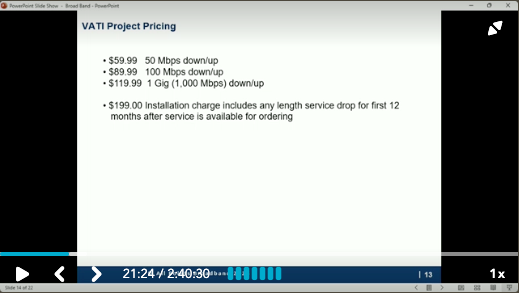
The proposed pricing tiers—$60 for 50 Mbps, $90 for 100 Mbps, and $120 for 1 Gbps—are considerably higher than what many private providers offer for equal or better speeds. Local providers like Glo Fiber and Brightspeed provide much better value:
- Glo Fiber: 600 Mbps for $70, 1.2 Gbps for $85, and 2.4 Gbps for $140.
- Brightspeed: 200 Mbps for $49 (with promotional rates as low as $29), 500 Mbps for $69, and 1 Gbps for $69.
The FCC defines the minimum broadband speed as 100 Mbps down / 20 Mbps up, with a long-term goal of 1 Gbps by March 2024—yet the proposal includes a 50 Mbps plan.
One of the biggest issues with VATI’s pricing is the poor cost-to-speed ratio at lower tiers. For example, the 50 Mbps plan costs $1.20 per Mbps, while the 1 Gbps plan is only $0.12 per Mbps—a tenfold difference. This structure disproportionately affects those who can only afford lower speeds, effectively forcing residents to either overpay or remain on outdated, slow connections. A graph comparing the cost per Mbps of VATI against other providers would make this disparity even more evident.
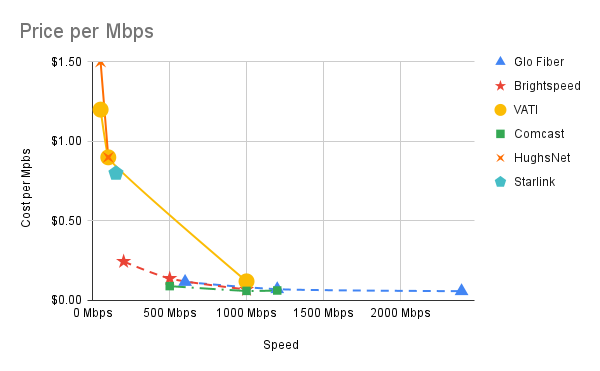
It’s difficult to overlook the likelihood that these prices are intended to push our residents into higher tiers, regardless of their affordability. A more reasonable pricing structure would set the lower tiers at $15 and $30 per month. While still higher than terrestrial competitors, this would at least address the noticeable price gap. Moreover, speeds of 50 and 100 Mbps feel inadequate, similar to what you would find with satellite providers like HughesNet or Starlink. For comparison, standard mobile plans charge $0.15 to $0.30 per Mbps with 5G coverage, but they come with data limits. A more suitable minimum offering would be 200 Mbps at $0.30 per Mbps or less, ensuring that Warren County residents get value on par with other terrestrial broadband options.
Given the current pricing, residents with satellite service have little incentive to switch. For example, Starlink offers speeds of 30-150 Mbps and unlimited data for $120 per month, making VATI’s pricing neither affordable nor competitive, unless it’s a particularly cloudy day. If the goal is to genuinely improve broadband access, why are these rates on par with satellite service, rather than reflecting the more cost-effective nature of fiber and copper? Personally, I only switched to fiber when the monthly cost dropped and my cable provider’s bill went up—reducing the price gap to just $10, while providing a 300% speed increase and symmetrical upload and download speeds.
The additional $200 installation fee creates yet another barrier, especially when other providers offer free or heavily discounted installation. This added cost discourages sign-ups and raises concerns about whether APB is truly prioritizing broadband expansion or simply capitalizing on public funds with minimal accountability. If I had been faced with a $200 installation fee, I likely would have remained on copper and accepted the rising monthly costs.
It was argued that a universal installation fee is necessary because some residents have driveways up to half a mile long. However, this approach forces homeowners along existing fiber lines to overpay for installation. Furthermore, my father’s driveway is a full mile long, and he wasn’t charged for installation. In his case, fiber was extended to the end of his driveway, with copper running the rest of the way to his house—yet he still enjoys the benefits of broadband, a vast improvement over dial-up. If similar infrastructure investments were feasible in a remote area of West Virginia, why are rural Virginians being burdened with excessive costs for a publicly funded service?
Public funding for broadband should aim not only for coverage but also for fair and competitive pricing. Currently, VATI’s pricing seems to prioritize infrastructure over affordability, which makes it challenging for many residents, particularly those on fixed incomes, to benefit. I encourage county officials and stakeholders to reassess this pricing model to ensure that taxpayers funding this project receive a fair value in return.
In closing, I want to raise some concerns about All Points Broadband. They have a history of delays in reporting on their progress. Rappahannock County is working on an exit plan from the project due to delays in delivering high-speed internet, and just last month, a supervisor from Culpeper called the project an “abject failure.” The company is also a year behind schedule in Fauquier County. When the project is finished in Fauquier, it’s reported that residents with access will be able to get service at speeds of one gigabit per second, with no data caps, for under $60 per month—comparable to Comcast’s current offering in Warren County. This raises an important question: Why is Fauquier receiving reasonable pricing for speeds 20 times faster than what is offered in Warren County at the same price by the same company?
- Rappahannock News: Rappahannock supervisors seek ‘exit plan’ options from All Points Broadband project, February 3, 2025
- Fauquier Times: All Points Broadband plan 11 months behind schedule, December 3, 2024
- Federal Communications Commission (FCC): FCC Increases Broadband Speed Benchmark, March 14, 2024
If the internet can’t be fast, at least let the prices be reasonable.
Lewis Moten
Warren County
Disclaimer: The opinions expressed in the letters published on this page are solely those of the respective authors and do not necessarily reflect the views or opinions of the Royal Examiner’s editorial team, its affiliates, or advertisers. The Royal Examiner does not endorse or take responsibility for the accuracy, completeness, or validity of any statements made by the authors. The Royal Examiner has not independently verified the statements and claims presented in the letters. Readers are encouraged to exercise their own judgment and critical thinking skills when evaluating the content. Any reliance on the information in the letters is at the reader’s own risk.
While the Royal Examiner makes every effort to publish diverse opinions, it does not guarantee the publication of all received letters. The Royal Examiner reserves the right to edit letters for clarity, length, and adherence to editorial guidelines. Moreover, the Royal Examiner does not assume any liability for any loss or damage incurred by readers due to the content of the letters or any subsequent actions based on these opinions.
In submitting a letter to the editor, authors grant the newspaper the right to publish, edit, reproduce, or distribute the content in print, online, or in any other form.
We value the engagement of our readers and encourage open and constructive discussions on various topics. However, the Royal Examiner retains the right to reject any letter that contains offensive language, personal attacks, or violates any legal regulations. Thank you for being a part of our vibrant community of readers and contributors, and we look forward to receiving your diverse perspectives on matters of interest and importance.

Spanberger Joins Other Governors in Push for PJM to Prioritize Ratepayer Protections

Cannabis Testing Challenges Persist as Virginia Retail Market Nears

Quick Quiz on Tooth Decay

The Fat Facts: Busting Common Food Myths

Importance of Chiles v. Salazar and the Protection of Free Speech

MAGA Suicide?

Warnick Posts Natural Hat Trick as Shenandoah Downs Opens Spring Meet

Youngkin Returns to Campaign Trail, Calls for Court to Strike Redistricting Vote

‘We Have To Do Something’: Former U.S. Attorney General Eric Holder Supports Virginia Redistricting

3 Ways to Extend the Life of Your Electric Vehicle Battery

Serious Charges Highlight Warren County Grand Jury Indictments

Ducks, Flowers, and Fun: Redbud Festival Returns to Browntown

Potato-Crust Quiche Makes a Lovely Brunch

Faye Barr Vance (1930 – 2026)

James Christopher “Chris” Sain (1948 – 2026)
Alice “Maybelle” Henson (1938 – 2026)

How Sleep and Stress Affect Cancer Risk

Spanberger Signs Sweeping Public Safety and Gun Violence Bills

Horses, Fans Return as Shenandoah Downs Season Begins

Skill Games Halted Again as Spanberger Issues Veto

VDOT: Warren County Traffic Alert for April 13 – 17, 2026

The Cat Who Outlasted Six Prime Ministers
Front Royal, Virginia. Vacation Destination?

Virginia State Police Report Major Drug Seizures in Weekly Crime Suppression Effort
