
Local Government
Council supports FRPD school zone speed enforcement cameras, okays move toward maintenance of unimproved alleys
After reviewing five items slated to appear on the Consent Agenda at the May 22nd meeting, at its work session of May 8, the Front Royal Town Council and staff took on three items for more extensive discussion on departmental initiatives involving the town police and public works departments. Those included two of wider public interest, the placing of Speed Camera Enforcement in School Zones and taking on regular surveying and maintenance of unimproved alleys throughout town.
A third item, also involving the Front Royal Police Department, appears headed to that May 22 Consent Agenda for routine approval after council’s discussion with Chief Kahle Magalis about the reasoning and logistics of the move. That request was to allow FRPD to utilize $36,000 in Asset Forfeiture Funds to help it upgrade its standard-issue firearms for officers.
Magalis responded to questions related to the agenda summary of the matter. That summary notes that: “Currently issued weapons are ten years old. The previous decade has seen a tremendous rise in available technology and ammunition development to provide officers with enhanced abilities for training and firing accuracy. The department has used Glock 21 (.45 caliber) as its standard issue for 20 years. The department intends to stay with Glock as its standard firearm; however, the transition would be to the 9-mm caliber of ammunition and the enhanced optics of an RMR sighting system along with its standard sights.”
Council seemed on board with the non-tax-supported funding that would also be supported in part financially by the contracted sale of seized or used weapons.
Back on the non-Consent Agenda topics likely headed to public hearings at some point, prioritizing road safety and speed limit enforcement in school zones on well-traveled town roads while the community’s children are arriving and leaving school was cited in the FRPD proposal to install Speed Cameras, initially in four locations (discussion begins at 30:40 mark linked video). Chief Magalis noted the need for camera enforcement to back up the five patrol units he has on the road on any given shift. He told council and the mayor that school zone placement of enforcement cameras was a developing trend across the commonwealth.
The locations cited were Strasburg Road (A.S. Rhodes Elementary), Criser Road (Ressie Jeffries Elementary), Luray Avenue (Skyline Middle School), and Leach Run Parkway (Warren County Middle School). When Councilman “Skip” Rogers, whose Able Forces veterans assistance office is on Chester Street near E. Wilson Morrison Elementary, suggested adding Chester Street to the mix, Chief Magalis noted the department was only likely to be able to get four cameras to begin with due to the rising demand statewide for the equipment.
Speed studies would be done prior to installation, then the cameras were anticipated to be in place for “a couple of years,” Magalis told council. They would be operational only during the hours around school opening and closing when students arrive and depart. Improving safety was cited, not only for students who walk to school but also for those who are being dropped off and picked up by vehicles entering and exiting school grounds. A.S. Rhodes and Strasburg Road were cited for specific concern on that latter front. The potential of utilizing the cameras at various school locations for special events like ballgames or graduations was also noted by the chief. And if the program is successful, eventually, other school sites would be added as more cameras become available, the chief pointed out.
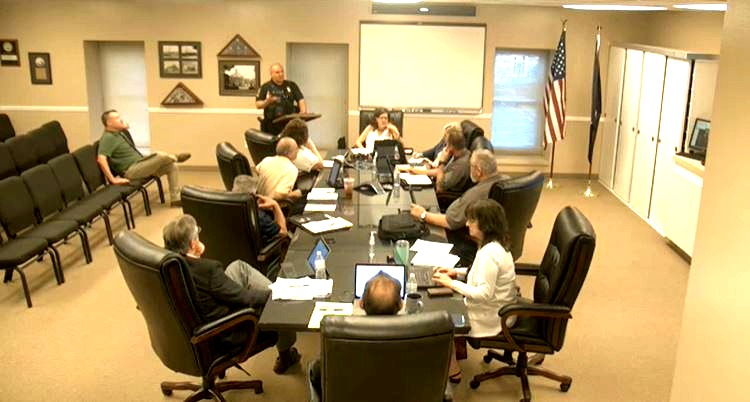
FRPD Chief Kahle Magalis, at podium upper left, explained the process of camera speed limit enforcement in school zones his department is recommending the Town begin to implement. Council was receptive to the cost-effective program designed to improve traffic safety for the community’s school-age children. Royal Examiner Photos Roger Bianchini
Chief Magalis observed that the technology utilized to judge vehicular speed was essentially the same as radar enforcement. But he added that tickets issued from the camera enforcement are considered civil offenses rather than criminal.
Town Manager Joe Waltz pointed out that during a previous discussion with a vendor involved with the cameras, it was noted that the violation notice was set around ten mph above the posted speed limit, so tickets would not be issued to someone exceeding the posted speed limit by just a few miles per hour. Chief Magalis also noted that once the vendor established that the impacted school zones were all properly marked as to speed limits, a 10-day “grace period” where violators would be issued warnings of excessive speed in the school zone before actual issuing of civil violation speeding tickets.
Those civil fines are set at a standard of $100, $25 of which the vendor keeps for their role in the operation, with the $75 balance coming back to FRPD. And the vendor handles all collections, it was pointed out. During the discussion of the civil violation process versus a criminal violation process, Mayor Cockrell observed that it appeared that offenders’ car insurance rates would not be impacted. “There are no reports to DMV, the consequence is a $100 fine to slow down for the safety of the children. I think it’s a win/win,” the mayor observed of the requested enforcement path.
“The proceeds from this project go specifically for traffic safety,” Chief Magalis said of the department’s $75 share of the fines being committed to improved signage, crosswalk improvements, and other traffic safety tools.
“I think this is fantastic. I know there’s going to be people who don’t like it, but those people should think of the children’s safety,” Councilwoman Morris said, seeming to express the council consensus. “That’s what this is all about; revenue is kind of secondary,” Chief Magalis responded to Morris’ observation.
“Because the alternative is to hire more officers, which is going to create a much larger budget item, so I can’t imagine anybody being against this,” Mayor Cockrell said hopefully of the public reaction.
It was noted near the discussion’s end by Town Manager Waltz that the item was brought forward to judge council’s support on whether to continue with the implementation process with the vendor. So, the item is not yet at the point for council consideration and a vote this month, Waltz said.
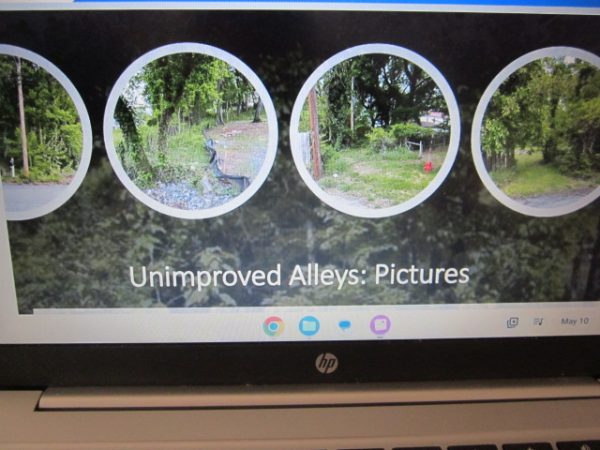
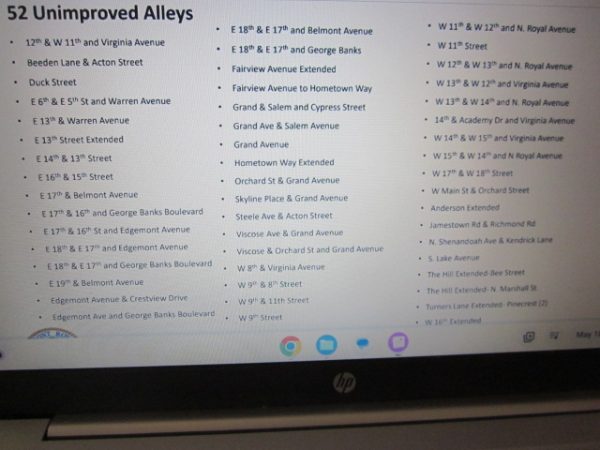
It was then on to the discussion of “Maintenance for Unimproved Alleys” (46:44 video mark). Town Manager Waltz introduced the matter as having originated with a complaint filed to council about the condition of an unimproved alley near 12th Street. Consequently, town staff did an assessment of such alleys within the town limits. There are 52 unimproved “right of ways” or “alley-ways” in town, Waltz reported of the result of that inventory. The staff recommendation is for the Town to perform regular inspections of those alleys or right of way. Whether those would be annual or perhaps twice-a-year inspections has yet to be determined, Waltz told council. Waltz then turned the presentation over to Public Works Director Robbie Boyer, who presented some slides of what had been found at various locations around town.
As the agenda staff summary noted: “During this evaluation, staff recognized that the Town should be more proactive with our unimproved alleys and the need to create an inspection program. I have instructed staff to implement an annual inspection of all unimproved alleys effective immediately. The Annual inspection would look for illegal dumping, dead trees, damage from vehicle traffic, and obstacles placed in the unimproved alleys. The interval of inspections can be adjusted after our first review of inspections and issues identified.”
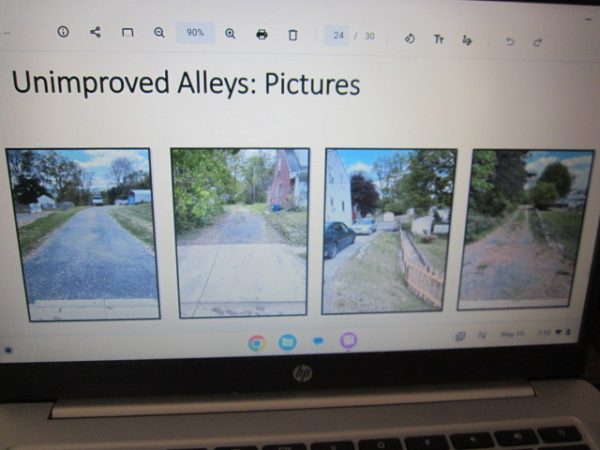
Visual images of staff’s survey of what was counted at 52 unimproved alleyways in the town limits presented by Public Works Director Robbie Boyer. Final image below is the full list of those alley locations – see your neighborhood in there anywhere? A council consensus was to proceed with an annual inspection program encouraging citizen participation in the upkeep of unimproved alleys near their properties.
Following Boyer’s presentation, Councilwoman Melissa DeDomenico-Payne observed, “I know we don’t have to maintain them by code, but I feel like it sends an example to people to take care of their property and especially if technically we own the alleyways.” She suggested, at the time of inspections reaching out to surrounding property owners to gauge their willingness to assist the Town in the maintenance of those alley properties abutting their properties.
“At the end of the day, it’s community pride. And I think that’s the message we need to reinforce in our community,” Councilman Rogers added of cultivating a Town-citizen partnership in maintaining the properties in question.
The potential of adding an “Adopt your unimproved alley” to the “Adopt a Street” program, encouraging citizens to become more proactively involved in keeping their neighborhood and adjoining town-owned unimproved alleyways clean and kept was broached.
When the subject of dumped leaves in alleyways was broached, Town Attorney George Sonnett pointed to existing codes forbidding “illegal dumping” of the refuse of a variety of definitions that could be utilized to enforce neighbors from using unimproved alleys to discard leaves or any other refuse.
The consensus was to pursue the suggested inspection and maintenance program seeking community participation as available, with no set time frame yet in place for implementation.
And following this discussion, council went into Closed/Executive Session for “consultation with legal counsel … regarding specific legal matters requiring the provision of legal advice by such counsel, more specifically, proposed tourism agreements with Discover Front Royal, Inc. and Warren County.”

South Warren Ruritan Club Hosts 20th Annual Spaghetti Dinner Fuels Scholarships for Local Teens

Trees Take Root as Virginia’s Frontline Defense Against Urban Heat

Virginia Set to Rejoin RGGI as Utilities Prepare to Pass the Cost Back to Ratepayers

Virginia Joins Multi-State Lawsuit Challenging Trump’s Election Order

Trump Budget Seeks 43% Boost in Defense Spending, Cuts in Many Domestic Programs

Virginia Sees 33,000 ACA Enrollment Drop Since Subsidies Expired, More Likely on the Way

Annual Dental Checkups and Cleanings: Essential Appointments

4 Stimulating Activities for a Healthy Brain After 50

The First Amendment: America’s Unique Foundation of Freedom

How to Tackle Credit Card Debt

Summer Enrichment Camp Gives Teens Hands-On Learning Opportunities

VDOT: Warren County Traffic Alert for April 6 – 10, 2026

David Silek to Remain in Chairman’s Seat of WC Republican Committee Pending 6th District Appeal Decision

Sales Set to Bloom Like Daffodils This Spring

America 250: The Bookseller Who Helped Save the Revolution

Business Growth Series: Why Good Businesses Still Struggle to Grow

Brownies with Mini Chocolate Easter Eggs

Shenandoah Downs Opens 11th Season April 11 with Tribute to Roger Hammer

We Don’t Know Everything About DNA

How PAAS Came to Dominate the Easter Egg Dye Tradition

Spanberger Signs Bipartisan School-Safety, Student Support Bills Into Law

Melanie J. Pomeroy (1958 – 2026)

David Benjamin Heller (1990 – 2026)
1776 Wasn’t Just About Independence
