
EDA in Focus
County attorney invokes attorney-client privilege on EDA workforce housing questions
On May 16, Warren County Attorney Dan Whitten invoked attorney-client privilege in declining to respond to a question from Shenandoah District Supervisor Tom Sayre about his knowledge of an undisclosed deadline attached to the Economic Development Authority’s workforce housing project.
During the county attorney’s report, Sayre asked Whitten if he or his predecessor Blair Mitchell, who retired last year as the workforce housing project was being developed, had been aware of a March 1, 2017 deadline attached to a “gifted” deed of transfer of the property executed last June.

County and EDA attorney Dan Whitten’s lips are sealed by attorney-client privilege regarding the EDA’s workforce housing project. Photos/Roger Bianchini
That deadline was first publicly revealed following an April 28 EDA board closed session and unanimous vote to proceed with a purchase of the 3-1/2-acre parcel that had previously been “gifted” to the EDA by Mr. and Mrs. Walter L. Campbell. As she disclosed in September 2014 when the project and transfer were first discussed, the Campbells are EDA Executive Director Jennifer McDonald’s aunt and uncle.
In exchange for the gift of the then landlocked commercial parcel (access road Royal Lane was at its maximum 800-foot length by town code for dead-end streets), the Campbells were to receive a federal tax credit. Our research indicates such tax credits are based on a third of the value of the transferred property.
Following Sayre’s May 16 question about his knowledge of the deadline, the county attorney who also serves as the EDA attorney, explained that the EDA executive director “has not given me permission to violate attorney-client privilege” on the matter. Without such a waiver, Whitten indicated he could not legally respond to questions about the EDA’s workforce housing project.

Architect’s rendering of one of what was to be three, now reduced to two, 12-unit apartment buildings to house locally-employed young professionals – that might be one expensive drawing. Courtesy Photo EDA
Whitten then noted that a summary of the workforce housing project was being assembled by McDonald for the EDA to be released publicly. He suggested letting that release and Ms. McDonald herself address any questions about the project. Whitten noted McDonald was scheduled to appear at a June 6 supervisor’s work session, when she could personally respond to any questions from board members.
Sayre began his query into the project by asking Whitten about the County’s annual funding of the EDA. Whitten cited $116,850 in operational funding and $106,900 in debt service payments provided by the county to the EDA in the current budget cycle. Sayre then noted he had seen media reports about a March 1, 2017 deadline not being met, leading to changes in the financial parameters of the project. The primary change is the requirement the EDA now purchase the property for $445,000, the price placed on the deed of transfer dated June 6, 2016.
click here to read related story
According to McDonald and EDA Board Chair Patty Wines, the decision to proceed with a purchase at $445,000, a price Councilwoman Bébhinn Egger pointed out last November was $140,000 above the 2015 assessed value of the property, was made because the EDA has already spent $500,000 in developing the project at that site.
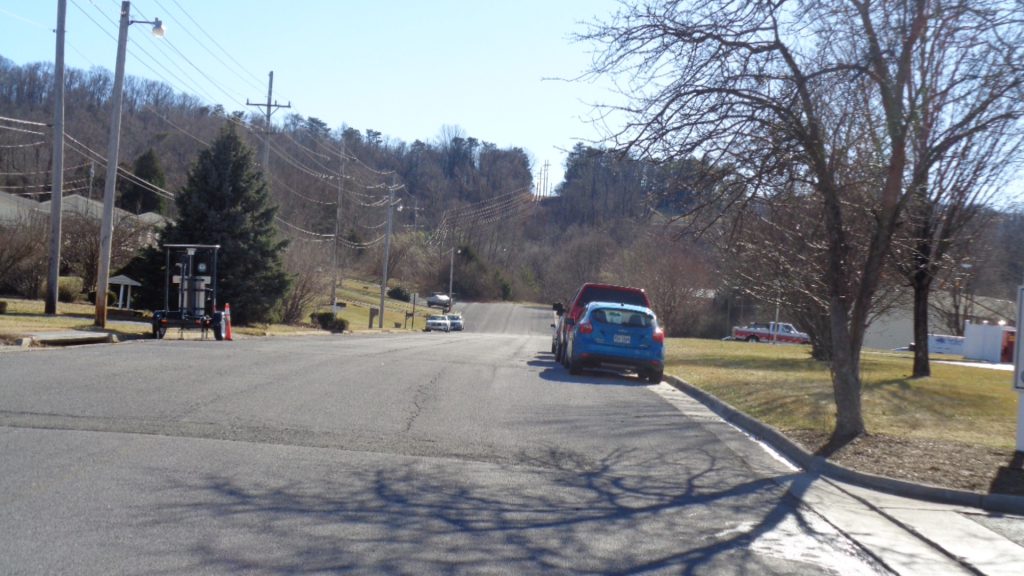
A look down Royal Lane toward the workforce housing parcel, where no dirt yet appears to have been turned.
Among questions raised by Egger on May 8 was how the EDA has spent $500,000 with nothing but permitting and preliminary planning having been done. Egger was particularly incensed by the revelation that the $445,000 price attached to the “gift” was not based on a 2016 appraisal of the property, as McDonald told Council on November 14, 2016. EDA officials now say the price was “agreed upon”. McDonald has elaborated that that agreed-upon price was based on comparisons to comparable commercial properties.
Egger asked for answers to her list of questions by Friday, May 19, three days prior to the town council’s next meeting. When Royal Examiner submitted its own list of questions to the EDA board on May 10, we were told to wait for the summary being prepared with a target release the middle of the following week. As of the afternoon of Wednesday, May 17, EDA staff said the release was still being assembled.
Our base questions were:
- When the individual EDA board members became aware of the confidential agreement and its March 1 deadline?
- What was to be accomplished by March 1, 2017, just under nine months after the property was transferred to the EDA with several local, as well as state permitting issues outstanding?
- Was the EDA board aware town staff and officials had not been made aware of the project deadline during the permitting process?
- And echoing Egger, how the EDA has spent $500,000 on the project? – The stated justification for proceeding with the purchase at a price of $445,000 for a parcel assessed at $305,000 in 2015.

South Warren Ruritan Club Hosts 20th Annual Spaghetti Dinner Fuels Scholarships for Local Teens

Trees Take Root as Virginia’s Frontline Defense Against Urban Heat

Virginia Set to Rejoin RGGI as Utilities Prepare to Pass the Cost Back to Ratepayers

Virginia Joins Multi-State Lawsuit Challenging Trump’s Election Order

Trump Budget Seeks 43% Boost in Defense Spending, Cuts in Many Domestic Programs

Virginia Sees 33,000 ACA Enrollment Drop Since Subsidies Expired, More Likely on the Way

Annual Dental Checkups and Cleanings: Essential Appointments

4 Stimulating Activities for a Healthy Brain After 50

The First Amendment: America’s Unique Foundation of Freedom

How to Tackle Credit Card Debt

Summer Enrichment Camp Gives Teens Hands-On Learning Opportunities

VDOT: Warren County Traffic Alert for April 6 – 10, 2026

David Silek to Remain in Chairman’s Seat of WC Republican Committee Pending 6th District Appeal Decision

Sales Set to Bloom Like Daffodils This Spring

America 250: The Bookseller Who Helped Save the Revolution

Business Growth Series: Why Good Businesses Still Struggle to Grow

Brownies with Mini Chocolate Easter Eggs

Shenandoah Downs Opens 11th Season April 11 with Tribute to Roger Hammer

We Don’t Know Everything About DNA

How PAAS Came to Dominate the Easter Egg Dye Tradition

Spanberger Signs Bipartisan School-Safety, Student Support Bills Into Law

Melanie J. Pomeroy (1958 – 2026)

David Benjamin Heller (1990 – 2026)
1776 Wasn’t Just About Independence
