
Local Government
County ponders off-hour citizen misuse of trash convenience sites
While the Warren County Board of Supervisors tries to figure out where it stands with the Town of Front Royal as far as threatened fees to compensate the Town for additional costs tied to direct shipment of treated sewage to the Page County landfill, during its May 11 meeting Public Works Director Mike Berry briefed them over problems with after-hour citizen disposal of trash at County solid waste convenience sites. Also, on the table for discussion, last Tuesday were increased funding needs to adequately staff Chester Gap Fire & Rescue Company 9. See that discussion in a forthcoming related story.
Fortunately perhaps, considering unresolved Town-County solid waste dispute variables including potential back fees the Town may owe the County for avoided commercial sewage disposal fees and the County’s financial contribution to federally and state-mandated upgrades to the Town Wastewater Treatment Plant, neither topic was new to the supervisors. Both have been the subject of at least one previous work session discussion.

County Public Works Director and former Solid Waste Manager Mike Berry summarize the convenience site misuse situation to the county supervisors. Royal Examiner Photos by Roger Bianchini
On the citizen trash disposal side of the agenda, Public Works Director Berry explained that convenience site issues revolved around trash and other large-scale items like furniture being dumped after operational hours. North River Supervisor Delores Oates noted problems she has observed headed to or from church on Sundays with improperly discarded trash at the Cooley site “blowing everywhere and litter everywhere. – And so the community needs to understand that (they) need to be better stewards of the things that are provided to them,” Oates reasoned.
She observed that the so-called trash convenience sites are provided as just that, a “convenience” to county residents. It is a convenience that could be removed if it continues to be abused and was eventually judged too costly a convenience for the County to continue to provide. Alternatives to the convenience sites could be the long haul of residential trash to the Bentonville collection and transfer station; neighborhood contracting of their own trash pickup; or perhaps continued illegal dumping at random, remote locations. None of those would seem a preferable option for county citizens as a whole.
Oates was joined by Board Chair Cullers and Sheriff’s Office Lt. Robbie Seal in suggesting some sort of public relations campaign to raise awareness of the difficulties and additional costs to the County in dealing with the problem. “But they just need to understand that this is important to all of us, that we maintain a clean and beautiful community and not just throw your trash wherever you feel like it,” Oates concluded.
During the discussion, Lt. Seal and the sheriff’s office were commended for increased patrols trying to deter the after-hours dumping. Seal observed that people pulling up before or after hours who saw a marked sheriff’s office vehicle nearby tended to turn around and leave with whatever they had with them.
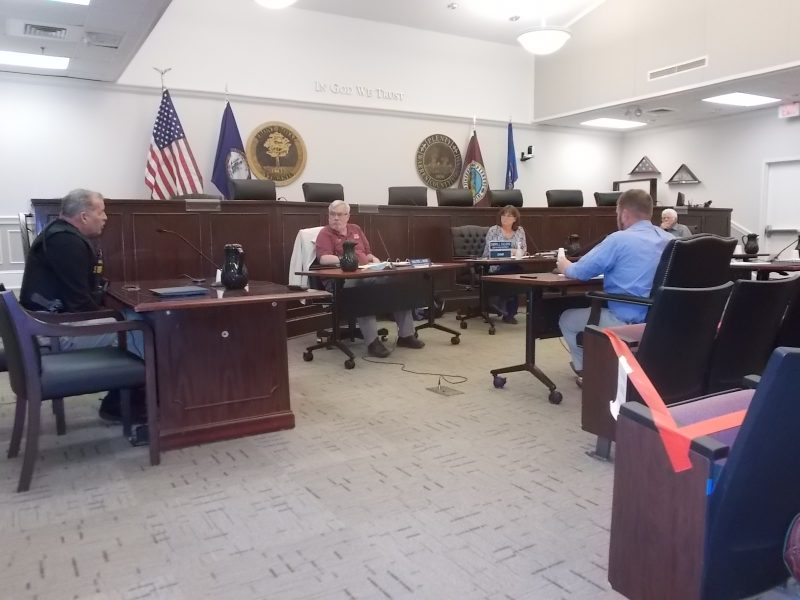
WCSO Lt. Robbie Seal explains his department’s efforts to stem closed hour dumping at the solid waste convenience sites.
A variety of operational methods were raised to deal with the problem, including longer hours, opening on Wednesday and Sundays when the sites are now closed or operating at reduced hours; alterations to fencing and placement of open containers near or beyond entrances when the sites are closed. However, problems including costs for additional staffing and equipment and installation, overloaded open containers, and bagged trash being tossed over fencing toward containers catching, ripping and adding to the blowing trash and litter problem, were also cited.
Questioned by Fork District Supervisor Archie Fox on costs to keep the sites open seven days a week or for longer hours, Berry estimated $35,000 a year to open Wednesdays, along with additional costs for added site adjustments. To increase Sunday hours from the current 12-noon to 7 p.m., to 7 a.m. to 7 p.m. could add another $16,000 to $20,000, Berry told the board.
Cullers and Shenandoah Supervisor Walt Mabe took the stance that improved services with additional hours and altered facilities as necessary to meet off-hour customer needs as the preferred route. However, Cullers acknowledged problems even on fully operational 7 a.m.-to-7 p.m. days: “Even when we open at 7 (a.m.), my understanding is that there’s stuff piled up there before 7 in the morning, right?”
“Yes,” Berry replied.

Ed Daley, at the staff table at the far end of the room, summarized what he heard of a board consensus in moving forward while trying to stem illegal dumping during off-hours at County convenience sites.
Following a sixteen-minute discussion, Interim County Administrator Ed Daley summarized the apparent board consensus on a path forward:
“So, with the board’s concurrence we’re going to, number one, start opening the gates more, see what that does. If we run into problems then we’ll stop. But we’re going to try it.
“We’re going to look at the fencing like Lt. Seal was talking about – putting ups some more fencing, and also (Assistant County Attorney) Caitlen (Jordan) is working on this signage she said she’ll have for you in June …
“We’ll look at the cost of open containers and where they could be placed …
“And also looking at increasing the Sunday hours, and also Wednesday hours. We’re talking in terms of $50,000 as to what that total would be there.
“So, we will look at all these options in a progressive manner and start moving forward and see if we can get some of this cleaned up,” Daley concluded.
Berry sighted necessary personnel moves to accomplish the desired operational changes related to available hours and shifts, forecasting what he called “not too significant” a hike in those hourly personnel costs. Cullers questioned the public works director on those shifts, asking if there were staff working full 12-hour shifts. Berry replied that those 12-hour days were generally split between two six-hour shifts, other than Sunday when a seven-hour shift was pulled.
And with that discussion resolved, the board moved toward Sheriff Butler’s report on his department’s investigation of stinky treated sewage mixed with Town residential trash being dumped at the Bentonville Transfer Station as reported in our story “Illegal sewage dumping investigation closed with no charges – but is that the end of the story?” The convenience site portion of the meeting begins 39 minutes into the open meeting video right after the EDA Resolution and meeting adjournment and ends around the 61-minute mark.

Samuels Public Library Prepares for Annual “Taste for Books” Fundraiser

Assistant Chief and Fire Marshal Gerry Maiatico Highlights Staffing Needs and Volunteer Opportunities

Data Center Bills Dominated This Year’s General Assembly. Here’s What Passed.

Housing Bills to Boost Supply, Protect Tenants On The Way to Spanberger’s Desk

4 Ideas for Keeping Fit While Babysitting Your Grandchildren

Do You Know Your Grains?

Tips for Staying Safe Around Unfamiliar Dogs

Skyline FFA Students Promote Agriculture at South River Community Forum

Warren Coalition Works to Build Resilience and Prevent Substance Abuse

Warner Files for Reelection, Launching Bid for Fourth U.S. Senate Term

Registrar Urges Residents to Stay Informed and Participate in Upcoming Elections

South River Forum Brings Residents and Leaders Together at Skyline

CHEO Garden Expands Mission of Food, Learning and Community

Sharing a Room: How to Avoid Sibling Conflicts

Laurel Ridge to Host Week of the Young Child Art Exhibit

Free $1,000 ‘Trump Accounts’ Draw 1 Million Families

‘The Revenant: A Novel of Revenge’

Virginia Lawmakers Close 2026 Session With Focus on Lowering Costs

The 10 Most Important Things That Happened in Virginia’s 2026 Legislative Session

Electric Vehicle Market Adjusts as Industry Rethinks the Road Ahead

Cultures Around the World Mark the Spring Equinox With Unique Traditions

Laurel Ridge to Host 46th Annual Spring Follies: “Back to the ’90s”

Love Revival to Host Free Community Easter Celebration in Front Royal

Salvation Army of Front Royal Plans Annual Dinner and Raffle Fundraiser
