
National News
Developing: Army Detonates Degraded Lead Azide in Middletown, Iowa
The U.S. Army intentionally detonated degraded, lead-based explosive Wednesday morning in southeast Iowa.
The operation has drawn public criticism in Iowa and across the country due to concerns about the spread of lead, which is toxic, from the detonation.
The Army decided to go ahead with the blast after significantly increasing mitigation strategies and working to evacuate the area because it determined intentional detonation was the best way to get rid of the material, which was liable to detonate on its own.
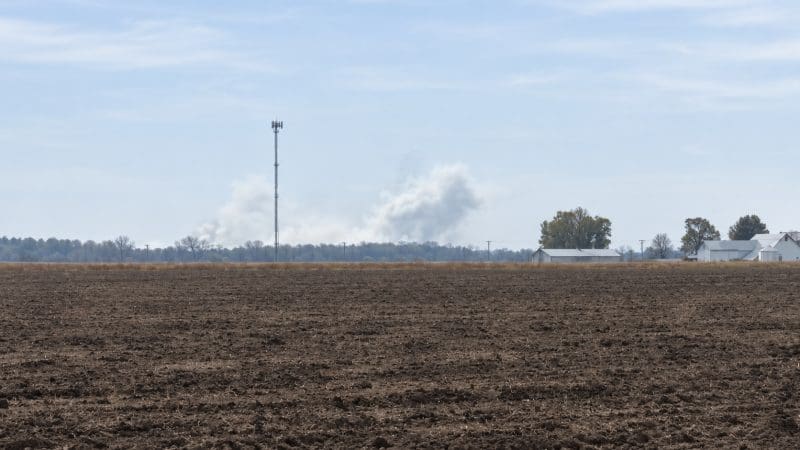
A plume is visible from the detonation of nearly 5 tons of lead-based explosive material in Middletown, Iowa, Nov. 25, 2026. (Screenshot via C-SPAN livestream)
The Army said it would update the public about the status of the operation by 11 a.m. at the latest.
The most recent maps from the U.S. Army showed lead particles released from the blast were likely to travel southwest of the site, as far as 100 miles over the next several hours. Dust with lead particles was expected to settle as far as 40 miles southwest of the blast site.
Residents in those areas have been advised to remain indoors, with windows and doors closed until the Army gives an all-clear. Updates can be found online. The Army is also working with the Federal Emergency Management Agency to distribute mobile notifications to people in the area.
The U.S. Environmental Protection Agency and the Army have been in Middletown and surrounding communities taking samples and are slated to take samples following the detonation to determine how much lead was released by the blast.
EPA has published a dashboard with air sampling and monitoring.
EPA leader says mitigation ‘exceeded expectations’
EPA Administrator Lee Zeldin said in a live interview with CNN Wednesday morning that the initial feedback he received from the U.S. The Department of Defense was that the mitigation efforts “exceeded expectations” in containing the plume.

Zeldin said that while EPA monitors on the ground currently show no detectable lead concentrations in the surrounding area, he encourages people in the area to wait for additional feedback before going outside.
Zeldin referenced the aftermath of the Sept. 11, 2001 attacks on the trade center and said in that instance, EPA told people it was safe to go outside too soon.
“I’m not going to rush and just immediately declare everything is safe before I can receive the data, that we can transparently release it publicly,” Zeldin said.
Zeldin also attributed the cross-department federal response to White House Chief of Staff Stephen Miller, who was only recently appointed to the role.
“I have never witnessed an individual take the reins of the interagency process as exceptionally as what I have witnessed over the last few days to make sure that absolutely every possible option was being considered,” Zeldin said.
Public responses
Missouri Gov. Mike Kehoe posted on X saying the blast had occurred and that initial analysis he received from federal partners “indicates that the mitigation measures appear to have been successful and the explosion was well-contained.”
President Donald Trump posted on his social media platform that “early reports from Iowa are that the Army’s mitigation efforts have far exceeded expectations.”
This story will be updated as more information is released.
This story was originally produced by Iowa Capital Dispatch, which is part of States Newsroom, a nonprofit news network which includes Virginia Mercury, and is supported by grants and a coalition of donors as a 501c(3) public charity.
By Cami Koons, Virginia Mercury

Virginia Mercury is part of States Newsroom, a nonprofit news network supported by grants and a coalition of donors as a 501c(3) public charity. Virginia Mercury maintains editorial independence. Contact Editor Samantha Willis with questions: info@virginiamercury.com.




Developing: Army Detonates Degraded Lead Azide in Middletown, Iowa

22 States Including Virginia Sue Feds Over the Rule Stripping Housing Aid from Mixed-Status Immigrant Families

Judge to Decide Dec. 4 If Virginia’s Reproductive Rights Constitutional Amendment Will Stand

Dominion-NextEra Merger Hearings Wrap Up at the SCC, Decision Expected by Jan. 11

And a River Runs Through It: Thoughts About Fathers and Sons

Teachers in Detention? Warren County Educators Join $30,000 Giving Tuesday Challenge

Democrats Plan Investigations of Trump. Here’s How His Justice Department Is Fighting Back.

After the Trees Are Pruned, Show Front Royal the Plan for Their Future

Does Artificial Intelligence Need a Thank You? The Answer May Surprise You

Front Royal Detective Richard Williamson Graduates from Virginia Forensic Science Academy

Rotary Values Become Visible to Drivers on Commerce Street

Blue Ridge Wildlife Center Patient of the Week: Great Blue Heron

This Week’s Showtimes at Royal Cinemas as of November 25th

POLICE: 7 Day FRPD Arrest Report 11/23/2026

Eight Warren County DECA Students Qualify for State Competition After Record District Conference

From the Classroom to Careers: Warren County DECA Celebrates Three Alumni Success Stories

Blue Ridge Singers Announce Three Free Christmas Concerts, Welcome New Conductor
Senate Democrats Need New Leadership, Not Business as Usual

What Happened to the Front Porch and the Respect We Shared?

What’s On The Horizon for Virginia’s Healthcare Landscape in 2027?

Albemarle Families Navigate Closure of Schools After Employees Weren’t Screened for Child Abuse

Michael Lane “Mike” Umstot (1953 – 2026)

Danny Ray Mullins (1952 – 2026)

Guaranteed Income Just Got a Raise: Why Retirees Are Taking Another Look at Annuities
