
Local Government
Divided Board Tables Staff-Suggested Agritourism Code Changes in Face of Highly Negative Public Feedback
The Open Meeting agenda of the Warren County Board of Supervisors meeting of Tuesday, July 15, appeared to involve a lot of technical “housekeeping” matters involving staff-suggested Code changes, as well as matters recently tabled for additional information gathering.
However, it soon became apparent that many citizens present, and signed up to speak to “Public Concerns” or the two scheduled Public Hearings, were far from considering some of these matters routine. High on that list were the two public hearing topics under “Unfinished Business”:
- Public Hearing: Z2025-05-01 – Zoning Text Amendments for Accessory Dwelling Units – Warren County Planning Staff; and
- Public Hearing: Z2025-05-02 – Zoning Text Amendments for Agritourism Activities – Warren County Planning Staff.
Appearing to be most at issue for public speakers was the second of these two topics. Four public hearing speakers identifying as Ag District property owner farmers or homesteaders urged the supervisors NOT to approve this staff-suggested change to County Codes, citing bureaucratic overreach on matters already addressed as by-right uses with Conditional Use Permitting (CUP) in Agricultural Districts. Those speakers were Edwin Wright, Melanie Salins, Amber Martin, and Mike Salins. Chairman “Jay” Butler introduces those comments public comments at the 1:00:55 mark of the linked County video following some board discussion.

If the supervisors were expecting a rather routine, business as usual session, public hearing comments ended that notion. Royal Examiner Photos Roger Bianchini
It seemed that those speakers all had a fear that the proposed added County staff scrutiny would push the community toward rezonings for increased residential building proposals as a lone option left for Ag District property owners to make money from their properties. Rules to prevent negative impacts to the “health, safety, and welfare of the community” from Agritourism activities are already in place, they told the board, asking why a restating of those rules was necessary.
Staff summary of requested change
So, what is all the fuss about? Below is a portion of the agenda packet staff summary of the proposed Agritourism code change:
“These text amendments are being requested by Planning staff at the recommendation of the County Attorney to allow the County to regulate agritourism activities based on an assessment of whether the activities have a substantial impact on the health, safety, or general welfare of the public. Code of Virginia §15.2-2288.6 restricts the locality from regulating agritourism activities unless there is a substantial impact on the health, safety, or general welfare of the public. As such, the draft ordinance differentiates agritourism activities found to have a substantial impact on the health, safety, or general welfare of the public from agritourism activities found to not have a substantial impact on the health, safety, or general welfare of the public and only requires a conditional use permit for agritourism activities found to have a substantial impact on the health, safety, or general welfare of the public.”
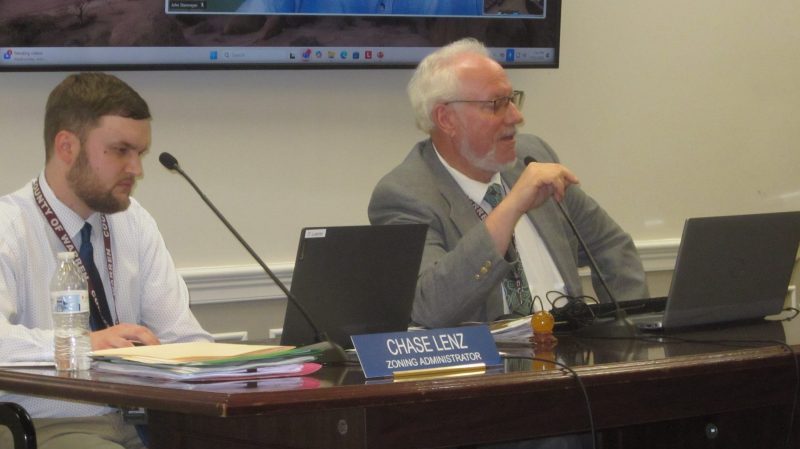
Zoning Administrator Chase Lenz, left, and Planning Director Matt Wendling handled staff summaries on some the ‘Unfinished Business’ items. Planning Staff, Zoning Administrator Lenz in particular, became the focus of Agritourism Public Hearing comments. Rather than anything he has personally done on the job it seemed the county board’s handing off of permitting oversight authority to staff was the primary
issue.
Public Feedback
Wright opened the public feedback, telling the board, “Agritourism, on the practical side, it is the overlap between tourism, recreation, and farming … On the existential side it is both protected in State laws in said rights and privileges for working farms. And it is one of the most powerful tools we have for protecting farmland and open spaces in our community.
“Agritourism is so valuable and so good for farmers, for our community, for everybody that it is not only protected in State law, that the State went out of their way to say that local governments can’t mess with it unless it has a substantial implied negative impact on the health, safety, and welfare of the community.
“This text amendment seems to flip around that intent. This answer,” Wright continued of the proposed County code amendment, “would be to make everyone who wants to do this thing have an evaluation of whether their plans or existing activities have the potential to have a substantial impact on the health, safety, or general welfare of the public, but without any objective standards on what that means,” Wright said acknowledging Supervisor Jamieson, who earlier had raised the issue of a lack of such standards in the enforcement plan for the proposed code change.
Wright continued to suggest that even with substantiated impacts, the use should be allowed “because they are better for everyone than any realistic alternative,” he said, observing that “Farmers and Homesteaders have every incentive to take care of their land, their products, and their community.” He continued citing a long existing list of regulations enforced on Agritourism operations by Health, Building and Zoning Departments, noise ordinances, water quality and air pollution standards, management plans, and on and on. And you already have the ability to intervene if an activity that we do on our farm or Agritourism business breaks the law or causes harm in some way.
Melanie Salins followed Wright to the podium. She opened by questioning the topic being included on a Closed Session agenda and a consequent legal claim to refuse a FOIA request on the topic due to that closed session discussion. She then mirrored some of Wright’s comments on Agritourism rules in place to allow municipal oversight that the uses remain non-harmful in general.

School Board member Melanie Salins shifted her attention from WC Public School matters to the County’s proposed Agritourism code amendments. She was not a happy camper, nor was her husband Mike, who also addressed the issue.
“It is unclear what is being written and what is being spoken are two very different things,” Salins claimed, adding, “… As this is written, we can use whatever flowery language we want to, to try and smooth this over for the citizens of this community, but this ordinance is not Okay. I do not hear any citizens in this county saying ‘We want to ask the government for permission to use our own land in ways in which we are already zoned to use our own land’. This is ludicrous,” Salins concluded of the proposed code change formulated by County Planning & Zoning staff and the County Attorney without any direct oversight or input from the county’s elected officials.
Amber Martin identified herself and her family as operators of a small homesteading operation in the Fork District. “I am here tonight because I have strong opposition to this proposed Agritourism text amendment. There’s no clear list of what these (violating actions) actually are. Therefore, citizens and landowners have no way to know what is covered or how this might affect existing or future uses,” she told the county’s elected officials.
Martin also questioned one staff position, the Zoning Administrator, currently Chase Lenz, having full violation and permitting withdrawal authority on such a sweeping municipal regulation. She suggested such a process should be publicly held before the county’s elected officials, with public response opportunities for involved landowners.
“I respectfully ask you to deny this amendment tonight. Keep Agritourism fair, predictable, and open as a public process. That’s how we protect both our farms and our community,” Martin concluded.
Last at bat was Mike Salins, Melanie Salins’ husband. “There seems to be an issue of power and control within the county government. It seems like there’s always some overreach attempt that causes me to waste my time and come speak up against.
“This most recent one is absurd,” Salins observed, adding, “You have members of staff working behind the scenes in what appears to be an attempt to bleed out small farm owners and others by means of fees and licenses.
“The request this evening will make it more difficult and expensive for many people to do the simple things they’ve been able to do, or bought their land for. This type of request is how Northern Virginia became the mess it is today,” Salins asserted, pointing to former Northern Virginia Ag District landowners who eventually sold out to developers as agricultural uses became too expensive and/or time-consuming.
“I shouldn’t need to remind you or the public, but we elected you to run the government and not the staff. I’m requesting that you all vote against this. The staff works at the will of the board. So, I’m asking that you take back control of your staff and get them focused on what we, the citizens, are actually concerned about,” Mike Salins concluded without elaborating on what his perception of that was.
Public Hearing comments concluded (1:11:00 video mark), Chairman Butler asked if the board, including John Stanmeyer, who was remotely connected from an out-of-town trip with his family, if there were additional comments from the supervisors. After some extended silence, Fork District Supervisor Vicky Cook said she was ready to vote. Butler then asked South River Supervisor Cheryl Cullers if she had any additional comments.
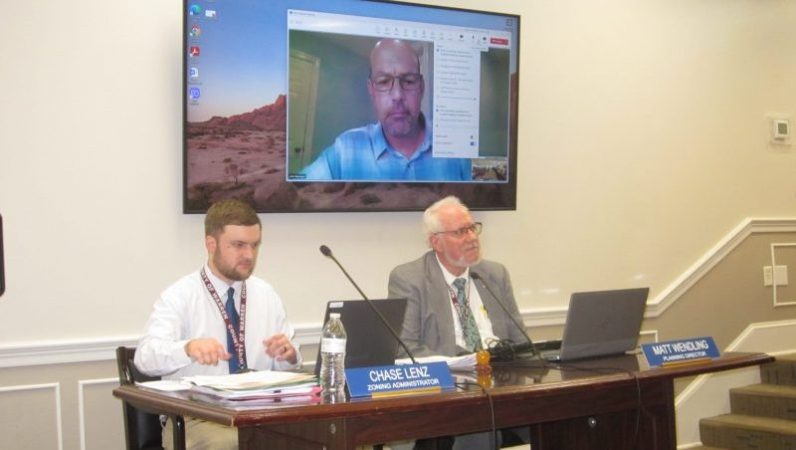
Remotely connected Shenandoah District Supervisor John Stanmeyer looms over the shoulders of Planning and Zoning staff members Chase Lenz and Matt Wendling as the Public Hearing on the Agritourism permitting initiative became increasingly critical.
“I think there are a lot of questions still to this, and in my mind, tabling it and getting everything ironed out and solid on what this is might be the best thing at this point,” Cullers told her colleagues. In response to the chair’s call for a motion Cullers replied, “I motion to table this for more information and getting this solid.”
Chairman Butler’s call for a second was met with extended silence before he seconded Culler’s tabling motion. The role call vote was 3-2, with Stanmeyer and Butler voting with Cullers to table, Jamieson and Cook dissenting.
And so the matter was again delayed for the board to absorb what it had heard in dissent from Ag District property owners, and try to establish a clearer idea of what it would actually be approving if the staff-suggested code amendments were approved.
See a summary of other actions at Tuesday’s meeting in a related, coming story.
Closed Session
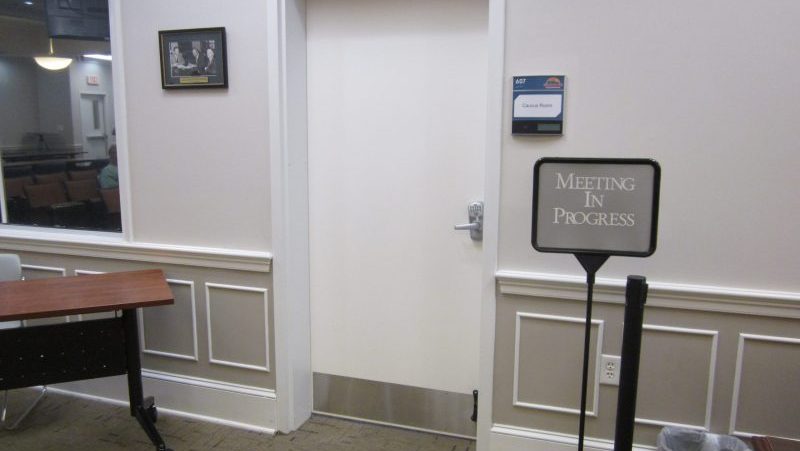
Indeed, there was a ‘meeting in progress’ after 6 p.m., but it was behind closed doors till shortly before 7 p.m. on a variety of topics, including the new County Administrator search, library services, and State and local road renaming guidelines.
We will, however, note here that the July 15 meeting began with a Closed/Executive Session convened at 6 p.m. The motion into that Closed Meeting read (underlining emphasis added on topics of discussion):
“I move that the Board enter into a closed meeting under Section 2.2- 3711(A)(1) for the discussion or consideration of the assignment, appointment, promotion, demotion, salaries, and resignation of a specific public officer of the public body. The subject matter is applicants for the County Administrator position.
“I further move that the Board enter into a closed meeting under Section 2.2-3711(A)(29) for the discussion of the award of a public contract involving the expenditure of public funds, including interviews of bidders or offerors, and discussion of the terms or scope of such contract, where discussion in an open session would adversely affect the bargaining position or negotiating strategy of the public body. The subject matter is Library Services.
“Finally, I move that the Board enter into a closed meeting under Section 2.2-3711(A)(8) for the purpose of the provision of legal advice regarding specific legal matters requiring such advice. The subject matter is Chapter 142 of the County Code and state law regarding road naming.”
See the full meeting discussions and actions in the County video.

Blue Ridge Wildlife Center Acknowledges a Quarter of a Century of Work in Wildlife Preservation & Human Education

What Does A ‘Fair Share’ Really Mean?

South Warren Ruritan Club Hosts 20th Annual Spaghetti Dinner Fuels Scholarships for Local Teens

Trees Take Root as Virginia’s Frontline Defense Against Urban Heat

Virginia Set to Rejoin RGGI as Utilities Prepare to Pass the Cost Back to Ratepayers

Virginia Joins Multi-State Lawsuit Challenging Trump’s Election Order

Trump Budget Seeks 43% Boost in Defense Spending, Cuts in Many Domestic Programs

Virginia Sees 33,000 ACA Enrollment Drop Since Subsidies Expired, More Likely on the Way

Annual Dental Checkups and Cleanings: Essential Appointments

4 Stimulating Activities for a Healthy Brain After 50
The First Amendment: America’s Unique Foundation of Freedom

How to Tackle Credit Card Debt

Summer Enrichment Camp Gives Teens Hands-On Learning Opportunities

VDOT: Warren County Traffic Alert for April 6 – 10, 2026

David Silek to Remain in Chairman’s Seat of WC Republican Committee Pending 6th District Appeal Decision

Sales Set to Bloom Like Daffodils This Spring

America 250: The Bookseller Who Helped Save the Revolution

Business Growth Series: Why Good Businesses Still Struggle to Grow

Brownies with Mini Chocolate Easter Eggs

Shenandoah Downs Opens 11th Season April 11 with Tribute to Roger Hammer

We Don’t Know Everything About DNA

How PAAS Came to Dominate the Easter Egg Dye Tradition

Spanberger Signs Bipartisan School-Safety, Student Support Bills Into Law

Melanie J. Pomeroy (1958 – 2026)
