
State News
Drive for More Housing Sparks Rare Bipartisanship in Statehouses, Including in Virginia
In contrast to highly partisan debates over many other issues, state lawmakers of all political stripes are joining forces to pass legislation to increase the supply of housing.
The policies attracting support range from requiring cities to allow manufactured homes in areas with single-family homes to easing regulations for accessory dwelling units to allowing housing on church-owned land and strip malls.
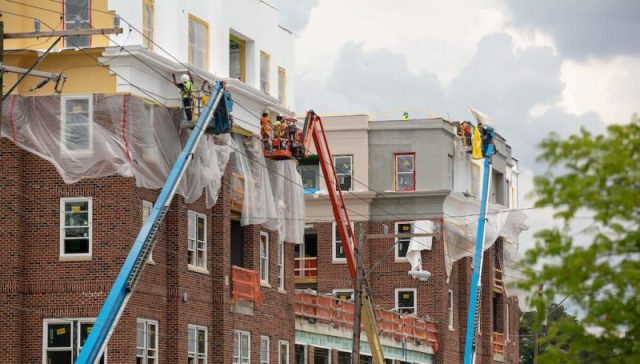
New housing is under construction in Richmond, Va. State lawmakers around the country are working across the aisle to pass housing legislation. (Photo by Parker Michels-Boyce/Virginia Mercury)
Housing has become a can’t-ignore issue for lawmakers across the political spectrum, said Henry Honorof, director of Welcoming Neighbors Network, which connects pro-housing advocacy organizations across 24 states.
“Almost every victory in the country for pro-housing policy has been bipartisan, and has actually required votes from the minority party. … It’s not moderates working together. It’s urban progressives and rural conservatives and libertarians working together,” said Honorof.
“There’s a huge amount of political pressure to do something about housing prices, but the average person doesn’t have a clear sense of what that ‘something’ is, but they’re just saying, ‘Fix housing prices, for the love of God.’”
From July 2024 through June 2025, 124 pro-housing bills cleared state legislatures, up from 40 during the same period in 2022-2023, according to the Mercatus Center, a research institute at George Mason University.
This year, lawmakers in Florida, Idaho, and Virginia have passed bills requiring municipalities to allow manufactured homes — houses that are built in a factory rather than on site and then transported to a permanent location — anywhere single-family or other housing is permitted. New Hampshire legislators are considering a similar bill.
Michigan lawmakers have also filed housing legislation — including measures to reduce minimum lot sizes, allow accessory dwelling units and set caps on minimum parking requirements — all of which have at least some Republican sponsors. None has passed yet.
Michigan Republican state Rep. Joe Aragona is working alongside Democratic colleagues on a package aimed at easing zoning restrictions.
Aragona is co-sponsoring a bipartisan bill that would dictate who gets a say in opposing new housing in a neighborhood. Instead of just a few nearby neighbors, anyone within 300 feet could be part of a protest petition, which would require at least 60% of those neighbors to sign the petition for it to impede any new development.
Aragona noted that in a March executive order, President Donald Trump outlined a few steps states could take to increase supply and reduce costs. Those included capping fees and reducing timelines associated with permitting, allowing by-right development, and curtailing mandates that may increase costs, such as “green-energy building requirements” and reexamining restrictions on manufactured housing.
Some issues still are harder than others to solve, he added, such as how far states should go in overriding local zoning rules.
“Some of the harder issues to find agreement among all types of groups is zoning. How do you step in as the state and try to referee that?” he said.
Granny flats and strip malls
Indiana this year enacted a wide-ranging law with broad backing from both parties to limit local zoning rules, streamline approvals, and expand the types of residential development that must be allowed without public hearings, unless a city or county opts out.
The Indiana law also promotes backyard accessory dwelling units, often known as granny flats or in-law suites. ADUs have increasingly gained momentum in statehouses as a way to fit more housing into existing lots.
Last year, Arizona, Arkansas, Iowa, Maryland, and New Hampshire enacted bipartisan laws to ease regulations on ADUs.
A Virginia ADU bill passed overwhelmingly this year that would limit permitting fees to $500 and ease requirements compared with a “primary dwelling.” It’s now on Democratic Gov. Abigail Spanberger’s desk.
Utah has had mixed results on ADU legislation. Legislators this year enacted a bipartisan law requiring certain municipalities with populations of at least 5,000 to adopt a land use regulation to allow ADUs. But the legislature did not pass two bills last year that would have required urban cities to allow ADUs in residential zones.
Honorof, of the Welcoming Neighbors Network, said messaging has been important, with broad coalitions coming together over the left-leaning politics of affordability and equity and the right-leaning priorities of property rights and markets.
“The first major reforms almost every state passes are legalizing accessory dwelling units and allowing more housing near jobs, and that combo is the lowest-hanging fruit of the pro-housing push,” Honorof said. “The next tier is what to do with land zoned only for large single-family homes, and that’s where you start seeing fourplexes, townhomes, and lot splits.”
Honorof and other pro-housing advocates have pointed to Washington state as a national test case for how far states can go to expand supply. Lawmakers enacted a law in 2025 capping parking minimums and a law this year forcing cities to allow residential development in commercial zones, opening the way for strip malls to become apartments.
On the parking minimums vote, 13 of 19 Senate Republicans and seven of 39 House Republicans voted for it, and the 2026 law received similar GOP support.
‘Yes in God’s Backyard’ bills
Virginia Democratic state Sen. Jeremy McPike was the lead sponsor on two pro-housing bills that both passed this session, including a “Yes In God’s Backyard” bill and a bill that would allow cities and counties to create affordable housing plans and amend zoning as they see fit.
McPike believes pro-housing bills that aim to reduce red tape in the building process can draw votes across the aisle.
“Some of the bipartisan support comes from reducing red tape and answering the question, how do you get to ‘yes’ when it comes to building more housing?” McPike told Stateline.
Yet division around policies requiring a certain percentage of units to remain affordable can stall some bills, he said.
McPike’s YIGBY bill passed mostly along party lines, with just one Senate Republican and two House Republicans voting for it.
The bill would allow churches and certain nonprofits to build housing on their land by right, bypassing lengthy rezoning and approval processes. Under the bill, at least 60% of the homes would have to be affordable and remain so for 30 years, and once built, local governments could tax the housing like other property.
The Rev. Michael Sessoms, a senior pastor at Little Union Baptist Church in Dumfries, Virginia, who supports YIGBY legislation, said he talks to Democrats, Republicans, Independents, and apoliticals who sit in church pews every week. He said many faith leaders in the housing space see themselves as connectors to groups who seem diametrically opposed on most issues.
Despite the floor votes for the YIGBY measure skewing heavily Democratic, Sessoms said that a coalition of Republicans and Democrats lobbied for the bill.
“This was, for the most part, nonpartisan, and we got more pushback from Democrats than Republicans, and we had over 50 coalition partners involved, including conservative groups. So this is a win-win for everybody,” said Sessoms. “People on the left, people on the right, people in the center, and we all came together because this is a crisis.
“The No. 1 issue voters were concerned about in Virginia is housing. There’s not enough housing, and it affects everybody who calls this place home,” Sessoms said. “We have people … teachers, police officers … who can’t afford to live in the county in which they work. Elected officials don’t want to see people leaving their communities, and that’s happening.”
Sessoms said that despite the will from churches to build affordable housing, they simply can’t produce housing on their own without some level of support from the cities they are in.
“One church has been working for about five years to try to build affordable housing on their property, and because of zoning laws it just wasn’t happening,” said Sessoms. “That church ended up spending well over $300,000 without a shovel in the ground. They decided late last year that they would give up.”
Stateline reporter Robbie Sequeira can be reached at rsequeira@stateline.org.
This story was originally produced by Stateline, which is part of States Newsroom, a nonprofit news network that includes Virginia Mercury, and is supported by grants and a coalition of donors as a 501 (c) (3) public charity.
by Robbie Sequeira, Virginia Mercury
Virginia Mercury is part of States Newsroom, a nonprofit news network supported by grants and a coalition of donors as a 501c(3) public charity. Virginia Mercury maintains editorial independence. Contact Editor Samantha Willis for questions: info@virginiamercury.com.

Spanberger Joins Other Governors in Push for PJM to Prioritize Ratepayer Protections

Cannabis Testing Challenges Persist as Virginia Retail Market Nears

Quick Quiz on Tooth Decay

The Fat Facts: Busting Common Food Myths

Importance of Chiles v. Salazar and the Protection of Free Speech

MAGA Suicide?

Warnick Posts Natural Hat Trick as Shenandoah Downs Opens Spring Meet

Youngkin Returns to Campaign Trail, Calls for Court to Strike Redistricting Vote

‘We Have To Do Something’: Former U.S. Attorney General Eric Holder Supports Virginia Redistricting

3 Ways to Extend the Life of Your Electric Vehicle Battery

Serious Charges Highlight Warren County Grand Jury Indictments

Ducks, Flowers, and Fun: Redbud Festival Returns to Browntown

Potato-Crust Quiche Makes a Lovely Brunch

Faye Barr Vance (1930 – 2026)

James Christopher “Chris” Sain (1948 – 2026)
Alice “Maybelle” Henson (1938 – 2026)

How Sleep and Stress Affect Cancer Risk

Spanberger Signs Sweeping Public Safety and Gun Violence Bills

Horses, Fans Return as Shenandoah Downs Season Begins

Skill Games Halted Again as Spanberger Issues Veto

VDOT: Warren County Traffic Alert for April 13 – 17, 2026

The Cat Who Outlasted Six Prime Ministers
Front Royal, Virginia. Vacation Destination?

Virginia State Police Report Major Drug Seizures in Weekly Crime Suppression Effort
