
Local News
Follow-Up: Aurora Activity Continues After Major Solar Storm
After the geomagnetic storm that lit up the skies earlier this week, space weather conditions continued through Monday and into Tuesday night, keeping aurora activity in play even after the initial storm didn’t bring as intense aurora as expected.
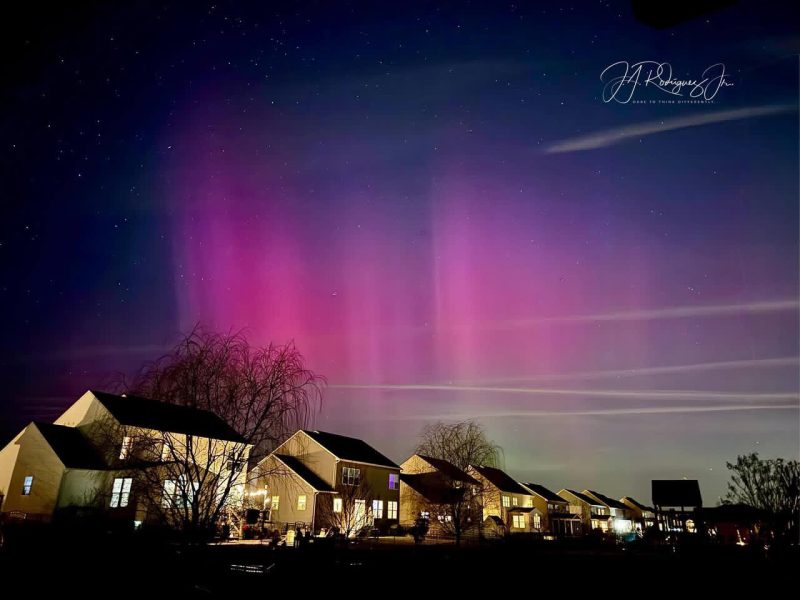
A viewer in Gainesville, Va., captured this dramatic image of the storm’s intensity — visible even in well-lit areas. Photo courtesy of Ja. Rodriguez.
The geomagnetic disturbance was triggered by a powerful coronal mass ejection (CME) associated with an X1.9-class solar flare from the Sun on January 18, 2026. When that CME struck Earth’s magnetic field on January 19, it pushed conditions into a G4 (severe) geomagnetic storm, with NOAA’s Space Weather Prediction Center reporting that storm levels reached G4 on the afternoon of January 19 as the CME shock arrived.
The strength of this event translated to a high planetary Kp index, around 7 to 8, during peak activity, indicating a strong disturbance in Earth’s magnetic field. Storms at that level are capable of moving the auroral oval far equatorward, which is why northern lights were spotted well beyond their usual latitude and seen in regions not normally treated to such displays.
Though the system weakened after the initial impact, the geomagnetic activity lingered into the next night. Observers reported continued aurora displays, with at least one notable substorm on Tuesday evening around 6:30 p.m. local time, and auroras were reported as far south as Florida and other lower latitudes, a rare occurrence tied directly to the significant space weather disturbance.
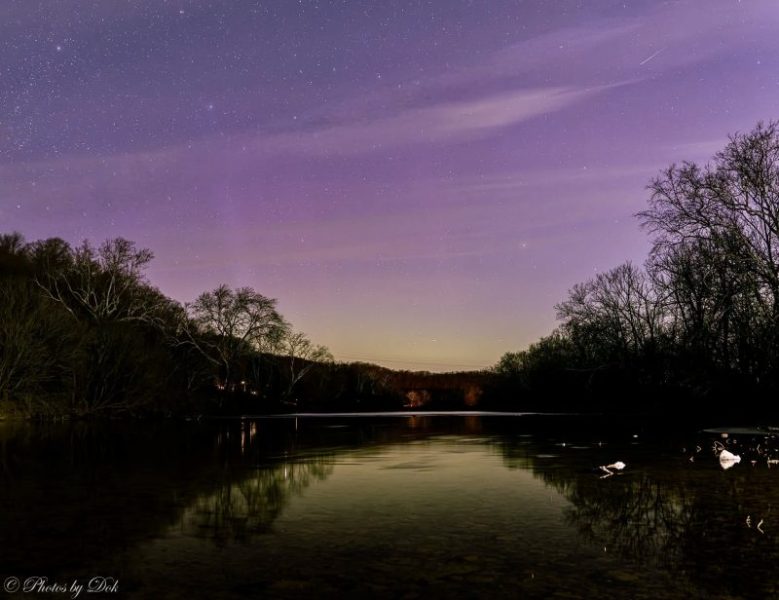
Photo taken from the Dog Park boat ramp, showing the storm’s impact on the water. Photo by DOK.
Scientists believe the storm’s unusual strength, one of the most vigorous in recent years, may also have influenced atmospheric conditions, potentially affecting precipitation patterns and contributing to why the heavy snow event originally forecast didn’t materialize as strongly as expected. The storm’s charged particles and radiation effects can temporarily alter atmospheric dynamics, though exactly how these effects translate into specific weather patterns remains an area of ongoing research.
Despite the storm’s intensity, disruptions to power grids and satellites were minimized. Still, the continued aurora activity offered photographers and skywatchers across broad swaths of the U.S. and Canada another chance to capture the rare lights after the initial peak had passed.

Blue Ridge Wildlife Center Acknowledges a Quarter of a Century of Work in Wildlife Preservation & Human Education

What Does A ‘Fair Share’ Really Mean?

South Warren Ruritan Club Hosts 20th Annual Spaghetti Dinner Fuels Scholarships for Local Teens

Trees Take Root as Virginia’s Frontline Defense Against Urban Heat

Virginia Set to Rejoin RGGI as Utilities Prepare to Pass the Cost Back to Ratepayers

Virginia Joins Multi-State Lawsuit Challenging Trump’s Election Order

Trump Budget Seeks 43% Boost in Defense Spending, Cuts in Many Domestic Programs

Virginia Sees 33,000 ACA Enrollment Drop Since Subsidies Expired, More Likely on the Way

Annual Dental Checkups and Cleanings: Essential Appointments

4 Stimulating Activities for a Healthy Brain After 50
The First Amendment: America’s Unique Foundation of Freedom

How to Tackle Credit Card Debt

Summer Enrichment Camp Gives Teens Hands-On Learning Opportunities

VDOT: Warren County Traffic Alert for April 6 – 10, 2026

David Silek to Remain in Chairman’s Seat of WC Republican Committee Pending 6th District Appeal Decision

Sales Set to Bloom Like Daffodils This Spring

America 250: The Bookseller Who Helped Save the Revolution

Business Growth Series: Why Good Businesses Still Struggle to Grow

Brownies with Mini Chocolate Easter Eggs

Shenandoah Downs Opens 11th Season April 11 with Tribute to Roger Hammer

We Don’t Know Everything About DNA

How PAAS Came to Dominate the Easter Egg Dye Tradition

Spanberger Signs Bipartisan School-Safety, Student Support Bills Into Law

Melanie J. Pomeroy (1958 – 2026)
