
Local Government
Front Royal reverses course, raises tax rate a half-cent
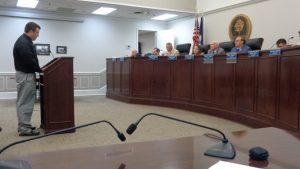
Town Finance Director B.J. Wilson revisits coming debts versus committed revenue. Photos/Roger Bianchini
After the verbal equivalent of Custer’s Last Stand against setting ANY money aside in the coming fiscal year for nearly $15-million dollars of capital improvements begun, in design, otherwise committed to, or it would seem imagined, on Monday night the Front Royal Town Council approved a half-cent increase to the Real Estate Tax rate.
The vote after extensive debate – John Connolly and Bébhinn Egger took on the role of Custer and his troops – was 4-2 (guess who dissenting) to increase the Town Real Estate Tax rate from 13 cents per $100 of value to 13.5 cents. The estimated $55,000 of revenue that half-cent increase will produce will be set aside for the estimated $9.3-million cost of a new Front Royal Police Headquarters.
The vote reversed a first-reading approval of a flat tax rate on March 13. As we previously reported, a detailed “History of the Real Estate Tax Rate” presented by Finance Director B.J. Wilson at the March 20 council work session appeared to swing several members from their previous too-early-to-tax-for-future-stuff stance. The bottom line of that “History” was an estimated total cost of $14.9 million on four pending projects with only $553,796 currently committed to those projects.
And on Monday (March 27) Jacob Meza and Chris Morrison joined previous let’s-start-to-set-the-money-aside-now proponents Eugene Tewalt and William Sealock to swing the result. However, the shift did not swing all the way to the one-cent hike preferred by Council’s elder statesmen Tewalt and Sealock (even if Sealock has only been states-manning on council for just under three months now; he does have two terms on the EDA board behind him).
Sealock’s first amendment to Connolly’s original motion to maintain the flat tax rate, to increase it by a full penny, failed 4-2 along the same lines a similar motion had failed on March 13 – with only Sealock and Tewalt voting yes. The full penny would have produced $110,000 of revenue in FY 2018 to be added to the FRPD headquarters revenue stream.

Bébhinn Egger, center, has heard it all before – and while she agrees in principal with William Sealock, left, and Eugene Tewalt on phasing in revenue for coming projects, she said her opposition to the major expense, a new police station, cemented her “no” vote on a tax hike this year.
But after that failure to increase the tax rate, it was Meza who made the motion to increase the rate by a half-penny, which was the staff recommendation. Sealock initially seconded Meza’s motion. But when it was pointed out by Tewalt that Meza had not included the set-aside qualification for the new revenue to the police station, a second motion was required. Meza agreed to add the qualification sought by Tewalt, leading the former mayor to second Meza’s amended, amended motion.
Even Egger prefaced her “no” votes by saying she agree with Tewalt’s logic of beginning to set aside funds in smaller increments for coming capital improvements. However, she cited her opposition from the start for the primary of those capital improvements, the $9-million police station. It was that opposition to so large an expenditure for a police station that prompted her “no” vote, she explained.
Connolly alone stood on the principal of not creating new revenue until bills come due. He pointed to the alternative of stretching loans out from the suggested 20-year terms, to 40 years, the suggested lifespan of some of the capital improvements, particularly the police station. – I’ll bet General Custer would have liked an extra 20 years to pay his “debt” off for crossing the Little Big Horn – of course Sitting Bull didn’t offer him a 20-year-term on that debt in the first place …

“Christmas in April” or Overspending? Budget Draws Criticism

Court Ruling Voids Prince William Data Center Rezoning, Raising Stakes for Local Debate

Spanberger Signs First Bills Targeting Healthcare, Housing and Energy Costs

Blue Ridge Singers Spring Concerts to Showcase Powerful Blend of Voices and Brass
What Counts as “Good Policy” Depends on Who’s in Power

Planned Parenthood Presses Virginia to Restore State Funding for Contraception Program

Weapon Offenses Rise on Virginia University Campuses

Trump Steps In to Pay TSA Workers as Congress Remains Stalled

Escaping the ‘Captivity of Activity’ by Making Time to Rest

Why Wearing a Bike Helmet Matters

Wilma J. Martin (1927 – 2026)

Michael Fanning (1957 – 2026)

Spanberger Order, RNC Lawsuit Highlight Divide Over Virginia Voter Roll Maintenance

DNC Kicks Off Voter Registration Blitz, Unveils New Campaign Playbook Ahead of Midterms

Republican State Lawmakers Propose Three-Month Gas Tax Holiday in Virginia

April Star Birthdays: Famous Faces Celebrating This Month

Time to Strengthen Those Hips Again

Supervisors Discuss Evolving FY-26/27 Budget Priorities and Revenue Sources, Including Real Estate Tax Hike & Cigarette Tax

From Students to Leaders: Mountain Vista Governor’s School Hall of Fame Honors Two Graduates

Hundreds Gather in Front Royal for “No Kings Day” Rally

How Public EV Charging Stations Work

A Social Network Just for AI? Bots Chat About Life, Love and More

Out of Closed Session FR-WC EDA Approves Resolutions Regarding Evolving Property Sales and Brokerage Services

Driver Dies After Crash While Fleeing Police on I-81
