
Local Government
Front Royal urges governor’s veto of landmark pro-industry legislation

FRONT ROYAL – As recounted following January work session discussion, the Town of Front Royal joined municipalities and municipal organizations statewide in opposing Republican-sponsored legislation described by staff as removing traditional municipal controls of commercial rezoning requests. Now after the failure of that municipal uprising to stop State General Assembly approval of that legislation – House Bill 1258 and Senate Bill 405 – Front Royal’s Town Council, one would imagine again with many other municipal governments across the commonwealth, is urging Democratic Governor Ralph Northam to veto those bills now on his desk.

HB 1258 sponsor Del. Terry G. Kilgore – Photo/State legislative website

SB 405 sponsor Sen. Ryan T. McDougle – Photo/State legislative website
And while there wasn’t much discussion surrounding the unanimous, Monday night (March 26) vote approving a resolution now asking Northam to veto the wireless industry legislation forwarded to him by the General Assembly, previous work session discussion has pointed to the massive implications should the legislation become law in Virginia.
The resolution itself accuses the wireless industry of failing to “engage in meaningful discussions” with Virginia Municipal League (VML) and Virginia Association of Counties (VACO) representatives regarding expansion of wireless technology to underserved areas, generally more rural locations across the commonwealth.
“Industry officials … only wanted to discuss a further erosion of local land use authority regarding new structures,” the resolution states. It also refers to the two bills, sponsored in the House by Terry G. Gilgore and in the Senate by Ryan T. McDougle, as the “2018 legislation by the Industry”.
Why the fuss – and near state of bipartisan panic among municipal officials around Virginia? As stated in the Resolution:
“This legislation mandates a ministerial process which eliminate the ability for local officials, residents and businesses to have meaningful input into decisions affecting the character of their own communities” and “this Legislation represents a shift in authority, moving decision-making authority from the local community and elected officials, to for-profit corporations that install wireless equipment” not to mention adding that “wireless equipment installations can have significant adverse health, safety, economic, and
aesthetic impacts on the local communities, but Industry companies have frequently shown little, if any, interest considering these concerns that potentially conflict with their profit margins”.
More specifically as Royal Examiner recounted following the January work session, the proposed legislation shifts advantage to wireless company proposals on equipment installation and any required rezonings in a manner that municipal legal staffs fear will set a precedent for all other industries operating in the state were this legislation to become law in the Commonwealth of Virginia.
What precedents would be set?
For starters according to Town Attorney Doug Napier in his January staff summary, the assumption of approval is written into the legislation by way of a brief and highly technical review period being included that most municipalities would not have the in-house expertise to address without outside contractor help.
“The locality must provide guidance on incomplete application within 10 days or application is ‘Deemed Approved’ which takes a legislative decision away from local elected officials. Specifically, the ‘Deemed Approved’ language strikes down local legislative process. These bills take away the ability of a locality to ask questions of the applicant or negotiate with the industry about a specific location or type of equipment or screening. This is not the process for a typical zoning application and there is no compelling justification for this industry to be treated in a special manner,” the Front Royal Town staff summarized of the legislation earlier this year.
Town legal staff also noted, “These bills would treat the wireless industry differently from all other private profit-making industries, thus leaving localities (and the state) open to charges of discrimination against other industries. The likelihood is high that other industries will expect the same or similar treatment.”
Much like what has occurred at the federal level over the past year as governmental regulatory authority has systematically been stripped from a variety of departments, this proposed state legislation gives private-sector, for-profit companies the upper hand over Virginia municipalities from the start. The legislation even goes so far as to create new language to accomplish that.
“The locality may not require a special exception, special use permit or variance for ‘Administrative Review-Eligible Projects’ (which is a new term the legislation creates),” the Front Royal legal and administrative staffs have pointed out in summarizing how all future wireless industry project applications would be considered if the legislation is signed into law by the governor.
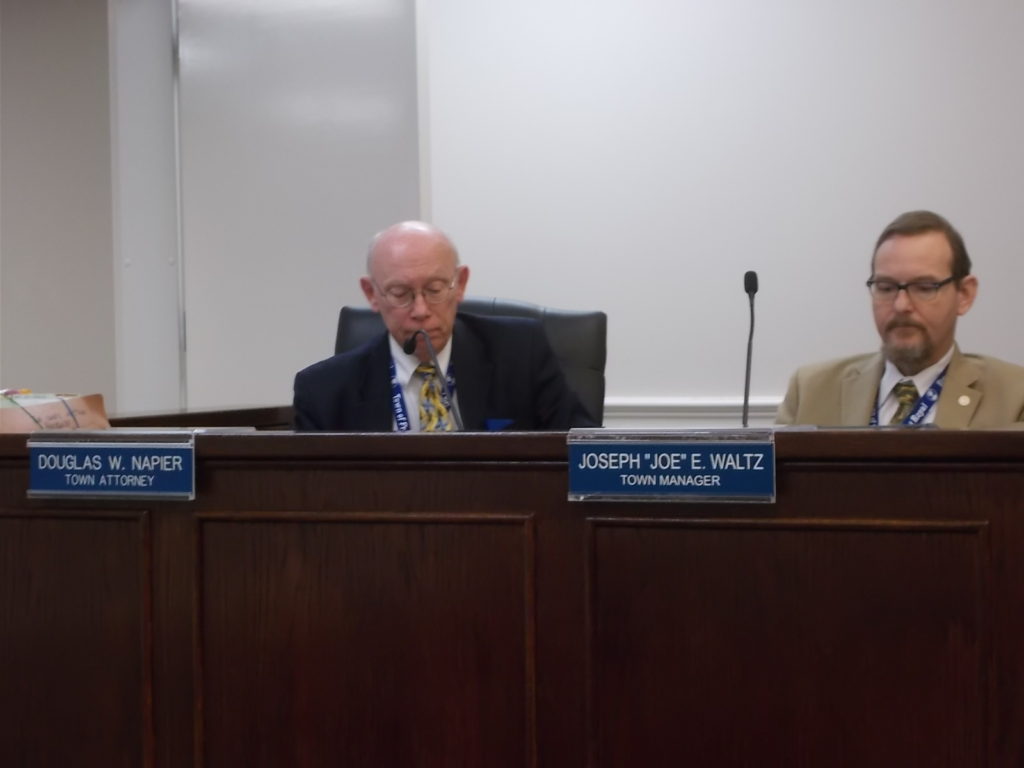
In January, Town Attorney Doug Napier and Town Manager Joe Waltz explained dynamics of new wireless legislation on the table in the Virginia General Assembly – those dynamics are NOT municipal friendly, they said. Photos/Roger Bianchini
As for a maximum $500 fee placed on the applicant versus costs incurred by the municipality in reviewing the application, the Front Royal staff summary states, “The fees will never be in tune with actual costs. A State statute-determined fee does not account for the differences in actual local workloads as well as the costs and availability of professional services costs that occur in different local jurisdictions occasioned by differing applications throughout the Commonwealth.
“Actual Direct Costs are not typically calculated by localities; this unfunded mandate would place an additional burden on local taxpayers who will end up subsidizing the applicants.
“The alternative is that the applications will be automatically approved because localities won’t have the resources to review the various projects within the arbitrary deadlines.”

Front Royal and other municipalities are urging Virginia Governor Ralph Northam to veto proposed wireless industry legislation. Photo/Governor’s website
Where a municipality to reject an application, it must: Provide a written statement explaining the rejection of the application; Explain any modifications in writing (this may be used by the applicant as evidence that the locality’s disapproval was arbitrary and capricious, staff noted); Must explain the disapproval by a substantial record of evidence contained in a written record publicly released within 30 days.” These are criteria town staff has pointed out that Front Royal, like many smaller Virginia municipalities, would not have the in-house expertise to prepare, particularly in the required time frame.
So now we find ourselves in the odd position of being a largely conservative, Republican-dominated, rural, Virginia municipality, along it appears with others of a similar make up, urging a Democratic governor to veto Republican-sponsored, pro-industry legislation.
One can only wonder if the reality of total governmental deregulation is finally beginning to achieve a bipartisan consensus, if not yet among a majority in the state General Assembly, at least in communities across the commonwealth. Which way the pendulum falls on the future of municipal control of their own communities is now in the hands of one man.

Spanberger Joins Other Governors in Push for PJM to Prioritize Ratepayer Protections

Cannabis Testing Challenges Persist as Virginia Retail Market Nears

Quick Quiz on Tooth Decay

The Fat Facts: Busting Common Food Myths

Importance of Chiles v. Salazar and the Protection of Free Speech

MAGA Suicide?

Warnick Posts Natural Hat Trick as Shenandoah Downs Opens Spring Meet

Youngkin Returns to Campaign Trail, Calls for Court to Strike Redistricting Vote

‘We Have To Do Something’: Former U.S. Attorney General Eric Holder Supports Virginia Redistricting

3 Ways to Extend the Life of Your Electric Vehicle Battery

Serious Charges Highlight Warren County Grand Jury Indictments

Ducks, Flowers, and Fun: Redbud Festival Returns to Browntown

Potato-Crust Quiche Makes a Lovely Brunch

Faye Barr Vance (1930 – 2026)

James Christopher “Chris” Sain (1948 – 2026)
Alice “Maybelle” Henson (1938 – 2026)

How Sleep and Stress Affect Cancer Risk

Spanberger Signs Sweeping Public Safety and Gun Violence Bills

Horses, Fans Return as Shenandoah Downs Season Begins

Skill Games Halted Again as Spanberger Issues Veto

VDOT: Warren County Traffic Alert for April 13 – 17, 2026

The Cat Who Outlasted Six Prime Ministers
Front Royal, Virginia. Vacation Destination?

Virginia State Police Report Major Drug Seizures in Weekly Crime Suppression Effort
