
Local Government
Update: Jamieson, Butler Indicate Support of Rearranged Funding Dynamics, Cuts to County Support of Samuels Public Library
(Writer’s Note: some additional points of observation on the back and forth between supervisors and Samuels Library officials have been added to expand somewhat on those exchanges. Included is an apology for a misheard quote in the third paragraph beneath the second set of photos.)
The final outside agency operations and expenses presentation of the Warren County Board of Supervisors Fiscal Year-2024/25 Budget Work Session of January 30 gave a glimpse into the library budget mindset of several supervisors. Those included ones who have termed themselves “pro-library” despite statements or actions during the “CleanUpSamuels” (CUS) alternative sexual identity censorship effort last year that have led some to question that categorization.
Particularly, third-year Happy Creek District representative Jerome “Jay” Butler and newly-elected North River District representative Richard Jamieson grilled Samuels Library Operations Director — and she noted outgoing Interim Library Director with the in-house hiring of Erin Rooney — Eileen Grady about the 501-c3 non-profit’s financial status, accounts, and funding parameters. Other supervisors, including Vicky Cook and John Stanmeyer under the moderation of Chairman Cheryl Cullers also had questions about the library’s financial and operational systems.

The WC Board of Supervisors listen as Eileen Grady presents financial and fundraising dynamics of library operations. Photos Royal Examiner

Analysis vs. Philosophical Impasse
And yes, questions seeking clarification on finances and financial need is, indeed, the supervisors job regarding, not only the County’s million-dollar FY-2024 library budget, but all the outside agencies and county departments that come before them in the annual budget cycle — including at three budget work sessions in January. However, one might question exactly where legitimate scrutiny may have lapsed into simple excuses to cut County funding of its public library over philosophical differences. What philosophical differences? One might guess from the direction of questioning, particularly by Jamieson and Butler, of municipal taxing policy for county-wide services available to all citizens provided by independent, self-regulating outside agencies. Our understanding of the outside agency community services process is that municipalities save quite a bit of money each year from not having to create their own departments to provide these services.
And are we mistaken to wonder if perhaps there was some lingering dissatisfaction with the outcome of last year’s debate over appropriate library content as it applies to referencing alternate sexual identity questions some teens may face as they reach puberty? We suggest readers judge for themselves from that questioning, primarily seen from the 1:58:24 to 2:30:22 video marks, with particular attention to the 2:04:45 to 2:29:45 marks.
At one point Jamieson said he felt library donation estimates were not made in “good faith” because they tended to come in higher than estimated. At another, elaborated on below, he called library fundraising techniques “a problem” because they were not sought for basic operations. However, at another point (2:16:44) he did say he was not saying that anything the library was doing from a budget perspective “was wrong, unethical, or dishonest, or anything like that” — just that from his financial oversight perspective “I don’t think it’s favorable to the County. I think it puts the County at a disadvantage.”
Grady responded to Jamieson’s negative analysis (2:16:50 to 2:22:40) of the library functioning as a private non-profit company with decision-making authority on its operations, while being funded partially and crucially (enabling state funding) by public tax money from the county government. She pointed out that Samuels has functioned in this manner for years, and it would seem without major issues from previous county boards.
“Why should the fact that we’re successful in fundraising take away from our ability to improve things? Why should that take away the responsibility of the taxpayers to fund us just like they fund the Humane Society and everybody else that you’re talking with?” Grady asked Jamieson of municipal tax-based operational funding of other outside agencies not owned or operationally regulated by the County. She noted library fundraising was often directed at improvements like added computer access, new furniture, facility reorganization or renovations as occurred with the Children’s section last year, that while improving the library, may not be deemed necessary operationally in a given year.
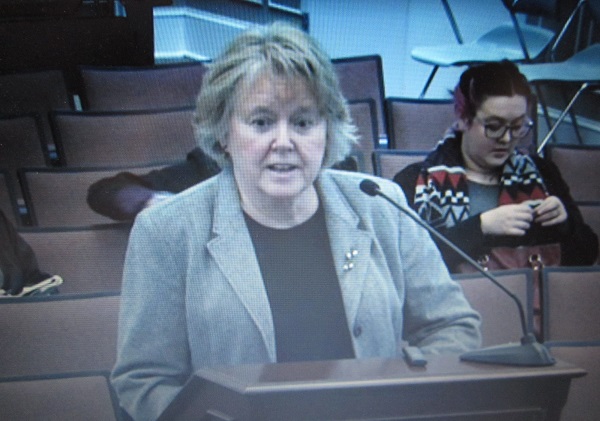
Melody Hotek presents mid-fiscal year operational information as the supervisors scheduled in releasing partial Fiscal Year-2024 funding during the library content debate last year. Below, Richard Jamieson explains why he doesn’t like the existing funding arrangement with the independently owned, non-profit Samuels Public Library.

Current Samuels Board of Trustees President Melody Hotek joined Grady from her seat in the gallery first row, albeit somewhat inaudibly some distance from any microphone, to counter Jamieson’s negative perspective on the library’s funding relationship with the County. It is a relationship born of over 70 years as Samuels Public Library, not to mention over 200 years as a functioning community library operation.* Hotek invited Jamieson to sit down with library officials or see a Library Board of Trustees meeting discussion of operations and finances to help him understand the complexity of its financial dynamics. However, he countered that it wasn’t that complex and he understood it from viewing the related paperwork in front of him.
Jamieson and Hotek engaged in an apples-to-oranges vs. apples-to-apples debate (2:26:20) around aspects of the library budget and argued over whether “unexpected” vs. “expected” donations were primary to larger-than-anticipated donation totals in various budget columns. Regardless of argued details, nothing offered by library officials altered Jamieson’s basic outlook that voluntary donations by whatever portion of the county population that chooses to make them, should be the primary financial basis for public library operations, with countywide tax revenue used only to fill remaining gaps.
“But what you’re implying though is that the donations that we raise should be utilized to fund the operations budget … And in fact that isn’t what people are told when they donate that money,” Grady explained, leading Jamieson to respond, “Well, that’s a fraud.” (Writer’s Note: It has been asserted that here at the 2:28:20 to 2:28:28 video mark Jamieson does not use the word “fraud”, but rather “problem”. After several re-listens I will agree I misheard “fraud, hmm” for “problem” and apologize for the misquote.) However, Grady was describing a system in place where County tax revenue collected equally from all the community’s citizens traditionally goes to cover outside agency operations available countywide to all citizens, just as it would if it was a County department offering those services.
“I would ask, so you think it’s reasonable that you take that (operational funding) responsibility off all taxpayers of Warren County to fund the library equally?” Grady asked of the existing system. One would anticipate that it is a system that if altered by the County Board of Supervisors for library funding, could have immediate funding implications stretching beyond this one outside agency service provider to all of similar independent ownership and self-regulating operations with fundraising mechanisms in place.
Happy Creek Supervisor Butler came to Jamieson’s defense, supporting the notion that library-generated private donation revenue should be the bottom line of the community’s public library’s operational budget, as opposed to extra income for additional needs or improvements. Butler pointed to some lower-income county citizens who may struggle to meet their annual tax obligations as an additional reason to reduce the county government’s funding of the public library with municipal tax revenue.
Other business
It might be noted that Grady followed Hotek to the podium that evening. Samuels Library Board of Trustees President Hotek opened the two-pronged library presentation with a six-month review of Library operations, programs, and expenses as part of the Library Funding Agreement the supervisors tied to initial partial funding of the library in the current fiscal year during the library content controversy last year. View Hotek’s presentation beginning at the 1:04:35 mark of the linked County video.
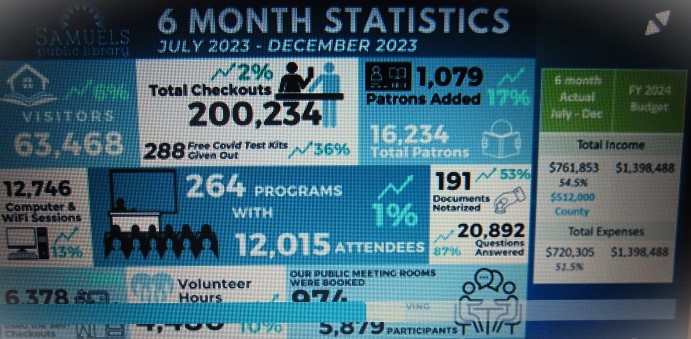
Six-month library operational numbers in the blue field. In box at right are half fiscal year ‘Total Income’ and ‘Total Expenses’, including 6-month ‘Actual’ numbers at left, and full-year budgeted numbers to right of that box. This was part of Melody Hotek’s PowerPoint 6-month report on public library operations and expenses the supervisors sought as a condition of initial funding in the current fiscal year.
The meeting opened with employee recognitions and service awards (Item A). The full budget work session agenda in order of presentations was:
- Public Works, VDOT – Roads & 6-Year Comprehensive Plan Update;
- Concern Hotline – Budget Presentation;
- Friends of the Shenandoah River – Budget Presentation;
- Humane Society – Budget Presentation;
- Blue Ridge Arts Council – Budget Presentation;
- Samuel’s Public Library FY-24 Mid-Year Performance Measures;
- Samuel’s Public Library – Budget Presentation;
The meeting adjourned two-hours-and-44-minutes after being convened at 5 p.m. See, not only the linked January 30 budget work session, but the two previous Outside Agency budget work sessions of January 4 and January 9.
(*Footnote: From a past Samuels Library release on its history: About Samuels Library: Originally founded in 1799 and renamed Samuels Public Library in 1952, it became the second library in the state to receive a charter and has served the citizens of Front Royal and Warren County for more than two centuries. In the past fiscal year, the library has added 2,035 new cardholders and held 650 in-person and virtual programs, hosting 19,843 attendees. Attracting more than 125,000 visitors annually, the library logged 391,919 total checkouts last year. For more information on Samuels Public Library, go to: www.samuelslibrary.net)

What Factors Are Most Likely to Affect the Cost of a Funeral?

Learn to Spot Scams: Free Workshop Set for June 2

Smart Ways to Use Your Tax Refund This Year

Supervisors Revisit Cross-County Chester Gap F&R Service, See Member-Staff Confrontation After Numbers Apology Offered

Get Your Equipment Ready Before the Start of Fishing Season

Landscaping Careers Offer Outdoor Work and Creative Opportunities

Blue Ridge Wildlife Center Patient of the Week: Virginia Opossum

From Crime Scenes to K9 Units: Citizens Academy Opens in May

Weekly Yard Waste Pickup Begins April 8 in Front Royal

Town Council Reviews Goals at Retreat in Advance of Work Session

New Virginia Laws Target School Construction and Classroom Cellphone Use

Clear Horizons Brings Fresh Approach to Mental Health

Funding Cuts, State Error Strain Virginia’s HIV Care System

Virginia Hospitals Filed More Than 1 Million Medical Debt Lawsuits Since 2010, a New Report Finds

POLICE: 7 Day FRPD Arrest Report 4/6/2026

Spanberger Signs Bipartisan Bills Tied to Billions in Business Investment Across Virginia

Birthright Case Forces US Supreme Court to Confront Prospect of Americans Losing Citizenship

Caleb Benton McKinstry (2010 – 2026)

Ideas for Nurturing — or Rediscovering — Your Inner Child

Protein Takes Center Stage in Updated U.S. Dietary Guidelines

Blue Ridge Wildlife Center Acknowledges a Quarter of a Century of Work in Wildlife Preservation & Human Education

What Does A ‘Fair Share’ Really Mean?

South Warren Ruritan Club Hosts 20th Annual Spaghetti Dinner Fuels Scholarships for Local Teens

Trees Take Root as Virginia’s Frontline Defense Against Urban Heat
