
Crime/Court
Judge will hear oral arguments in reconsideration of Meza appointment decision
In an April 29th letter to attorneys for the plaintiff and defendants in the legal challenge of the appointment of Jacob Meza to the Front Royal Town Council four days after the term he chose not to run for re-election to in November had expired, Judge William W. Sharp alerted both sides that he will hear oral arguments on the plaintiff motion for reconsideration of the court decision that the appointment was legal.
Citing scheduling and other factors, Sharp noted he was staying his Order of Dismissal of the plaintiff’s case until those oral arguments can be heard. A date has yet to be set as counsel and court availability is still being determined.

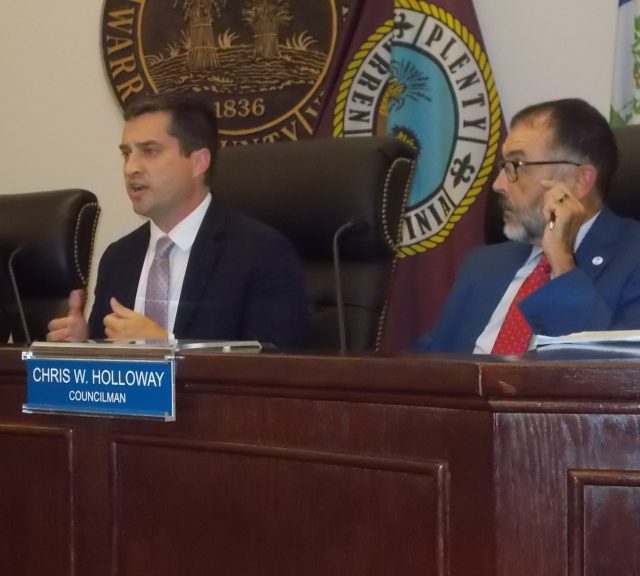
It will be back to the Warren County Courthouse for additional oral arguments on the legality of Jacob Meza’s, below left, Jan. 4 appointment to fill now Mayor Holloway’s vacant council seat. Royal Examiner File Photos by Roger Bianchini
In his letter to plaintiff Paul Aldrich’s counsel David Downes and Town and Meza attorney Heather Bardot, Judge Sharp explained: “Not a small part of my decision to enter the stay order and give one last chance for oral argument, is my realization that I gave a very poor articulation of my reasons for my original decision, and I do not want to make that mistake again. It is, therefore, my intention to give a written explanation of my decision, whichever way it goes, in which my words are more carefully expressed.”
As reported in our story on the April 7 hearing and court ruling “Judge rules Town Charter Section 47 does not prohibit council appointments for one year” Judge Sharp seized on the inclusion of the words “appointed or elected” in Town Charter Section 47 upon which the plaintiff case was based, in ruling for the defense stance that Meza’s appointment was not prohibited for one year from the end of his last term on council.
The relevant Section 47 passage reads: “No member of the council of the Town of Front Royal shall be appointed or elected to any office under the jurisdiction of the council while he is a member of the council, or for one year thereafter,” continuing to note for an unexplained reason an exception for the position of Town Treasurer.
As previously reported by The Royal Examiner, “In her Demurrer filing for dismissal, Bardot pointed to Section 6D and related wording on filling council vacancies, such as the one created by Councilman Chris Holloway’s November 2020 election to mayor. ‘The council may fill any vacancy that occurs within the membership of council for the unexpired term, provided that such vacancy is taken within 45 days of the office becoming vacant,’ Section 6D states. No reference to a one-year hiatus per appointment is made here, Bardot noted.”
Pointing to the words “or elected” in Section 47 of the Town Charter, Judge Sharp noted that obviously in the 84 years since the Charter was created, it had not been used to prevent council members from running for re-election. Thus, he contended Section 47 was not the applicable section of the charter at issue in internal appointments, siding with Bardot’s conclusion that Sections 6 and 9 of the Charter were the applicable sections on council appointments, rather than Section 47.
However, plaintiff counsel Downes argued that the framers of the 1937 Town Charter were using the words “appointed” or “elected” synonymously referencing achieving a consensus on internal appointments, and not referencing general elections decided by citizen’s votes. The framers’ intent was to avoid the fact or appearance of cronyism by political allies within council, Downes asserted.
Some supporters of the plaintiff case have noted Meza might have faced an uphill battle had he run for re-election in 2020 after alienating a segment of his support base during his last term. That lost base appeared in reaction to Meza’s reversal of initial recusals from discussion of his employer Valley Health’s request for a municipal loan through the EDA to finance the construction of the new Warren Memorial Hospital without a Maternity Unit. When his vote was needed to achieve the necessary council majority to approve the loan, Meza reversed course, claiming no conflict of interest to prevent his voting. He did note the support of that stance by the town attorney.

As far back as 2018 ‘Birth Local’ demonstrators were making their case for not eliminating some patient services at the new hospital. And they were not happy with Councilman Meza’s decision to reverse previous recusals from the topic, to vote for approval of the EDA loan to his employer Valley Health, for construction of the new hospital minus a Maternity Unit and other patient amenities deemed not financially viable.
Meza cited job and family time constraints in explaining his decision not to run for re-election in 2020.
As to delays in finalizing the order to dismiss the plaintiff case due to any lack of clarity in verbally rendering his April 7 ruling, on April 29 Judge Sharp observed, “In a case of this complexity and magnitude, I normally would have taken your arguments under advisement on April 7 and prepared a carefully worded final decision. As I stated in the courtroom, I wanted to give the parties a prompt decision to prevent ongoing uncertainty. It is evident from reviewing your subsequent pleadings that I may have created more problems than I solved, and I do want to clarify a few points so that we do not go chasing down rabbit holes, and miss the core issues.”
And one might guess that among core issues during the oral arguments for reconsideration will be the plaintiff counsel’s observation that a council member’s term has yet to expire when they are running for re-election. Thus, if re-elected, one term flows seamlessly into the next without any real-time out of office.
It might also be relevant to the court’s reconsideration to establish whether, in the intervening 84 years since the Town Charter’s 1937 establishment, any former council members have been reappointed within a year of electing to leave office by choice or having been removed by the will of the people at the general election.

South Warren Ruritan Club Hosts 20th Annual Spaghetti Dinner Fuels Scholarships for Local Teens

Trees Take Root as Virginia’s Frontline Defense Against Urban Heat

Virginia Set to Rejoin RGGI as Utilities Prepare to Pass the Cost Back to Ratepayers

Virginia Joins Multi-State Lawsuit Challenging Trump’s Election Order

Trump Budget Seeks 43% Boost in Defense Spending, Cuts in Many Domestic Programs

Virginia Sees 33,000 ACA Enrollment Drop Since Subsidies Expired, More Likely on the Way

Annual Dental Checkups and Cleanings: Essential Appointments

4 Stimulating Activities for a Healthy Brain After 50

The First Amendment: America’s Unique Foundation of Freedom

How to Tackle Credit Card Debt

Summer Enrichment Camp Gives Teens Hands-On Learning Opportunities

VDOT: Warren County Traffic Alert for April 6 – 10, 2026

David Silek to Remain in Chairman’s Seat of WC Republican Committee Pending 6th District Appeal Decision

Sales Set to Bloom Like Daffodils This Spring

America 250: The Bookseller Who Helped Save the Revolution

Business Growth Series: Why Good Businesses Still Struggle to Grow

Brownies with Mini Chocolate Easter Eggs

Shenandoah Downs Opens 11th Season April 11 with Tribute to Roger Hammer

We Don’t Know Everything About DNA

How PAAS Came to Dominate the Easter Egg Dye Tradition

Spanberger Signs Bipartisan School-Safety, Student Support Bills Into Law

Melanie J. Pomeroy (1958 – 2026)

David Benjamin Heller (1990 – 2026)
1776 Wasn’t Just About Independence
