
Local News
Krakow sees an influx of refugees
Krakow, Poland is a very old city, a vibrant city, dirty but no trash, almost ancient at its core with buildings that actually lean but somehow stay erect. Narrow brick streets lead to a giant city square. There are probably 100 restaurants, pastry shops, and pubs, each serving exceptional food at reasonable prices. This is old Krakow, never bombed in World War II. Catholic churches spiral upward to ridiculous heights. Symbols of the religion of Poland are everywhere adorning otherwise nondescript structures. Roads are more sidewalks than roads. Cars and delivery vans struggle for space. Just beyond the city’s core lie more mundane places, unadorned square buildings, cold looking, barren, almost industrial.
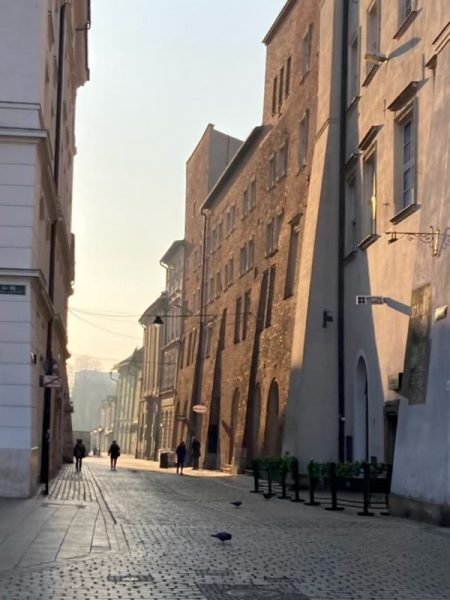
A cobblestone street between buildings
The train station straddles the line between the two Krakow’s. This is where the war in Ukraine, just two hours away, filters into the life of the city. Thousands pass through here every day, refugees from war.
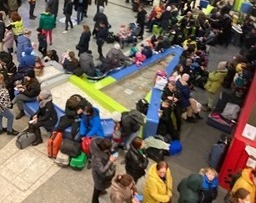
Refugees crowd into the train station, hoping to catch a free train ride to a European city of their choice, free of charge.

It’s children and old folks that get you. The children, some only toddlers, cling to their stuffed animals with one hand and to their mother’s hand with the other. Old folks sit on their luggage and stare straight ahead. The refugees are stoic for the most part. They have to be. The lines are long for everything. Lines for tickets, lines for trains, lines for the porta-potties, and lines for the bags of fruit and granola bars and baby products handed out by the worn-out volunteers. Next to the station is a very modern, very ugly three-story galleria housing every possible high-end retail shop, also packed with people, almost grotesque in comparison.
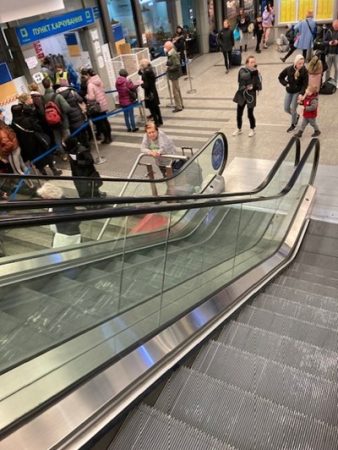
An elderly refugee pauses to rest against an escalator railing. (Photos by Stan Brooks)
Life in the city appears fairly placid. People go about their lives as they normally would. Only in conversation do you find an underlying tension, a combination of concern, fatigue, and guilt.
And there is a faint acrid smell in the air though the war is over a hundred miles away. No bombs are heard exploding, nor rifle fire, only babies crying and only if you go to the station.

Royal Examiner reader Stan Brooks traveled to Krakow, Poland earlier this month, hoping to help Ukrainian refugees as they crossed into Poland. He describes his first full day in Krakow.




Mayor Lori Athey Cockrell Looks to Water, Economic Development and Rail Trail in Another Term

WCHS vs. Brentsville HS – Girls Volleyball – October 6, 2026

BMI Is Only One Piece of the Health Picture

The Eye Surgery Factory That Could Not Expand

Ancient Ownership of Israel

VDOT: Warren County Traffic Alert for October 5 – 9, 2026

Reaching Out Now Expands Programs and Opportunities for Warren County Youth

Dance and Arts VA Finds New Home, New Opportunities on Water Street

Ann L. Shuman (1933 – 2026)

Wendy Lee Whitacre-Stout (1966 – 2026)

Spanberger’s Energy Plan Keys in on Clean Energy to Meet Growing Demand and VCEA Goals

Jean Elizabeth Grubbs Fogle (1939 – 2026)

Feds Provide Guidance on New Federal K-12 Scholarship Tax Credit Program

Why Wait Till November? Mid-Term Election Early Voting Processes in Place Now

US Senate Leaves Nation’s Capital in Advance of Midterms With Much Still Undone

Business Growth Series: If You Don’t Control Your Day, It Controls Your Business

The End of a 20-Year Monopoly on the Credit Score
Voltron and Immigration

States OK Solar Panels for Balconies. Safety Guidelines Haven’t Caught Up

Trump TV Ads Paid for with $20M in Homeland Security Funds, Dems Find

Blue Ridge Wildlife Center Patient of the Week: Gray Treefrog

Birthday Twins: See Which Famous Face Shares Your Big Day

Meet-and-Greet Set Sunday for Republican-Endorsed Front Royal Candidates

Barbara Ann Mathews Smelser (1943 – 2026)
