
Crime/Court
Legality of Meza council appointment will be re-argued orally third week of September
A date of September 22, at 10:30 a.m. has been set by Warren County Circuit Court Judge William W. Sharp to again hear oral arguments in support of plaintiff (Paul Aldrich) and defense (Jacob Meza, Town of Front Royal) filings on the court’s decision to re-hear a citizen challenge of Meza’s appointment/election to council on January 4th, four days after the term he did not run for reelection to, expired. Plaintiff counsel David Downes was seeking an August date further in front of the November 2nd Special Election to fill the final year of the council seat term vacated by Chris Holloway when he was elected mayor in November 2020, taking office January 1, 2021.
Meza is not running to continue into that final year of Holloway’s old council seat term. With the filing deadline passed, only Warren County Republican Committee Treasurer Amber Morris and Bruce Rappaport, a conservative independent who lost the Republican Committee endorsement to Morris, have filed to be on the ballot in the November Special Election.
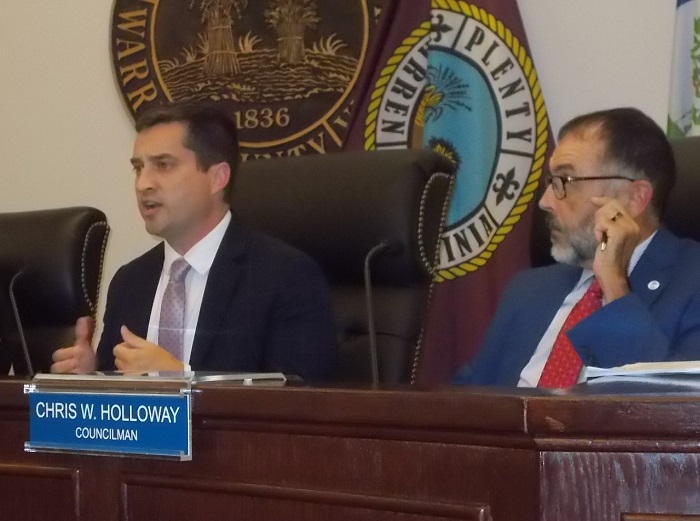
Could not only Councilman Meza’s seat, but Mayor Holloway’s be at issue in coming legal arguments on Meza’s council appointment? Probably not ‘judging’ from previous hearing discussion and judicial observations. Below, Bruce Rappaport and Amber Morris are on the November Special Election ballot to fill the final year of now-Mayor Holloway’s former council seat – Jacob Meza is not. Royal Examiner File Photos

Speaking of “elections”, how the term “elected” in Section 47 of the Front Royal Town Charter upon which the plaintiff case is based, is finally interpreted by the court could cast a larger shadow over the judge’s final ruling on the issue. In a letter to plaintiff attorney Downes and defense counsel Heather Bardot dated July 15, Judge Sharpe addresses his promise to resolve the case prior to the November 2, 2021, Special Election to fill the final year of the old Holloway council seat term.
“I intend to keep my word … the citizens of the Town of Front Royal deserve to have this matter resolved,” the judge wrote of that pre-Election Day resolution of the case promise, continuing, “As I have already noted, though the Complaint in this case challenges the validity of Mr. Meza’s office, if the Plaintiff’s position is right, then it is quite possible that the validity of the claims to office of other current council members and the mayor may also be in question.”
A potential impact on the mayor’s or other council members seats stems from initial May 25th hearing discussion on whether the relevant Section 47 wording could be interpreted as preventing elected town officials from running in General Elections for one year after their previous term had expired.
That Section 47 wording is: “No member of the council of the Town of Front Royal shall be appointed or elected to any office under the jurisdiction of the council while he is a member of the council, or for one year thereafter.” (underscore added)
However as previously observed during the May hearing, with an 84-year precedent in place of council members and mayors running for re-election since the 1937 passage of the Town Charter, the likelihood of such a judicial re-interpretation might seem remote. In fact, Downes noted that the plaintiff is not pursuing such an interpretation of the Charter wording, adding that what he termed “a methodical analysis” of relevant historical documents, which he cited as “the Virginia Constitution of 1776, the Virginia House of Delegates Rules of Procedure from 1912, Robert’s Rules of Order from 1915, the Town Charter of 1937” among others “shows that the framers of the charter were clearly addressing an election by councilmen and not a general election by the public.”
In addition to jurisdictional issues and legal standing of the plaintiff to challenge Meza’s “appointment” or “election” by his four Republican Committee colleagues to council on January 4, it continues to be the context of the words “appointed” and “elected” as it applies to council actions in Charter Section 47 around which the case revolves.
Much of the written arguments filed by the two sides in the wake of Judge Sharp’s decision to re-examine and re-hear those arguments, echo points made during the May 25 hearing. As reported in Royal Examiner’s story on that hearing, “Bardot pointed to the absurdity of the Section 47 wording” if it was interpreted to mean council could “appoint” someone who was already a council member to a council seat. So, she asserted that Charter Sections 6D and 9 applied to filling council seats, rather than Section 47.
In her Demurrer filing for dismissal, Bardot pointed to Section 6D wording on filling council vacancies: “The council may fill any vacancy that occurs within the membership of council for the unexpired term, provided that such vacancy is taken within 45 days of the office becoming vacant,” Section 6D states. No reference to a one-year hiatus per appointments is made here, Bardot noted.
Citing the inclusion of the words “appointed or elected” Judge Sharp’s initially ruled that Section 47 applied only to paid staff appointments, not council member appointments. Sharpe said it seemed clear that the Town Charter’s intent, dating to its 1937 adoption, was not to prevent council members from running for re-election for a year. So, the court sided with Bardot’s stance for the defense that Sections 6 and 9 of the Charter were the applicable sections on council appointments, rather than Section 47.

In the first round of oral arguments, as he likely will again on September 22, Downes countered that it was “dangerous to take one word out of context” in trying to decipher the intent of town fathers 84 year ago. The plaintiff counsel argued that the Section 47 wording referred to two distinct and different actions: 1/ appointment to a town staff position while being a council member, or within a year of having been a council member; and 2/ “election” as in acquiring a council majority consensus for reappointment to a council seat within a year of leaving council voluntarily, like Meza by not seeking reelection, or involuntarily, as in being voted out of office by the public.
Some have contended Meza did not run in 2020 because he may have believed he would have lost after a controversial year in office surrounding his employer Valley Health and his flip-flopping on recusals from discussion and votes in authorizing a $60-million County-Town EDA loan to help finance construction of a new hospital without a Maternity Unit.
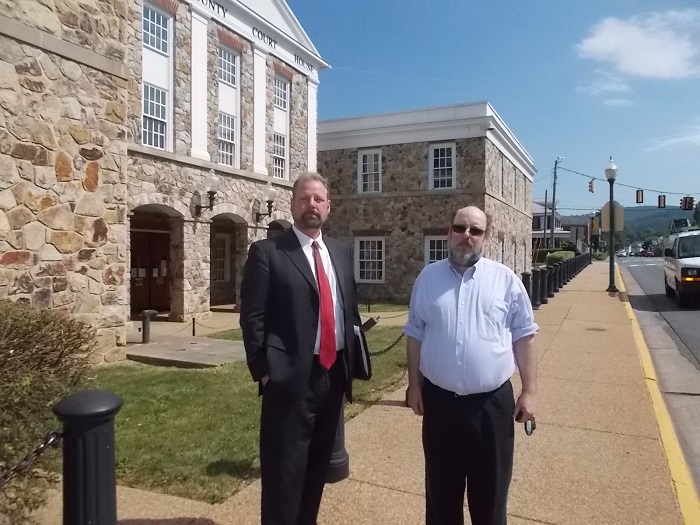
Plaintiff Paul Aldrich, right, and his counsel David Downes outside the courthouse on May 25, following initial oral arguments on the legality of Meza’s Jan. 4 appointment to the town council. Below, over the final years of his previous term Meza ran afoul of ‘Birth Local’ supporters trying to keep a Maternity Unit at the new Valley Health hospital in Front Royal. At issue for those citizens was Meza’s reversal of previous recusals from discussion of the matter due to his Valley Health employment, to cast a crucial vote in support of a County-Town EDA loan to help finance the project.

Plaintiff Paul Aldrich and his counsel contend Meza’s appointment/election by four of his County Republican Committee colleagues (the vote was 4-1) was the very type of political cronyism Section 47 of the Town Charter was designed to prevent.
And so the two legal sides continue to circle and counter the other’s points of contention on jurisdiction, authority of the plaintiff’s challenge and how long-dead town fathers used the English language 84 years ago.
Stay tuned, as a final decision on these issues has been promised by the court before November 2, 2021, one might guess by the end of September or early October at the latest.

Virginia Joins Multi-State Lawsuit Challenging Trump’s Election Order

Trump Budget Seeks 43% Boost in Defense Spending, Cuts in Many Domestic Programs

Virginia Sees 33,000 ACA Enrollment Drop Since Subsidies Expired, More Likely on the Way

Annual Dental Checkups and Cleanings: Essential Appointments

4 Stimulating Activities for a Healthy Brain After 50

The First Amendment: America’s Unique Foundation of Freedom

How to Tackle Credit Card Debt

Summer Enrichment Camp Gives Teens Hands-On Learning Opportunities

VDOT: Warren County Traffic Alert for April 6 – 10, 2026

David Silek to Remain in Chairman’s Seat of WC Republican Committee Pending 6th District Appeal Decision

Sales Set to Bloom Like Daffodils This Spring

America 250: The Bookseller Who Helped Save the Revolution

Business Growth Series: Why Good Businesses Still Struggle to Grow

Brownies with Mini Chocolate Easter Eggs

Shenandoah Downs Opens 11th Season April 11 with Tribute to Roger Hammer

We Don’t Know Everything About DNA

How PAAS Came to Dominate the Easter Egg Dye Tradition

Spanberger Signs Bipartisan School-Safety, Student Support Bills Into Law

Melanie J. Pomeroy (1958 – 2026)

David Benjamin Heller (1990 – 2026)
1776 Wasn’t Just About Independence

Three-Tiered System for Urban Agriculture Based on Lot Size Takes Shape at Town Planning Commission Work Session

Child Abuse Awareness Month Brings Focus to Reporting, Prevention in Warren County

National Dental Hygienists Week: Is Your Oral Care Routine Optimal?
