
Regional News
Maryland becomes haven for out-of-state abortion seekers, providers
BETHESDA — Off Old Georgetown Road, just south of Interstate 270 and not far from where abortion opponents are known to stand in the median and protest, is one of few abortion clinics in the U.S. that offers abortions in the latter stages of pregnancy.
Since the U.S. Supreme Court overturned Roe v. Wade in late June, the clinic’s staff has worked overtime to provide care to the influx of out-of-state patients.
When abortion was a federally protected right, the Clinics for Abortion & Reproductive Excellence, CARE staff typically saw 15 to 17 patients weekly. In the two months since abortions were left to states’ discretion, the number of patients from other states has surged, officials at the clinic said.
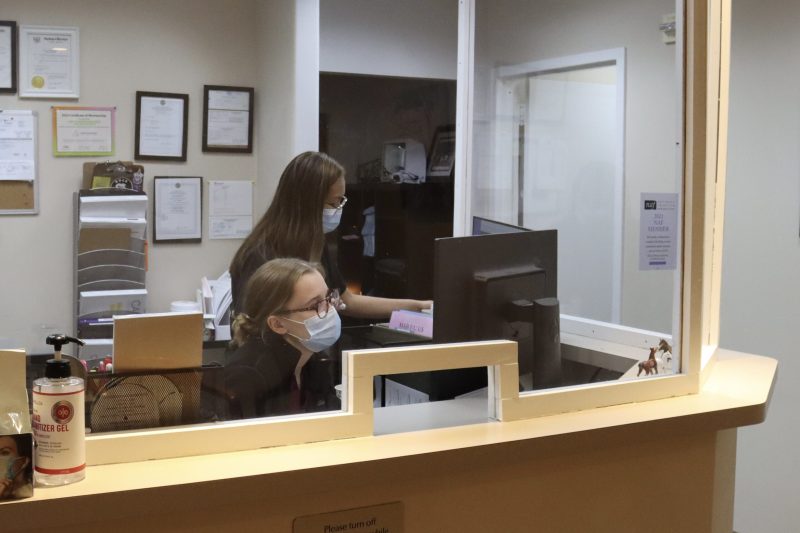
Kelsey and Katrina, who asked to be identified by their first names for security reasons, working at the front desk of Clinics for Abortion & Reproductive Excellence, an abortion clinic in Bethesda, Maryland. The staff has seen an increase in out-of-state patients and workers in the two months since the reversal of Roe v. Wade. (Abby Zimmardi/Capital News Service)
The acting clinic administrator and medical assistant at CARE is Kelsey, identified by only her first name for security reasons. Kelsey said that out-of-state people now account for a large portion of patients, and numerous referrals come from the South.
Dr. LeRoy Carhart, the medical director, echoed Kelsey’s comments.
“We’re increasing every week,” Carhart said. “We have 24 patients on the schedule right now this week…We have one or two patients from Mississippi or Atlanta every week.”
Abortion providers in Maryland said they see the impact of the reversal of Roe v. Wade as increasing numbers of out-of-state patients and even staff members from closed healthcare facilities make their way to their doors.
At Hillcrest Clinic, an abortion provider in Catonsville, Maryland, the staff has received calls from workers at abortionfinder.org and ineedana.com, websites that help people locate abortion clinics, said Hillcrest’s administrator, Charlotte.
Charlotte, who asked to be identified by her first name only for security reasons, said she thinks those calls are helping out-of-state clients find her clinic.
People from the surrounding states of Pennsylvania, Virginia, and Ohio, and also numerous patients from Texas, have come to Hillcrest to receive an abortion, she said. The result, she said, is an uptick in patients overall.
Clinics in Maryland were already seeing patients from West Virginia, even before this week when the state virtually outlawed all abortions because of abortion restrictions that previously existed in the state.
Whole Woman’s Health, an abortion provider, has clinics in Indiana, Virginia, Minnesota, and Maryland. The organization did have four clinics in Texas, but due to the state’s strict abortion laws, those clinics were closed, said Marva Sadler, senior director of clinical services. She said the staff from those shuttered facilities have been referring Texas patients to their clinics outside the state, including its Baltimore location.
At CARE, Kelsey said many of their patients are from Georgia. Under the state’s new law, abortions are outlawed after six weeks of pregnancy.
An official at Planned Parenthood Southeast said provisions in the law appear to be modeled after the Texas abortion law, which allows citizens to bring lawsuits against other Texans involved in helping a person receive an abortion.
Consequently, workers at Summit Medical Associate in Atlanta said they have been told not to refer patients to clinics outside the state for fear of running afoul of the law. Instead, they can only refer patients to abortionfinder.org.
“It’s real hard,” said Yaya Guy, a medical assistant at the facility. “We know the clinics where they can go to, but that part of the law restricts us from doing that.”
Many new patients from Mississippi at CARE are related to the closure of Jackson Women’s Health Organization, the state’s only abortion provider. The Mississippi clinic was the face of Dobbs v. Jackson Women’s Health Organization, the landmark ruling that reversed Roe v. Wade.
When women do decide to venture out of state for an abortion, it can be extremely difficult, Maryland providers said.
“Clinics go out of business, and then it becomes a fight for women to find the next closest one, which then [involves] coordinating with childcare and coordinating travel costs,” Kelsey said. “It’s just a huge take-on task for so many women to try to figure out how to do that.”
The overturning of Roe has caused not only patients to come to Maryland. Staff from closed abortion clinics in other states are also arriving in search of jobs.
CARE’s staff now includes workers who moved from other clinics to Maryland to continue their work as abortion providers. One staff member, Sue, who also wanted to be identified by only her first name, came from Tennessee, a state with a near-total abortion ban.
Sue, a nurse practitioner, said she could no longer work in Tennessee because under the state’s laws, performing an abortion is considered a Class C felony, leading to up to 15 years in prison.
“I also have a young daughter, and I’m not from Tennessee originally, but I had lived there for the past 12 years,” she said. “I had always told my husband that we would not raise a daughter in a state that didn’t have full-scope reproductive care for women. So, that was the last straw for us, and that’s why we relocated here.”
There are dozens of abortion clinics across Maryland, and new ones are in the works. In the most recent year for data on abortion clinics, 2017, there were 44 Maryland locations with providers offering abortions, according to the Guttmacher Institute, a nonprofit organization that reports on reproductive health and rights.
“Luckily, there are enough clinics in Maryland that I think we’ll be able to take care of all the Marylanders who need us and then do as much as we can for the out-of-state folks,” Sue said.
As a nurse practitioner, Sue is legally allowed to perform abortions in Maryland under the Abortion Care Act, which passed in the General Assembly during its last session and went into effect on July 1. The new law provides $3.5 million to train nurse practitioners and other medical professionals to perform abortions.
As a result, Carhart said he trained two nurse practitioners to work at CARE and provide abortions. Along with the nurse practitioners, CARE’s staff has grown to include one registered nurse, six medical assistants, one full-time doctor, and three part-time physicians.

Although the CARE team has increased, Carhart said he worked six days a week rather than four, his typical work schedule before the Supreme Court’s ruling.
Carhart began performing abortions in 1970 as a junior in medical school. He is well-known for practicing abortions in the later stage of pregnancy. He worked with George Tiller, a physician who performed the same procedures in Kansas, and who was gunned down while in church in 2009 in Witchita, Kansas, by an anti-abortion extremist. In 2013, he was featured in a documentary on Tiller’s life and murder,
Carhart was threatened in 1991 when anti-abortionists set numerous fires on his Nebraska property that burned down his home and farm, killing 21 horses, a dog, and a cat.
Additionally, Carhart was involved in the U.S. Supreme Court case Stenberg v. Carhart, in which Carhart argued that a Nebraska law prohibiting “partial-birth abortion” violated the Fourteenth Amendment. The U.S. Supreme Court ruled 5-4 in Carhart’s favor in 2000.
He is also known for Gonzales v. Carhart, in which Congress passed, and former President Bush signed into law a bill that banned partial-birth abortions. Carhart sued to stop the act from going into effect. The U.S. Supreme Court ruled against him in a 5-4 decision in 2007.
Carhart recently treated a patient from another state at CARE who was forced to carry her pregnancy for 30 weeks because where she lived in the Southeast, an area with restrictive abortion laws, she could not find any clinic that could legally give her an abortion at her stage in the pregnancy, Carhart said.
He said the woman wanted an abortion because her baby had a brain hemorrhage, had not moved for weeks, and did not have a chance at survival.
“It just took her that long to find somebody who would take care of her, and that’s the biggest part right now,” he said. “They’re devastated. They don’t know where to go.”
By Abby Zimmardi
Capital News Service

Virginia Sees 33,000 ACA Enrollment Drop Since Subsidies Expired, More Likely on the Way

Annual Dental Checkups and Cleanings: Essential Appointments

4 Stimulating Activities for a Healthy Brain After 50

The First Amendment: America’s Unique Foundation of Freedom

How to Tackle Credit Card Debt

Summer Enrichment Camp Gives Teens Hands-On Learning Opportunities

VDOT: Warren County Traffic Alert for April 6 – 10, 2026

David Silek to Remain in Chairman’s Seat of WC Republican Committee Pending 6th District Appeal Decision

Sales Set to Bloom Like Daffodils This Spring

America 250: The Bookseller Who Helped Save the Revolution

Business Growth Series: Why Good Businesses Still Struggle to Grow

Brownies with Mini Chocolate Easter Eggs

Shenandoah Downs Opens 11th Season April 11 with Tribute to Roger Hammer

We Don’t Know Everything About DNA

How PAAS Came to Dominate the Easter Egg Dye Tradition

Spanberger Signs Bipartisan School-Safety, Student Support Bills Into Law

Melanie J. Pomeroy (1958 – 2026)

David Benjamin Heller (1990 – 2026)
1776 Wasn’t Just About Independence

Three-Tiered System for Urban Agriculture Based on Lot Size Takes Shape at Town Planning Commission Work Session

Child Abuse Awareness Month Brings Focus to Reporting, Prevention in Warren County

National Dental Hygienists Week: Is Your Oral Care Routine Optimal?

The Coin That Traveled Through Time and Space

One “What If?” Question Is Changing the Future of Farming
