
Local News
Mildred Lee Grove – Philanthropist, Historian, Teacher, Social Worker, Activist…
In 1987, the Winchester-Frederick County Historical Society named the then 84-year-old Mildred Lee Grove, Historian of the Year. The inscription on the plaque she received at the annual meeting recognized Miss Grove as “a faithful and diligent historian” whose service to the Society has been invaluable. Miss Grove exceled at using history to tell stories. Her expertise was in the supervision of town records, taped recordings, photographs, drawings and the townspeople themselves to interpret the past of the local area. She had the perfect skill-mix of intelligence, patience and scholarship and art and writing, which she employed to preserve the memories and ideas of past events. She was a member of the Winchester-Frederick County Historical Society for over 40 years serving not only as Recording Secretary, but also on the Editorial Board. She belonged to the Archeological Society of Virginia and participated in many of their programs.
Miss Grove strongly believed that the community should have well documented records for reference in future years. She became increasingly involved in historic preservation which included preserving houses, commercial buildings and churches that played major roles in the community. Miss Grove understood that community pride is centered on town residents acquiring the knowledge to remember and to celebrate the past and to prepare important current events for memories as well.

Mildred Lee, Stephens City High School graduation, 1920.
Mildred Lee Grove was born in Stephens City, Virginia, December 29, 1902 and was the only child of Samuel Benton Grove and Cara Altha Steele Grove. She had a brother who died in infancy. After attending Stephens City High School, she continued her education, receiving a bachelor’s degree in Philosophy from Hollins College in Roanoke (Class of 1924) and a master’s degree in English Drama from the University of Virginia in 1929. Her thesis topic was on Henrik Johan Ibsen, the Norwegian playwright. [1] She took additional coursework in counseling at Richmond Professional Institute (Virginia Commonwealth University) and New York University. [2]
Miss Grove taught English for one year in Clifton Forge, followed in 1925 by five years teaching at John Handley High School in Winchester. Following a twelve year leave of absence to recover from tuberculosis, she returned to Handley in 1942 to teach English for seven more years before accepting the position of Visiting Teacher for Winchester Public Schools in 1949. In this capacity she served as truant officer, social worker and as the school’s liaison to various social agencies until her retirement in August 1968.

Mildred Lee, Visiting Teacher for Winchester Public Schools about 1950.
Mildred Lee Grove accepted the invitation to join the Delta Kappa Gamma Society, the National Honor Society for Women Teachers who have demonstrated leadership from kindergarten to university in both public and private schools. She was initiated into the society in 1951 at the State Convention in Staunton, Virginia. [3]
Before and after retirement, Miss Grove was engaged in many civic and philanthropic activities in Frederick County. She was the founder of the Social Service Council of Winchester and actively committed to the Northwest Sheltered Workshop, the Salvation Army Board and the Mental Health Board, as well as other organizations. During this time, she discreetly used her personal finances to purchase food, clothing, shoes and medicines for students and their families. [4]
Miss Grove had deep personal roots in Stephens City as over eight generations of her ancestors had resided in Frederick County. She lived her entire life in the home of her parents and grandparents at historic 5357 Main Street (Wells-Allemong-Steele-Grove House) in Stephens City. Her grandmother Altha Watson Steele and grandfather Milton Boyd Steele bought the house in 1872. According to Miss Grove, the brick building was built in 1834 and the adjoining log cabin store was built about 1762 to 1765. [5] A counting room was added in the 1830s that connected the log cabin store to the brick residence. [6]
Her Aunt Inez Virginia Steele was the author of Methodism and Early Days in Stephens City, Virginia. Like her Aunt Inez, Miss Grove became the town authority on Stephens City history. Her Grandfather Milton Boyd Steele was a devout Methodist and Sunday School teacher. Grove’s father, Samuel Grove, was employed in the carriage business with the Banner Buggy Company in Richmond. [7] Later, he was influential in the establishment of automobile dealerships in Virginia. [8] Miss Grove was a lifelong member and supporter of the Stephens City United Methodist Church. According to long time Church Trustee, Ray Ewing, Miss Grove provided substantial funding toward the 1966 Education Building extension. “Later on, she made continual donations to specifically reduce the principal amount of the mortgage on the education building debt. She didn’t like paying interest,” said Ewing.
As an early member of the Winchester-Frederick County Historical Society, Miss Grove had participated in the local preservation movement. She was among those who influenced the way George Washington’s Office, Abram’s Delight, the 18th Century Valley Cabin (from Cork Street in Winchester), and Stonewall Jackson’s Headquarters in Winchester were preserved, renovated and presented to the public as exhibition buildings. They were also, no doubt, what Miss Grove had in mind as she conceived and communicated her vision for the Stone House. [9]
Throughout the 1960s, 70s and 80s, Linda Simmons, Stone House Foundation Second Vice President, Secretary and first cousin, once removed, visited with Mildred Lee. “She was my mentor and took me to meetings of the historical society in Winchester, we went on endless tours of old houses. She shared my budding interest in art history and went with me to the state library as well as endless courthouses to search local records,” Simmons said.
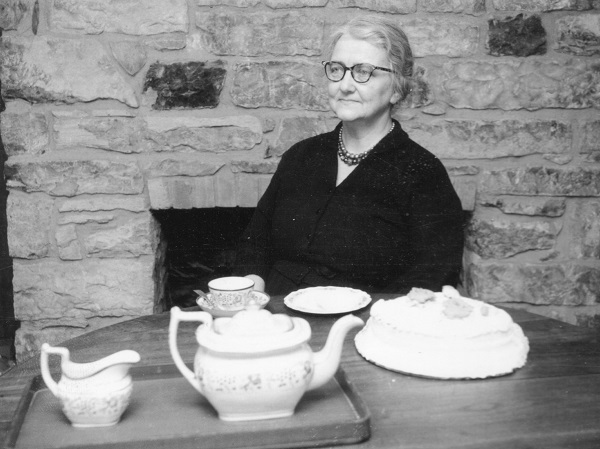
Mildred Lee, about 1968, at fireplace in her kitchen with a set of china she inherited from her ancestors. All photos courtesy Stone House Foundation.
Miss Grove had a reputation for living generously, which Simmons believes came from family history, personal adversity and a Christian, loving, kind heart. “This is why Miss Grove provided tuition assistance to female students attending college or university and older women and widows were given the gift of paying for or off their homes or houses to live in or remain as life estates,” Simmons added.
Miss Grove was a friend to the African American community in Stephens City. According to Simmons, “When Orrick Chapel merged with the local Methodist Church in 1991, the trustees of Orrick Chapel turned to Miss Grove to ensure the historic building would not be abandoned, sold or torn down.” In 1993, Miss Grove had the Orrick Chapel property transferred to the Stone House Foundation where it has since undergone several sensitive interior restorations.
Current Foundation President, Linden Fravel’s, first meeting with Miss Grove came after his discovery of thousands of pottery shards at the Andrew Pitman property. “I had been able to reconstruct a number of pots, jugs, and other vessels. I called and made an appointment for us to meet. That began our relationship that lasted until her death,” Fravel said.
Fravel continues, ”Our initial conversation dealt with the potters of Newtown. She remembered that she had observed a strata or layer of pottery at three distinct places on Main Street when the water lines were being installed. Each of the three instances occurred in front of properties that had previously been occupied by the potters John and Andrew Pitman and their nephew John Nolen. She correctly deduced that these shards were the remains of “wasters” that did not “fire” correctly. They had been smashed and used as cobble on the sidewalk in front of each location. I knew immediately that we were kindred souls, bound by our search for the unpublished history of Newtown/Stephensburg.”
Along with Linda Simmons, Fravel had the honor of speaking at Miss Grove’s funeral. He spoke about a small scrap of paper that he had found among Miss Groves many documents. Upon it was a verse written in Miss Grove’s handwriting, “Many follow the same trail, but few leave markers for those who follow.” Fravel concludes, “Miss Grove was a mentor to all who loved local history. The “markers” that she left and her observations and attention to detail are evident in the day-to-day work of the foundation she chartered over 30 years ago.”
During the 1980s and 90s, Miss Grove would often reminisce during frequent interviews about life at the turn of the twentieth century. The topics included early firefighting techniques, Christmas Eve childhood memories, Saturday night activity in town and Sunday morning routines, local shopping experiences, crushed limestone roads, country doctors and dentists, early post office locations, President Andrew Jackson’s speech from the front porch of the then Main Street Tavern, a once bustling Mudville business district and Grandma Steele’s version of General Phil Sheridan’s Cedar Creek “dash.” She gladly shared her memories with others who wanted to acquire knowledge just as she did through the learned art of story-telling.
In the early nineties, Winchester resident, Barbara Cooper, was a home health physical therapist with Valley Health who made visits to Mildred Grove at the family home on Main Street. ”Even with her broken hip, she insisted on giving me a tour of the home and showed me where the old detached kitchen had been connected to the house. I credit her for kindling my interest in local history. We had wonderful conversations. At ninety, her faith was strong. She never once complained of pain. I would describe her as serene. I also remember she was very excited about visits from the late Dr. Dave Powers, a former foundation board member, and his interest in Newtown history,” Cooper said.
The Newtown History Center is maintained by the Stone House Foundation, a not-for-profit, tax-exempt, privately-operated organization governed by a board of directors. Named for the small stone dwelling built in the 1760s (currently undergoing restoration) that originally housed the Museum, the Foundation has always been focused on educating children, residents and visitors about the history and culture of the lower Shenandoah Valley. With the town of Stephens City as its focus, the Foundation seeks to interest and engage residents, visitors, scholars and students in the events, life-ways and material culture of the region. [10]
The restoration continues the vision of Mildred Lee Grove, who established the Stone House Foundation in 1990. Near the end of her life, Grove felt the need to turn the Stone House into a museum so Stephens City would have a place to preserve its heritage. Grove died in 1997 at the age of 94. She left an endowment of about $3.5 million to ensure that the Foundation could carry her vision for the property forward. [11]
[1] The Winchester Star, Mildred Lee Grove Obituary, dated November 24, 1997
[2] The Winchester Star, Mildred Lee Grove Obituary and Some Worthy Lives, by Michael M. Forman, Winchester-Frederick County Historical Society, 2007, p.48-49
[3] Stone House Foundation digital files related to Mildred Lee Grove exhibit.
[4] Some Worthy Lives, by Michael M. Forman, Winchester-Frederick County Historical Society, 2007, p.48-49
[5] The great war and modern memory, by Linda McCarty, The Winchester Star, August 2, 1989
[6] Historical tour of Stephens City, by Linda McCarty, The Winchester Star, October 10, 1990
[7] Town life at the turn of the century, County tales, The Winchester Star, September 26, 1990
[8] Some Worthy Lives, by Michael M. Forman, Winchester-Frederick County Historical Society, 2007, p.48-49
[9] Restoration Project, Newtown History Center web site
[10] About the Foundation, Newtown History Center web site
[11] Stone House Foundation receives 50K for restoration work, by Josh Janney, The Winchester Star, September 29, 2021

4 Ideas for Keeping Fit While Babysitting Your Grandchildren

Do You Know Your Grains?

Tips for Staying Safe Around Unfamiliar Dogs

Skyline FFA Students Promote Agriculture at South River Community Forum

Warren Coalition Works to Build Resilience and Prevent Substance Abuse

Warner Files for Reelection, Launching Bid for Fourth U.S. Senate Term

Registrar Urges Residents to Stay Informed and Participate in Upcoming Elections

South River Forum Brings Residents and Leaders Together at Skyline

CHEO Garden Expands Mission of Food, Learning and Community

Sharing a Room: How to Avoid Sibling Conflicts

Laurel Ridge to Host Week of the Young Child Art Exhibit

Free $1,000 ‘Trump Accounts’ Draw 1 Million Families

‘The Revenant: A Novel of Revenge’

Virginia Lawmakers Close 2026 Session With Focus on Lowering Costs

The 10 Most Important Things That Happened in Virginia’s 2026 Legislative Session

Electric Vehicle Market Adjusts as Industry Rethinks the Road Ahead

Cultures Around the World Mark the Spring Equinox With Unique Traditions

Laurel Ridge to Host 46th Annual Spring Follies: “Back to the ’90s”

Love Revival to Host Free Community Easter Celebration in Front Royal

Salvation Army of Front Royal Plans Annual Dinner and Raffle Fundraiser

Stephen Paul Sill (1955 – 2026)

Virginia Seeks Public Input for 2026 Statewide Rail Plan

Front Royal Craftsmen Revive Centuries-Old Timber Framing Tradition

VDOT: Warren County Traffic Alert for March 16 – 20, 2026
